
Opening your dashboard
Class 12 Maths Chapter 3 Inverse Trigonometric Functions: Competency-Based Questions (CBQ)
45 questions on Chapter 3, each worked through on its own page with the AI tutor. Class 12 Maths, ICSE 2026-27.
45 questions
1–5 marks · Mixed difficulty
- 13 marks
Question 1
Competency: Application
A school is building a wheelchair ramp up to its library door, which is 0.5 m above the ground. If the ramp is a straight sloping surface of length metres, its angle of inclination with the ground satisfies . (Hypothetical data.)
(a) Write as a function of using an inverse trigonometric function, and find when m.
(b) For which values of does your formula give a value of ? Explain what this means for the ramp.
(c) A safety guideline says that must not be more than . Find the least length of ramp that meets the guideline.
- 21 mark
Question 2
Competency: Application
In a school robotics club, a distance sensor gives a reading (in cm). The program sets the elbow angle of a robot arm to and shows an error whenever this expression is not defined. (Hypothetical data.)
For which set of readings does the program give an angle?
- 31 mark
Question 3
Competency: Analysis & Evaluation
A student finds that her calculator shows an error message for but gives an answer for .
Assertion (A): The calculator is right to show an error for and to give a value for .
Reason (R): Every inverse trigonometric function has the domain .
- 41 mark
Question 4
Competency: Analysis & Evaluation
A stage-light controller sets the beam angle to , where is the reading of a slider. (Hypothetical data.)
Assertion (A): is defined exactly when .
Reason (R): is defined exactly when .
- 53 marks
Question 5
Competency: Application
The horizontal angle of view of a camera is given by , where is the width of the camera's sensor and is the focal length of the lens, both in mm. The school photography club's camera has mm. (Hypothetical data.)
(a) Find for a lens with mm.
(b) Find the focal length that gives (that is, ).
(c) A student says that a lens with a short enough focal length will give (that is, ). Use the range of to show that no lens can do this.
- 63 marks
Question 6
Competency: Application
A playground swing hangs from chains 2 m long. When the seat is moved a horizontal distance metres from its lowest position ( to the right, to the left), the chains make an angle with the vertical, measured as positive to the right. (Hypothetical data.)
(a) Find when .
(b) Find when , and say what the sign of your answer tells you.
(c) In one swing the seat moves from to . Through what angle do the chains turn?
- 71 mark
Question 7
Competency: Application
On a town map with the -axis pointing east, a straight road makes an angle with the positive -axis, measured anticlockwise, where . A surveyor's notes give . (Hypothetical data.)
Since lies in , the map software finds as the principal value of . What is ?
- 81 mark
Question 8
Competency: Analysis & Evaluation
A circular dial turns through radians from its zero mark. A sensor measures the cosine of the angle turned, and the control software works the angle back as of that reading. (Hypothetical data.)
Assertion (A): The software reports the angle turned as .
Reason (R): The principal value branch of is .
- 91 mark
Question 9
Competency: Analysis & Evaluation
A student enters two values in a graphing app that works with principal values.
Assertion (A): .
Reason (R): .
- 103 marks
Question 10
Competency: Analysis & Evaluation
A boat leaves a port and sails 10 km in a straight line. It ends up 5 km east of the north–south line through the port. Its bearing from the port is measured clockwise from north; for a point east of the port, and . (Hypothetical data.)
(a) The navigator takes . Find this value and the bearing in degrees.
(b) Explain why this value may be wrong, and give the other possible bearing.
(c) Radar shows that the boat is km south of the port. Using , find with and state the bearing.
- 111 mark
Question 11
Competency: Application
Light travelling inside a transparent block is totally reflected at its surface when the angle of incidence is more than the critical angle , where and is the refractive index of the material. So . A laboratory sample of a high-index crystal has . (Hypothetical data.)
The critical angle for this crystal is
- 123 marks
Question 12
Competency: Analysis & Evaluation
A searchlight is fixed at the top of a coast-guard tower, 20 m above sea level. It follows a boat that is moving straight away from the foot of the tower. When the boat is metres from the foot of the tower, the angle of depression of the boat from the light is . (Hypothetical data.)
(a) Show that for , and write the set of values that takes as varies over .
(b) Using the graph of , describe how changes as the boat moves away, and what happens to when is very large and when is very small.
(c) Given that , find the distance of the boat when .
- 131 mark
Question 13
Competency: Understanding
A sensor turns any real input into an output angle (in radians). An engineer notes that:
the output is defined for every real , and ;
the output decreases as increases;
it comes close to for large negative and close to for large positive , without reaching either value.
Which function has a graph with all these features?
- 141 mark
Question 14
Competency: Analysis & Evaluation
A cycling app shows the angle of a slope as , where is the gradient (rise per unit run) of the slope.
Assertion (A): However large is, the graph of does not meet the line .
Reason (R): The range of is the open interval .
- 151 mark
Question 15
Competency: Analysis & Evaluation
A student plots and on the same axes for .
Assertion (A): The two graphs meet at exactly one point, .
Reason (R): for every in .
- 163 marks
Question 16
Competency: Application
A solar panel's controller sends a signal , with , to a motor. The motor sets the tilt of the panel from the horizontal to radians. (Hypothetical data.)
(a) Write the domain and the range of as a function of , and find the tilt for and for .
(b) Using the graph of , say whether the tilt increases or decreases as increases, and find the signal that gives a tilt of .
(c) Show that the tilts for the signals and add up to , and state the symmetry of the graph of that this shows.
- 174 marks
Question 17
Competency: Analysis & Evaluation
In an art gallery a painting hangs on a wall, with its lower edge 1 m and its upper edge 3 m above a visitor's eye level. The visitor stands metres from the wall (). The angle that the painting subtends at the visitor's eye is . (Hypothetical data.)
(a) Show that .
(b) Show that the visitor sees the painting under the same angle from 1 m and from 3 m, and find this angle.
(c) Show that is greatest when , and find this greatest angle.
- 181 mark
Question 18
Competency: Analysis & Evaluation
A straight section of a roof slopes down by 2 m for every 5 m it runs horizontally, so its gradient is . A student's spreadsheet works in radians and computes , expecting the answer as for positive gradients. (Hypothetical data.)
What value does the spreadsheet actually give?
- 191 mark
Question 19
Competency: Analysis & Evaluation
Two straight support cables start from the same anchor point on level ground and rise to two masts with gradients 2 and 3. A student adds their angles of inclination, and , using the formula in R. (Hypothetical data.)
Assertion (A): .
Reason (R): when .
- 203 marks
Question 20
Competency: Application
A vertical pole 5 m tall stands on level ground. At 9 a.m. its shadow is 12 m long, and is the angle of elevation of the sun. (Hypothetical data.)
(a) Show that , and write also as an inverse sine and as an inverse cosine.
(b) At 9 a.m. the sun's rays make an angle with the pole. Write as an inverse tangent, and use a property of inverse trigonometric functions to show that .
(c) Later in the morning the shadow of the same pole is 5 m long, and the angle of elevation of the sun is . Express as a single inverse tangent.
- 211 mark
Question 21
Competency: Application
A straight support cable 17 m long runs from the top of a mast down to a peg on level ground. The top of the mast is 8 m above the ground. The angle that the cable makes with the horizontal is . The engineer's chart lists angles as inverse tangents. (Hypothetical data.)
Which of these is equal to ?
- 223 marks
Question 22
Competency: Application
A ladder 5 m long leans against a vertical wall. When its foot is m from the wall (), the angle it makes with the ground is . At first the foot is 3 m from the wall (angle ); the ladder then slips until the foot is 4 m from the wall (angle ). (Hypothetical data.)
(a) Show that for , and hence write and as inverse tangents.
(b) Find , the angle through which the ladder turns, as a single inverse tangent.
(c) Show that .
- 234 marks
Question 23
Competency: Analysis & Evaluation
A point lies on level ground on the straight line joining the feet of two vertical posts, between them. Post is 2 m tall with its foot 8 m from ; post is 6 m tall with its foot 10 m from , on the other side. The angles of elevation of the tops of and from are and . (Hypothetical data.)
(a) Show that , and hence find the angle between the two lines of sight from to the tops of the posts.
(b) In another set-up, two posts 1 m and 2 m tall stand on level ground and is midway between their feet, m from each. Find if the angle between the two lines of sight from to the tops of the posts is .
(c) In the first set-up, post is replaced by a taller post at the same place, so that the angle between the two lines of sight becomes . Find the height of the new post, correct to two decimal places.
- 241 mark
Question 24
Competency: Analysis & Evaluation
In a training drill, a coach places two marker poles on a straight line , on the same side of a point of , at distances 1 m and 6 m from . A player runs along the straight line through perpendicular to . When the player is m from , the angle that the gap between the poles subtends at the player is . (Hypothetical data.)
At what distance from is ?
- 251 mark
Question 25
Competency: Analysis & Evaluation
The reflector of a lamp is set so that the reading on its dial satisfies . (Hypothetical data.)
Assertion (A): The reading is .
Reason (R): for every real .
- 264 marks
Question 26
Prove that
- 274 marks
Question 27
Find the greatest and the least values of , and the values of at which they occur.
- 284 marks
Question 28
Solve for : .
- 294 marks
Question 29
Solve for : .
- 304 marks
Question 30
Solve for , where : .
- 313 marks
Question 31
Write the domain and range (principal value branch) of . Draw its graph.
- 323 marks
Question 32
Evaluate
- 333 marks
Question 33
Simplify ,
- 343 marks
Question 34
Prove that , .
- 353 marks
Question 35
Prove that .
- 363 marks
Question 36
Prove that
- 373 marks
Question 37
If , prove that .
- 383 marks
Question 38
Show that .
- 393 marks
Question 39
Prove that .
- 403 marks
Question 40
Solve for : .
- 413 marks
Question 41
Prove that .
- 423 marks
Question 42
If , prove that .
- 433 marks
Question 43
Prove that
- 444 marks
Question 44
Mahesh and Surbhi standing at a distance of m from each other on either side of a clock tower 30 metres high observe the top of the tower at angles of elevation and , respectively. The distance between Mahesh and the clock tower is metres.
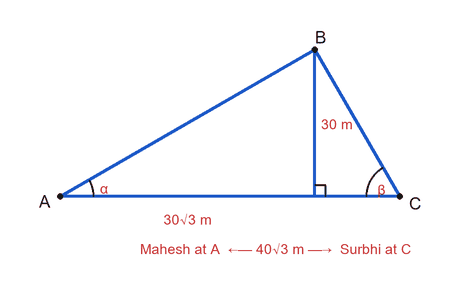
Based on the given information, answer the following questions.
(i)
(A) (B) (C) (D)
(ii)
(A) (B) (C) (D)
(iii)
(A) (B) (C) (D)
(iv) Domain and range of is
(A) , (B) , (C) , (D) ,
- 455 marks
Question 45
Three hoardings of an advertisement were placed by a business house at , and at different heights on a building. A person views them from a point at a distance of 20 metres from the building and observes the angles of elevation of and as double and triple of the angle of elevation of , respectively. Take the height of hoarding above the ground as m. (This height is supplied here because the printed question omits it; without it part (i) cannot be answered.)
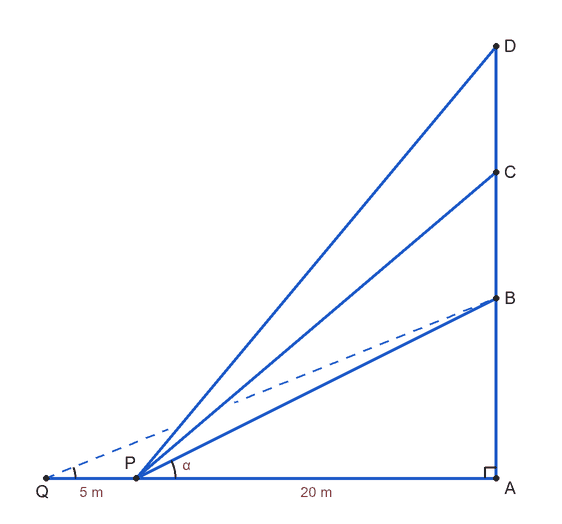
(Figure not to scale.)
Based on the given information, answer the following questions.
(i) Measure of angle is
(A) (B) (C) (D)
(ii) Measure of is
(A) (B) (C) (D)
(iii) Measure of is
(A) (B) (C) (D)
(iv) If some other viewer observes from a position located on the same line across the road, the distance being 5 metres, then __________.
(A) (B) (C) (D)
(v) Domain and range of are
(A) , (B) , (C) , (D) ,