
Competency: Application
A small robot arm moves in a vertical plane. Its upper arm OE, long, turns about the shoulder joint O, and its forearm EG, long, turns about the elbow joint E. The position of the gripper G from the shoulder is the vector sum . In the position shown in the figure, OE is horizontal and EG points vertically upwards. (Hypothetical data.)
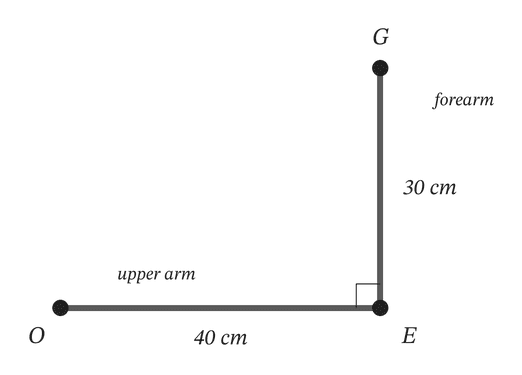
(a) Find how far the gripper is from O in this position, and the angle that OG makes with the horizontal.
(b) The elbow can turn the forearm to any angle. Find the least and the greatest distances from O at which the gripper can be placed, and say whether the arm can pick up a part from O.
(c) The upper arm is now raised to above the horizontal, and the forearm hangs vertically downwards. Taking horizontal (in the direction of OE in the figure) and vertically upwards, write in terms of and , and find its magnitude and direction.