
Opening your dashboard
Class 11 Physics Chapter 5 Motion in a Plane - Vectors: Competency-Based Questions (CBQ)
59 questions on Chapter 5, each worked through on its own page with the AI tutor. Class 11 Physics, ICSE 2026-27.
59 questions
1–4 marks · Mixed difficulty
- 11 mark
Question 1
Competency: Analysis & Evaluation
At a junction J in a circuit, wire 1 brings a current of into J from the west and wire 2 brings a current of into J from the south, so the two incoming currents are at right angles. A single wire 3 carries the current away from J, and an ammeter in wire 3 reads , not . (Hypothetical data.)
Assertion (A): Electric current is a scalar quantity, even though the current in a wire has a direction.
Reason (R): The ampere, the SI unit of electric current, is one of the seven SI base units.
- 21 mark
Question 2
Competency: Analysis & Evaluation
A train runs round a long curve in the track. All the way round the curve its speedometer reads a steady . (Hypothetical data.)
Assertion (A): Since the speedometer reading does not change, the velocity of the train is constant on the curve.
Reason (R): Velocity is a vector, so it changes whenever its magnitude or its direction changes.
- 31 mark
Question 3
Competency: Application
At the same moment, two weather stations report the wind. The station at Shimla reports " from the north-west". The station at Chennai reports ", blowing towards the south-east". (Hypothetical data.) Which statement about these two wind velocities is correct?
- 41 mark
Question 4
Competency: Analysis & Evaluation
Two survey teams track the same drone. Team 1 measures the drone's position vectors from the launch pad: at 10:00 and at 10:05. Team 2 measures the position vectors of the drone at the same two moments, and , from their tent, which is due east of the launch pad. (Hypothetical data.) Which quantity must be the same in both teams' records?
- 54 marks
Question 5
Competency: Application
A small robot arm moves in a vertical plane. Its upper arm OE, long, turns about the shoulder joint O, and its forearm EG, long, turns about the elbow joint E. The position of the gripper G from the shoulder is the vector sum . In the position shown in the figure, OE is horizontal and EG points vertically upwards. (Hypothetical data.)
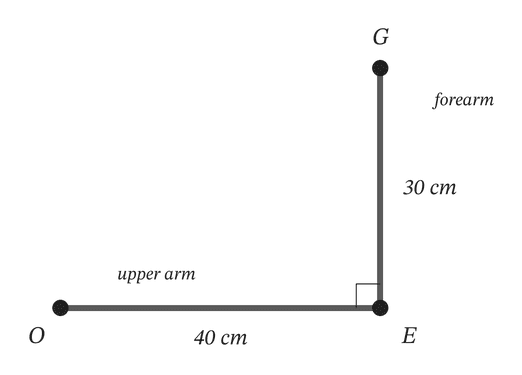
(a) Find how far the gripper is from O in this position, and the angle that OG makes with the horizontal.
(b) The elbow can turn the forearm to any angle. Find the least and the greatest distances from O at which the gripper can be placed, and say whether the arm can pick up a part from O.
(c) The upper arm is now raised to above the horizontal, and the forearm hangs vertically downwards. Taking horizontal (in the direction of OE in the figure) and vertically upwards, write in terms of and , and find its magnitude and direction.
- 64 marks
Question 6
Competency: Analysis & Evaluation
A geography class surveys the boundary of a field ABCD with a tape and a compass. Starting at corner A, the students walk round the boundary and record the length and the bearing (the direction measured clockwise from north) of each side. The figure shows the field. (Hypothetical data.)
Side Length Bearing AB BC CD DA 
(a) The students end at the corner A where they started. Use the polygon law of vector addition to state what the sum of the four recorded displacements should be.
(b) Taking due east and due north, find the east and north components of each recorded side, and hence the vector sum of the four recorded sides (the closing error), giving its magnitude and direction.
(c) The class's rule is that a survey is accepted only if the closing error is less than of the total length walked. Is this survey accepted?
- 71 mark
Question 7
Competency: Analysis & Evaluation
On a trek, Asha walks towards the north-east, then due east and then due north. Her friend Neha starts from the same point and walks the same three legs in the reverse order: due north, then due east and then towards the north-east. (Hypothetical data.)
Assertion (A): Asha and Neha end their walks at the same place.
Reason (R): The magnitude of the resultant of two vectors is greatest when the two vectors point in the same direction.
- 84 marks
Question 8
Competency: Application
An air-traffic radar at a tower T gives the position vector of each aircraft from T, with pointing due east and due north. At 10:00, aircraft P is at and aircraft Q is at . Both fly at the same height. (Hypothetical data.)
(a) Find the position of Q relative to P, , and the distance between the two aircraft.
(b) In which direction from P does Q lie?
(c) At 10:03 the radar shows P at and Q at . Find and the distance between the aircraft at 10:03, and the change in over these 3 minutes. Show that this change equals the displacement of Q minus the displacement of P.
- 91 mark
Question 9
Competency: Application
A wall clock has a minute hand long and an hour hand long, both turning about the centre O of the dial. A tiny light is fixed at the tip of each hand: H on the hour hand and M on the minute hand. (Hypothetical data.) At exactly 3:00, the displacement from the light H to the light M is
- 104 marks
Question 10
Competency: Application
On a small sailing boat, the wind's force on the sail acts at right angles to the sail. In the figure, seen from above, the sail makes an angle of with the keel line (the line along which the boat points), and the wind pushes on the sail with a force . (Hypothetical data.)

(a) Resolve into a component along the keel line and a component at right angles to it.
(b) The keel, a deep fin under the hull, makes the water push sideways on the boat with a force almost equal and opposite to the sideways component. Explain why the boat then moves forward and not sideways.
(c) With the same force on the sail, the skipper wants a forward component of at least . Find the least angle between the sail and the keel line that gives this.
- 111 mark
Question 11
Competency: Application
A ship's navigator records the course of the ship as a bearing, the angle measured clockwise from north. The ship steams at on a bearing of . (Hypothetical data.) Taking as the unit vector due east and as the unit vector due north, the velocity of the ship is
- 124 marks
Question 12
Competency: Application
A vertical radio mast stands on level ground. Three guy wires run from a collar P, up the mast, to anchors A, B and C on the ground. Each anchor is from the foot O of the mast, and seen from above the anchors are apart round O, as shown in the figure. Each wire is tightened to a tension of . (Hypothetical data.)

Take O as the origin, horizontal along OA, horizontal at right angles to OA (so that B is on the side), and vertically upwards.
(a) Find the unit vector along the wire PA, pointing from P towards A, and write the pull of this wire on the mast as a vector.
(b) Write the horizontal part of the pull of each of the three wires on the mast, and show that together they give no sideways pull.
(c) Find the total downward pull of the three wires on the mast.
- 131 mark
Question 13
Competency: Analysis & Evaluation
At a railway station, a porter can move a loaded trolley in two ways: by pushing on a handle that slopes down towards the trolley, or by pulling on a rope that slopes up from the trolley. In both cases the porter applies the same force at the same angle of to the horizontal. The friction on the trolley's wheels grows with the force with which the trolley presses on the floor. (Hypothetical data.)
Assertion (A): Pulling the trolley with the rope moves it along more easily than pushing it with the handle.
Reason (R): The upward vertical component of the pull reduces the force with which the trolley presses on the floor, while the downward vertical component of the push increases it.
- 143 marks
Question 14
Competency: Application
The figure shows a door, wide, seen from above. It turns about a vertical hinge line through O. A person pulls the handle P, from the hinge line, with a horizontal force of at to the door. The turning effect (torque) of a force applied at a point whose position vector from the hinge line is is . Take along the door from O towards P, horizontal and at right angles to the door (on the side towards which the person pulls), and vertically upwards, out of the page. (Hypothetical data.)

(a) Write and in terms of the unit vectors, and find the torque , giving its magnitude and direction.
(b) Which part of the pull does nothing to turn the door? Explain using the vector product.
(c) Find the smallest force at P that would give the same torque. Also find the force needed if it is applied at right angles to the door at the mid-point of OP.
- 154 marks
Question 15
Competency: Analysis & Evaluation
A traffic officer checks speeds with a radar speed gun at G, which stands from the straight path of a car. N is the point of the path nearest to G. The car C moves along the path towards N at a steady (). The gun shows only , the component of the car's velocity along the unit vector that points from the car towards the gun. The figure shows the car when it is from N. (Hypothetical data.)

(a) Taking N as the origin, along the path in the direction of motion and from N towards G, write and for the position shown, and find the speed shown by the gun in .
(b) Find the speed shown when the car is from N.
(c) The speed limit is . Find how close to N the car can come before the gun shows a speed below the limit, and say what this suggests about where the officer should take readings.
- 161 mark
Question 16
Competency: Analysis & Evaluation
A car moves at a steady along a straight road. A lamppost O stands from the line along which the car moves, as shown in the figure. Let be the position vector of the car from O and its velocity. (Hypothetical data.)
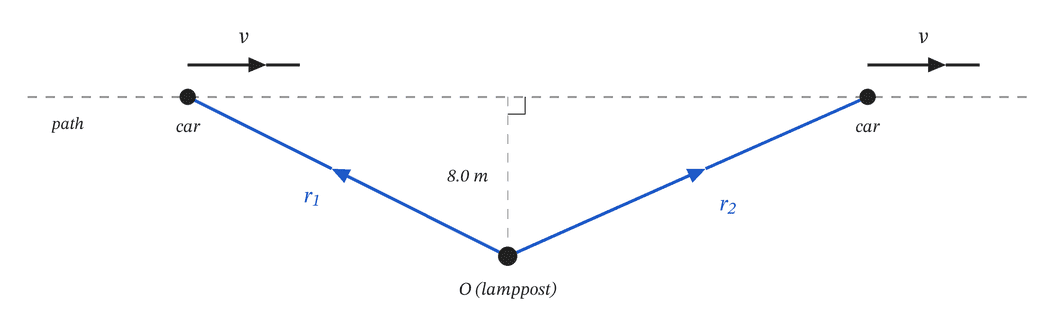
As the car comes towards the lamppost, passes it and moves away, the magnitude of the vector product
- 171 mark
Question 17
Competency: Analysis & Evaluation
To start a playground roundabout turning, a child pulls on a rope tied to a point on its rim. The turning effect of a force applied at a point with position vector from the axle is the torque .
Assertion (A): If the rope is pulled straight outwards, along the line from the axle through the point where the rope is tied, the roundabout does not start turning, however hard the child pulls.
Reason (R): The vector product of two vectors is zero only when one of the two vectors is the zero vector.
- 183 marks
Question 18
Competency: Application
A camera drone films a cyclist who rides due north at a steady on a straight road. A steady wind blows from the west at . The drone must stay directly above the cyclist all the time; its own motion through the air is set by its propellers. (Hypothetical data.)
(a) Taking due east and due north, write the velocity of the drone relative to the ground and the velocity of the air relative to the ground.
(b) Find the velocity the drone must have relative to the air: its airspeed and the direction in which it must fly through the air.
(c) The drone's greatest airspeed is . What is the strongest wind from the west in which it can still follow a cyclist riding due north at ?
- 191 mark
Question 19
Competency: Application
In a football match, Rohan at P passes the ball along the ground to his teammate Kiran, who is at K, away, at the moment of the pass. Kiran is running at a steady at right angles to the line PK, as shown in the figure. The ball travels across the ground at a steady . (Hypothetical data.)
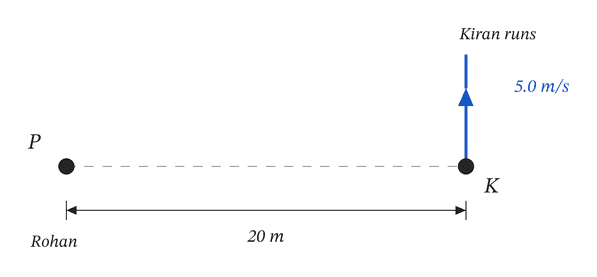
So that the ball reaches Kiran without his changing his run, Rohan should pass the ball
- 201 mark
Question 20
Competency: Analysis & Evaluation
A small aircraft points due east and moves through the air at , while a wind blows from the north at . A toy balloon that escaped earlier drifts freely with the wind at the aircraft's height. (Hypothetical data.)
Assertion (A): To the pilot, the balloon appears to move due west at .
Reason (R): The balloon is at rest relative to the air, so its velocity relative to the aircraft is the negative of the aircraft's velocity relative to the air.
- 214 marks
Question 21
Competency: Application
In a free throw, a player releases a basketball at R, above the floor, at above the horizontal. The centre H of the hoop is above the floor and from R horizontally, as shown in the figure. Treat the ball as a point, neglect air resistance and take . (Hypothetical data.)
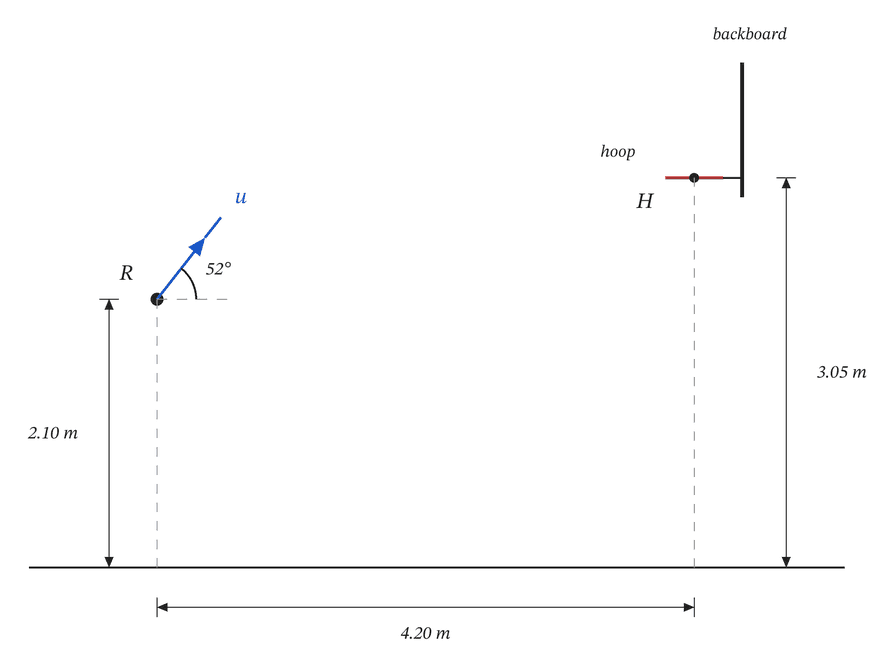
(a) Find the speed at which the ball must be released to pass through H.
(b) Find the time the ball takes to reach H.
(c) Is the ball rising or falling when it reaches H? Find the angle its velocity makes with the horizontal there, and the greatest height of the ball above the floor.
- 224 marks
Question 22
Competency: Application
To measure the flow from a water tank, a student lets the water run out through a horizontal pipe of internal diameter . The water leaves the end of the pipe horizontally, above a drain, and strikes the drain (measured horizontally) from the end of the pipe, as shown in the figure. Treat the water as leaving the pipe with the same speed across the whole pipe, neglect air resistance and take . (Hypothetical data.)
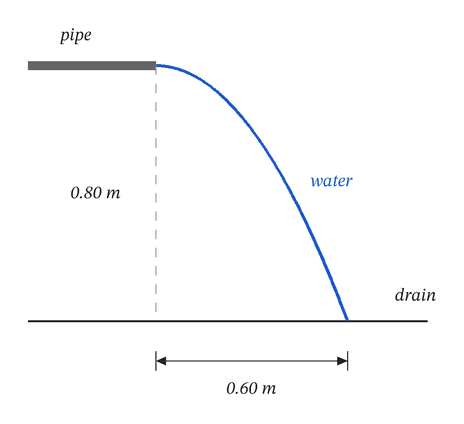
(a) How long does a small parcel of water take to fall from the pipe to the drain?
(b) Find the speed with which the water leaves the pipe.
(c) Find the volume of water flowing out each second, in litres, and the speed with which the water strikes the drain.
- 231 mark
Question 23
Competency: Analysis & Evaluation
A spring launcher fires a small ball horizontally, and a multi-flash photograph records the ball every , as shown in the figure. The positions measured from the photograph, from the launch point, are given below. (Hypothetical data.)
Flash (s) Horizontal distance (cm) Drop below launch level (cm) 1 0 0 0 2 0.050 9.0 1.2 3 0.100 18.0 4.9 4 0.150 27.0 11.0 5 0.200 36.0 19.6 
The launch speed of the ball and the value of given by these data are
- 241 mark
Question 24
Competency: Analysis & Evaluation
From a viewpoint on a hilltop, above a flat valley floor, a hiker throws stones at at different angles above the horizontal. Neglect air resistance and take . (Hypothetical data.)
Assertion (A): Of all the angles, a stone thrown at lands farthest from the point directly below the viewpoint.
Reason (R): For a projectile launched from and landing on the same level ground, the horizontal range is greatest for an angle of projection of .
- 251 mark
Question 25
Competency: Analysis & Evaluation
A football is kicked from the ground at , at above the horizontal. It passes the level of a window ledge above the ground twice: once on the way up and once on the way down. Neglect air resistance and take . (Hypothetical data.)
Assertion (A): The football has the same speed each time it passes the level of the ledge.
Reason (R): The horizontal component of the football's velocity decreases steadily during its flight.
- 263 marks
Question 26
At what angle two vectors and act such that their sum is .
- 273 marks
Question 27
If and , how will you combine them to get a resultant vector of (a) , (b) and (c) ?
- 283 marks
Question 28
and are two vectors having the same magnitude. What is the condition that (i) the vector sum and (ii) the vector difference have the same magnitude as and ?
- 294 marks
Question 29
and are two vectors such that is long and is above the -axis in the first quadrant. is long and is below the -axis in the fourth quadrant.
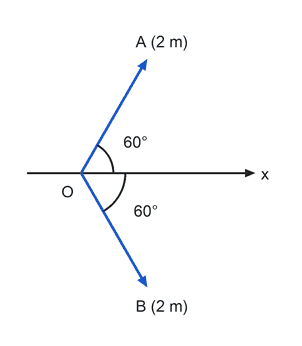
(a) Draw diagram to show , and .
(b) What is the magnitude and direction of , and ?
- 303 marks
Question 30
The greatest and least resultant of two forces acting at a point is and respectively. If each force is increased by , find the resultant of the two new forces when acting at right angles to each other?
- 313 marks
Question 31
An aeroplane has a velocity of directed due north and is subjected to a wind blowing from west to east at a speed of . Calculate the actual velocity of the aeroplane relative to the Earth.
- 323 marks
Question 32
An athlete runs along a circular track of circumference with a uniform speed . What is the change in velocity when he runs through a distance of (i) and (ii) ?
- 333 marks
Question 33
What is the resultant of two vectors 7 units and 8 units acting at an angle of to each other?
- 343 marks
Question 34
A body of mass is at rest on an inclined plane of angle . What are its components parallel and perpendicular to the plane?
- 353 marks
Question 35
If and , what is ?
- 363 marks
Question 36
Find the projection of the vector on the vector .
- 373 marks
Question 37
Given, and . What is the vector component of in the direction of ?
- 383 marks
Question 38
The magnitude of two vectors are and . If their scalar product is , what is the angle between the two vector?
- 393 marks
Question 39
Find the angle between and .
- 403 marks
Question 40
The diagonals of a parallelogram are given by the vectors and in m. Find the area of the parallelogram.
- 413 marks
Question 41
The vector is a force of 3.0 newton making an angle of with the displacement of magnitude .
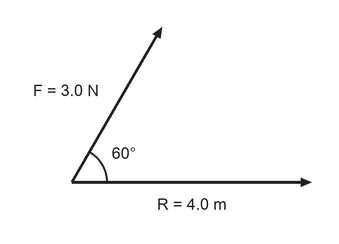
Find
(a) the value of the dot product and
(b) the magnitude and direction of the cross product .
- 423 marks
Question 42
If and , find the sine of the angle between and .
- 433 marks
Question 43
Find the cross product , given and is the distance between two points whose coordinates are and .
- 443 marks
Question 44
Two vectors and are mutually perpendicular. What is the value of ?
- 453 marks
Question 45
A bomb is dropped from an aeroplane flying horizontally with a velocity of at an altitude of . After what time will the bomb hit the ground?
- 463 marks
Question 46
A body is thrown horizontally from the top of a tower high and strikes the ground at an angle of with the horizontal. Find the speed with which it was thrown from the top.
- 473 marks
Question 47
A projectile is fired horizontally with a velocity of from the top of a hill high. Find (i) the time taken to reach the ground, (ii) the distance of the target from the hill and (iii) the velocity with which the body will strike the ground.
- 483 marks
Question 48
A shell is fired at an angle of to the horizontal with a velocity of . Find the time of flight, horizontal range and the maximum height attained.
- 493 marks
Question 49
A bullet fired at an angle with the vertical hits the ground at a distance of . Calculate the distance at which the bullet will hit the ground when fired at an angle of , assuming the speed to be same.
- 503 marks
Question 50
The maximum range of a gun on a horizontal terrain is . If is , find the muzzle velocity of the shell.
- 513 marks
Question 51
A football is kicked off with an initial velocity of at an angle with the horizontal. The goalkeeper at a distance away in the direction of kick starts running to catch the ball at that instant. What must be his speed, if he is to catch the ball before it hits the ground?
- 523 marks
Question 52
A bullet is fired at an angle of with the horizontal and hits the ground away. Is it possible to hit a target away by adjusting the angle of projection, assuming the initial speed to be the same?
- 533 marks
Question 53
A ball is projected horizontally from the top of a building high. If the line joining the point of projection to the point where it hits the ground makes an angle of to the horizontal, what is the initial velocity of the ball?
- 543 marks
Question 54
A ball is projected at an angle of , above the horizontal. The horizontal range is . (a) What is the maximum height to which the ball rises? (b) For the same initial speed, what are the two angles of departure for which the range is ?
- 553 marks
Question 55
A child throws a waterfilled balloon at an angle of with a speed of . A car is advancing towards the child with a constant speed of . If the balloon is to hit the car, how far away should the car be when the balloon is thrown?
- 563 marks
Question 56
Wind is blowing from the south at , but to a cyclist it appears to be blowing from the east at . Determine the velocity of the cyclist in vector form.
- 573 marks
Question 57
A cat is climbing a vertical pole with a speed of and a dog is running towards the pole with a speed of . What is the velocity of the dog relative to the cat?
- 583 marks
Question 58
To a man walking at the rate of , rain appears to fall vertically. When he doubles his speed, it appears to fall at to the vertical. Find real speed and direction of rain.
- 593 marks
Question 59
A train is accelerating towards north at the rate of . Find the acceleration of a bolt which falls from the ceiling relative to (a) the train and (b) the Earth?