
Before birth, a foetus gets its oxygen from its mother's blood in the placenta. There the two bloods flow very close together without mixing, and oxygen diffuses from the mother's blood into the foetus's blood. Foetal blood contains a different form of haemoglobin, called foetal haemoglobin. The graph shows the oxygen dissociation curves of the mother's blood and of the foetus's blood, lettered P and Q. In the placenta the pO₂ is about 30 mm Hg.
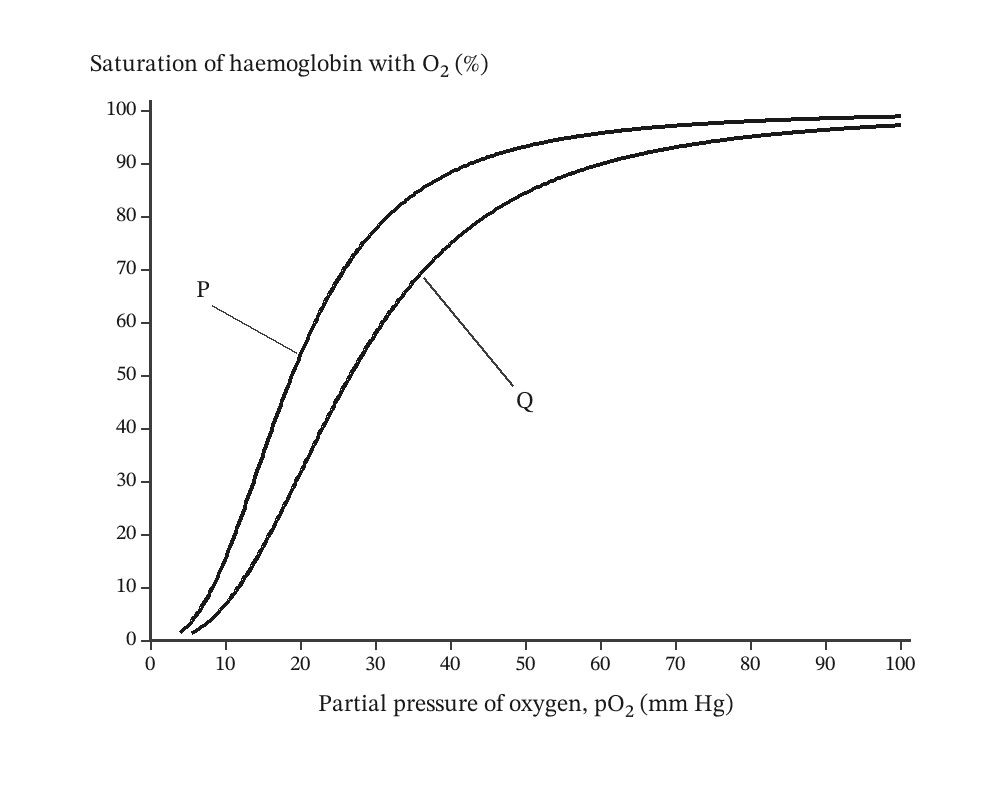
(a) Which curve, P or Q, belongs to the foetal blood? Give a reason. (1 mark)
(b) From the graph, read the percentage saturation of each kind of blood at a pO₂ of 30 mm Hg. (1 mark)
(c) Explain how the difference in (b) helps the foetus. Also explain how carbon dioxide passing from the foetal blood into the mother's blood in the placenta helps the mother's blood give up more oxygen. (2 marks)