
Opening your dashboard
Class 11 Biology Chapter 24 Breathing and Exchange of Gases: Competency-Based Questions (CBQ)
40 questions on Chapter 24, each worked through on its own page with the AI tutor. Class 11 Biology, ICSE 2026-27.
40 questions
1–10 marks · Mixed difficulty
- 14 marks
Question 1
In a blood bank laboratory in Chennai, mature red blood cells (RBCs) and white blood cells (WBCs) are separated from the same donor's blood. Each kind of cell is kept at 37 °C with glucose for 2 hours, once in air and once under pure nitrogen (no oxygen). The amounts used or formed are given in nanomoles per million cells. (Hypothetical data.)
Cells Gas above the cells Glucose used Lactic acid formed Oxygen used RBCs Air 20 40 0 RBCs Nitrogen 20 40 0 WBCs Air 10 4 48 WBCs Nitrogen 30 60 0 (a) Which of the two kinds of cell respires only anaerobically, even in air? Name the feature of its structure that explains this. (1 mark)
(b) In anaerobic respiration one glucose molecule gives two molecules of lactic acid. For the WBCs in air, calculate how much glucose was oxidised aerobically, and show that the oxygen used agrees with the equation for aerobic respiration. (2 marks)
(c) Why did the WBCs use three times as much glucose under nitrogen as in air? (1 mark)
- 21 mark
Question 2
Assertion (A): In cyanide poisoning, blood returning from the tissues in the veins can still be bright red and rich in oxygen, although the body cells are starved of energy.
Reason (R): Cyanide stops the cells from using oxygen to oxidise food (internal respiration), even though breathing and the transport of oxygen in blood continue.
- 31 mark
Question 3
During open-heart surgery at a hospital in Chennai, a heart-lung machine takes blood from the body, passes it over a membrane that adds oxygen to it and removes carbon dioxide, and pumps it back. The patient's lungs are not ventilated for an hour. Which phase of respiration does the machine's membrane take over?
- 44 marks
Question 4
In a zoology laboratory in Bengaluru, a large beetle is kept in a small glass chamber, and its spiracles are watched under a microscope while the carbon dioxide in the chamber air is changed. (Hypothetical data.)
CO₂ in chamber air Time spiracles are open Abdominal pumping movements per minute Water lost per hour 0.04 % 15 % 8 0.6 mg 2 % 60 % 20 1.5 mg 5 % 95 % 36 2.2 mg (a) Trace the path by which oxygen from the air reaches a flight-muscle cell of the beetle. (1 mark)
(b) The beetle's blood plays almost no part in carrying oxygen to its muscles. Explain why. (1 mark)
(c) Describe how the beetle responds to a rise in carbon dioxide, and use the last column to explain why, in normal air, it keeps its spiracles closed for most of the time. (2 marks)
- 51 mark
Question 5
Assertion (A): The blood of an earthworm is red, although the earthworm has no red blood cells.
Reason (R): An earthworm exchanges gases through its thin, moist skin, which is richly supplied with looped blood capillaries.
- 61 mark
Question 6
On a hot May afternoon in Nagpur, the goldfish in a crowded school aquarium gather at the water surface, gulping, and their gill covers move very fast. Which step would help the fish most quickly?
- 74 marks
Question 7
At a school canteen in Jaipur, a 12-year-old boy laughing while eating roasted peanuts suddenly cannot speak, cough or breathe, and clutches his throat. A teacher trained in first aid gives him firm back blows and then quick inward and upward thrusts just above his navel (abdominal thrusts), and the peanut shoots out. A week later, a classmate inhales a peanut piece that goes deep into one lung. In humans the right main bronchus is wider, shorter and more vertical than the left. (Hypothetical case.)
(a) Which structure normally stops food from entering the larynx when we swallow? Why does laughing while eating make choking more likely? (1 mark)
(b) Explain how an abdominal thrust forces the peanut out of the air passage. (1 mark)
(c) Into which main bronchus is the classmate's peanut most likely to go? If it blocks that bronchus completely, what happens to the air in the alveoli beyond the block and to the blood flowing past them? (2 marks)
- 81 mark
Question 8
A patient in an intensive care unit in Hyderabad breathes through a tracheostomy tube, a short tube placed through the front of the neck straight into the trachea. The nurses pass the air through a warm-water humidifier before it reaches the tube. Why is this done?
- 91 mark
Question 9
A man at a clinic in Kolkata has pleurisy. He feels a sharp pain in the chest with every breath in, and the pain stops for a moment when he holds his breath. Which explanation fits best?
- 104 marks
Question 10
For a science exhibition in Lucknow, students build the model of the chest shown below. A Y-shaped glass tube P passes through a rubber stopper into a bell jar R and ends in two small balloons Q. A rubber sheet S is tied across the open bottom of the jar, and a string is fixed to its centre.
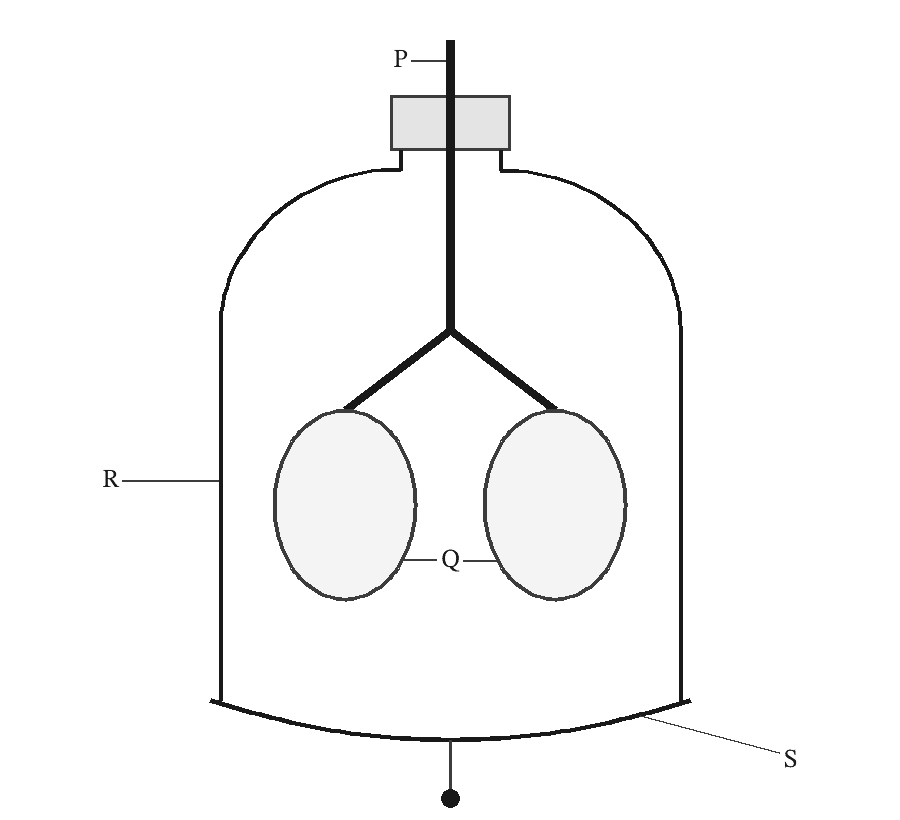
(a) Name the part of the human respiratory system that each of P, Q, R and S stands for. (1 mark)
(b) When the string is pulled down, the balloons swell; when it is let go, they shrink. Explain both changes. (2 marks)
(c) State one way in which this model does not show breathing correctly. (1 mark)
- 111 mark
Question 11
Assertion (A): A patient under general anaesthesia, whose lungs are inflated by a ventilator, breathes out without any push from the machine.
Reason (R): During normal inspiration the external intercostal muscles contract and move the ribs upward and outward.
- 121 mark
Question 12
On a snorkelling trip at Havelock Island, a student wonders why snorkels are so short. In a supervised test in a pool, he tries to breathe through a 1.5 m long hose with his chest 1.5 m below the surface, and finds he cannot draw in any air. What is the main reason?
- 134 marks
Question 13
In an intensive care unit in Delhi, awake patients with severe pneumonia are turned to lie face down (prone) for many hours a day. When a patient lies on the back, the weight of the heart and of the swollen lungs presses on the back parts of the lungs; many alveoli there collapse or fill with fluid, while blood keeps flowing through the capillaries around them. Lying face down lets many of these alveoli open again. One patient's oxygen saturation of haemoglobin (SpO₂), read with a pulse oximeter on the finger, is given below. (Hypothetical data.)
Position SpO₂ On the back 88 % After 1 hour face down 94 % 2 hours after turning back 91 % (a) Why can a fluid-filled alveolus not add oxygen to the blood flowing past it? (1 mark)
(b) Explain why the SpO₂ rose when the patient was turned face down. (1 mark)
(c) Suppose that, on the back, 40 % of the blood passes collapsed alveoli and leaves them 75 % saturated, while the rest passes open alveoli and leaves 97 % saturated. Calculate the saturation of the mixed blood, and explain why breathing faster cannot make up for the collapsed alveoli. (2 marks)
- 141 mark
Question 14
Assertion (A): Air at the top of a high mountain contains a lower percentage of oxygen than air at sea level.
Reason (R): The partial pressure of oxygen in the air falls with height, because the total pressure of the air falls.
- 151 mark
Question 15
A woman with pneumonia in a district hospital in Nashik has an SpO₂ of 88 %. An oxygen concentrator, which removes most of the nitrogen from room air, supplies her with oxygen through nasal prongs, and her SpO₂ rises to 95 %. (Hypothetical data.) How does the extra oxygen mainly help her?
- 164 marks
Question 16
Before birth, a foetus gets its oxygen from its mother's blood in the placenta. There the two bloods flow very close together without mixing, and oxygen diffuses from the mother's blood into the foetus's blood. Foetal blood contains a different form of haemoglobin, called foetal haemoglobin. The graph shows the oxygen dissociation curves of the mother's blood and of the foetus's blood, lettered P and Q. In the placenta the pO₂ is about 30 mm Hg.
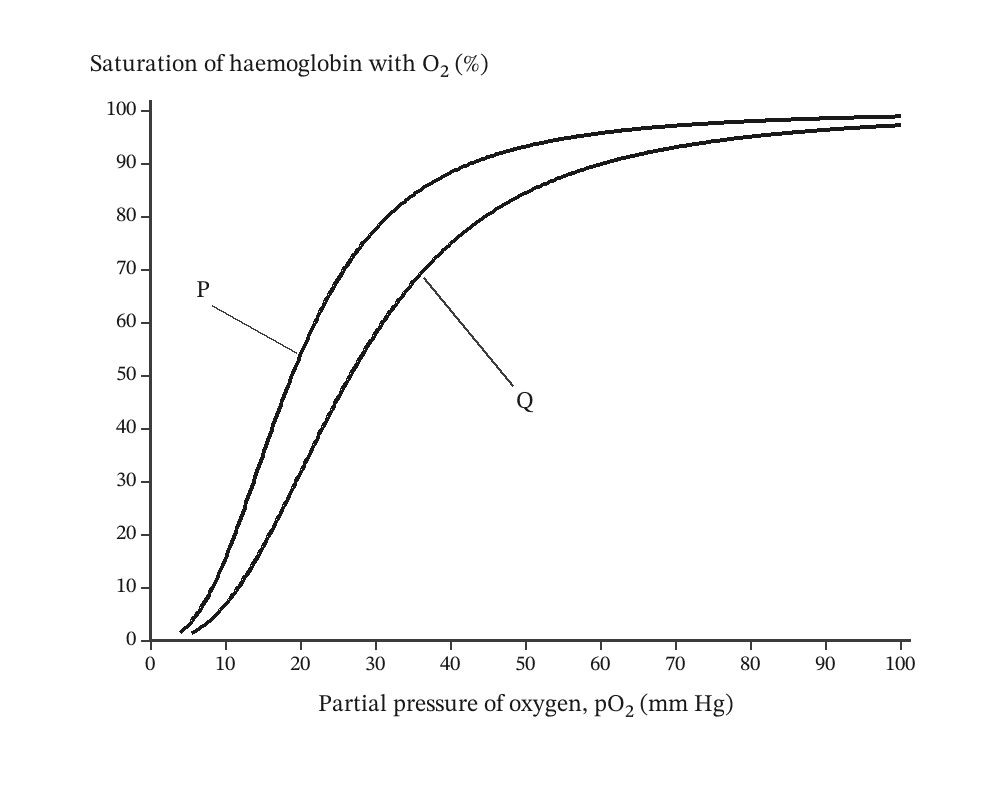
(a) Which curve, P or Q, belongs to the foetal blood? Give a reason. (1 mark)
(b) From the graph, read the percentage saturation of each kind of blood at a pO₂ of 30 mm Hg. (1 mark)
(c) Explain how the difference in (b) helps the foetus. Also explain how carbon dioxide passing from the foetal blood into the mother's blood in the placenta helps the mother's blood give up more oxygen. (2 marks)
- 174 marks
Question 17
A team of six mountaineers from Mumbai stays at Leh (about 3,500 m) for six weeks to acclimatise before a climb. A doctor records the average oxygen saturation of their haemoglobin (SpO₂) and their blood haemoglobin at rest. At sea level their SpO₂ was about 97 %. Throughout the stay their breathing at rest remained deeper than at home. (Hypothetical data.)
Day at Leh SpO₂ Haemoglobin (g per 100 mL of blood) 1 87 % 14.0 7 89 % 14.4 21 91 % 15.3 42 92 % 16.1 (a) Why is the SpO₂ on day 1 lower than at sea level? (1 mark)
(b) Calculate the percentage rise in haemoglobin from day 1 to day 42. (1 mark)
(c) Give two reasons why each 100 mL of the climbers' arterial blood carried more oxygen on day 42 than on day 1. (2 marks)
- 181 mark
Question 18
Assertion (A): Blood leaving a resting muscle still carries about three-quarters of the oxygen that it brought to the muscle.
Reason (R): Haemoglobin cannot give up any oxygen at pO₂ values below 40 mm Hg.
- 191 mark
Question 19
At a cricket match in Delhi, a fast bowler breathes pure oxygen from a small can between overs. A sports physiologist says that this hardly changes the amount of oxygen carried by his arterial blood. Why?
- 204 marks
Question 20
In a physiology laboratory of a medical college in Mysuru, under a doctor's supervision, a healthy volunteer breathes in and out of a 50-litre bag of air for 6 minutes. In Run 1 the bag has nothing else in it. In Run 2 the bag contains soda lime, which absorbs carbon dioxide. The gases in the bag and the volunteer's ventilation (litres of air breathed per minute) are measured. The test is stopped at once if the volunteer feels uncomfortable. (Hypothetical data.)
Time Run 1: O₂ in bag Run 1: CO₂ in bag Run 1: ventilation Run 2: O₂ in bag Run 2: CO₂ in bag Run 2: ventilation 0 min 20.9 % 0.04 % 7.5 L/min 20.9 % 0.04 % 7.5 L/min 3 min 19.4 % 1.2 % 9.5 L/min 19.4 % 0.1 % 7.5 L/min 6 min 17.9 % 2.4 % 15.0 L/min 17.9 % 0.1 % 7.8 L/min (a) Using both runs, identify the change in the bag air that mainly made the volunteer breathe more in Run 1. (1 mark)
(b) Explain how this change is detected and how it leads to faster and deeper breathing. (2 marks)
(c) In Run 2 the oxygen in the bag fell just as much, yet ventilation hardly changed. Explain why. (1 mark)
- 211 mark
Question 21
Assertion (A): Serious damage to the medulla oblongata stops normal breathing, while damage limited to the cerebral hemispheres need not.
Reason (R): The basic rhythm of breathing is generated by groups of neurons in the medulla oblongata.
- 221 mark
Question 22
Assertion (A): The pneumotaxic centre in the pons generates the basic rhythm of breathing.
Reason (R): A strong signal from the pneumotaxic centre cuts each inspiration short, so that the rate of breathing rises.
- 234 marks
Question 23
A 48-year-old man in Kanpur has smoked for 25 years and coughs up thick sputum every winter (chronic bronchitis). His doctor asks him to record his peak expiratory flow (PEF): the highest speed, in litres per minute, at which he can blow air out in one fast, forceful breath after a full breath in. PEF falls when the bronchi and bronchioles are narrowed. The expected PEF for a healthy man of his age and height is 580 L/min. He stopped smoking in January 2024, just after that year's reading. (Hypothetical data.)
January of year 2022 2023 2024 2025 2026 PEF (L/min) 470 440 410 405 400 (a) Express his PEF in 2024 as a percentage of the expected value. (1 mark)
(b) Explain how chronic bronchitis lowers the PEF. (1 mark)
(c) Describe the change in his PEF before and after he stopped smoking, and explain why it did not go back to 580 L/min. (2 marks)
- 244 marks
Question 24
At a municipal swimming pool in Pune, a valve on a chlorine cylinder leaks while the water is being treated. Swimmers near the pump room start coughing and wheezing, with burning eyes and throat and a tight chest. Chlorine gas dissolves in the moist lining of the air passages and forms acids that irritate and inflame it. (Hypothetical case.)
(a) Explain why the swimmers cough and wheeze. (1 mark)
(b) State two first-aid steps the pool staff should take for the affected swimmers. (2 marks)
(c) Some swimmers feel better after half an hour, yet the doctor keeps them under observation for several hours. Why? (1 mark)
- 251 mark
Question 25
Assertion (A): A patient with pneumonia caused by the bacterium Streptococcus pneumoniae is usually treated with antibiotics.
Reason (R): Antibiotics kill viruses as well as bacteria, so they cure every kind of pneumonia.
- 2610 marks
Question 26
Match the following:
Column A Column B 1. Tracheoles (a) Yeast 2. Lactic acid (b) Lungs 3. Fermentation (c) Bohr's effect 4. Gills (d) Insects 5. Cutaneous respiration (e) Fish 6. Larynx (f) Muscles during exercise 7. Pleural membrane (g) Inspiration 8. Trachea (h) Voice box 9. Haemoglobin (i) Earthworm 10. Relaxed diaphragm (j) Cartilaginous rings - 275 marks
Question 27
Read the sources given and answer any four from the questions given below.
On an average, an adult human being breathes approximately 12–15 times per minute. This equates to about 21,600 breaths per day. With every inhalation, air fills the lungs, and with every exhalation, it rushes out. Breathing is regulated by the respiratory centre in the brain in response to the signals it receives about the carbon dioxide content of the blood. The air enters the body through the nasal cavity where it is warmed to the body temperature. This helps to reduce any damage that cold and dry air can cause. Particulate matter in the air is removed by nasal hair, mucus and cilia.
From the nasal cavity, the air passes through the pharynx and the larynx (voice box) to the trachea. Trachea is lined with pseudostratified ciliated columnar cells and goblet cells. Goblet cells secrete mucus which traps the dust particles in the inhaled air and cilia move the particles towards the pharynx. Trachea is made of C-shaped incomplete rings of cartilage and smooth muscles.
(1) Passage of inhaled air in the body is from
(a) pharynx to nasal cavity to larynx
(b) nasal cavity to larynx to pharynx
(c) pharynx to larynx to trachea
(d) larynx to pharynx to trachea
(2) The cold and dry air from outside is warmed up in the
(a) lungs
(b) larynx
(c) pharynx
(d) nasal cavity
(3) Average breathing rate of an adult human being is about
(a) 720–900 breaths/hour
(b) 20–25 breaths/min
(c) 1000–1200 breaths/hour
(d) 25–30 breaths/min
(4) The trachea is lined with the following types of cells
(a) cuboidal cells
(b) pseudostratified ciliated cells
(c) squamous and goblet cells
(d) ciliated squamous epithelial cells
(5) The respiratory centre for breathing is present in
(a) nasal cavity
(b) lungs
(c) brain
(d) chest cavity
- 285 marks
Question 28
Read the sources given and answer any four from the questions given below.
Haemoglobin is a tetrameric oxygen transport protein found in the red blood cells (erythrocytes), whereas myoglobin is a monomeric protein found mainly in the muscle tissue where it serves as an intracellular storage site for oxygen. Haemoglobin is composed of two alpha and two beta globin chains. Myoglobin binds with oxygen more tightly than haemoglobin. Myoglobin releases the oxygen only when pO is below 20 mm Hg. By this time oxyhaemoglobin has already given off more than 50% of oxygen and its supply is exhausted. So myoglobin acts as a store house of oxygen and dissociates only when pO falls considerably low. Myoglobin serves as a local oxygen reservoir that can temporarily provide oxygen when blood oxygen delivery is insufficient during periods of intense muscular activity. Diving mammals such as seals and whales are able to remain submerged for long periods because they have greater amounts of myoglobin in their muscles than other animals do.
(1) Haemoglobin consists of
(a) four types of protein chains
(b) one type of four protein chains
(c) two alpha and two beta globin chains
(d) one type of many iron chains
(2) Myoglobin is present in the following tissue in the body
(a) blood
(b) liver
(c) muscles
(d) brain
(3) Oxyhaemoglobin dissociates to release oxygen when
(a) pO is 20–95 mmHg
(b) pO is less than 20 mm Hg
(c) myoglobin is 50% saturated
(d) myoglobin is less than 50% saturated
(4) Myoglobin dissociates to release the oxygen when
(a) pO is 50%
(b) pO is 15–20 mm Hg
(c) oxyhaemoglobin is 50% saturated
(d) oxyhaemoglobin is 70% saturated
(5) Mammals like seals and whales are able to remain submerged for long periods because they have
(a) large amount of haemoglobin
(b) large amount of myoglobin
(c) reserved oxyhaemoglobin
(d) reserved blood oxygen
- 291 mark
Question 29
After gulping down a hot meal quickly, a boy in Indore gets hiccups. Each hiccup is a sudden, involuntary contraction of his diaphragm, and a fraction of a second later the glottis (the opening of the larynx) snaps shut, which makes the "hic" sound. (Hypothetical case.)
Which statement correctly explains what happens in his chest during one hiccup?
- 301 mark
Question 30
Assertion (A): A rohu fish taken out of a pond soon suffocates, even though one litre of air holds about 30 times as much oxygen as one litre of pond water.
Reason (R): Out of water, the thin gill filaments are no longer held apart by water, so they collapse and stick together, and very little of their surface stays open for gas exchange.
- 311 mark
Question 31
A 15-year-old girl in Guwahati with uncontrolled type 1 diabetes is brought to hospital breathing very deeply and quickly. Tests show that acids made by her body have built up in her blood, so its H⁺ concentration is high. Her arterial pO₂ is normal and her chest X-ray shows clear lungs. (Hypothetical case.)
Which statement best explains her deep, fast breathing?
- 321 mark
Question 32
Assertion (A): A mouthful of food passes easily down the oesophagus, even though the oesophagus lies just behind the trachea, whose wall is kept stiff by rings of cartilage.
Reason (R): The cartilage rings of the trachea are complete circles, so the trachea is equally stiff all the way round.
- 331 mark
Question 33
A 64-year-old man in Ludhiana, who smoked for 35 years, has emphysema. His doctor notices that even while he sits quietly, he tightens his abdominal muscles each time he breathes out. (Hypothetical case.)
Why does he need his abdominal muscles to breathe out even at rest?
- 342 marks
Question 34
A 60-year-old woman in Thiruvananthapuram has pulmonary fibrosis: fibrous tissue has thickened the walls between her alveoli and the lung capillaries. Her doctor compares her with a healthy person of the same age. (Hypothetical data.)
Measurement Healthy person Patient Time taken by blood in a lung capillary to reach the pO₂ of alveolar air 0.25 s 0.60 s Time each red blood cell spends in a lung capillary, at rest 0.75 s 0.75 s Time each red blood cell spends in a lung capillary, during brisk walking 0.30 s 0.30 s SpO₂ (oxygen saturation of haemoglobin) at rest 97 % 95 % SpO₂ during brisk walking 97 % 86 % (a) Explain why the patient's SpO₂ is nearly normal at rest.
(b) Explain why her SpO₂ falls sharply when she walks briskly, while the healthy person's does not.
- 352 marks
Question 35
An adult tapeworm living in the small intestine of a human gets its energy by anaerobic respiration. A student writes in her notebook: "The tapeworm wastes food. To get the ATP that one glucose molecule gives in aerobic respiration, it must break down 19 glucose molecules. This must be a great disadvantage to it."
(a) Using the ATP yields given in your chapter, check the student's figure of 19.
(b) Is anaerobic respiration really a great disadvantage to the tapeworm? Give two reasons for your answer.
- 362 marks
Question 36
A pest-control worker in Pune explains that spraying cockroaches with a thin film of soapy water or oil can kill them without any poison. The cockroach has 10 pairs of spiracles along the sides of its body: 2 pairs on the thorax and 8 pairs on the abdomen. Oddly, a cockroach can stay alive for several days even after losing its head.
(a) Explain how a film of soap or oil over the body can kill a cockroach.
(b) Why does losing its head not stop the cockroach from breathing?
- 373 marks
Question 37
Students in a school in Bhopal want to test whether school athletes have a higher vital capacity than students who do not play any sport. They have a 10-litre transparent plastic water jar, a large basin of water, a 1-metre length of rubber tubing, a measuring jug, a marker pen and a packet of new drinking straws that fit into the tubing.
(a) Describe how they can turn the jar into a device for measuring vital capacity, and how each student should use it.
(b) State two precautions that will make the comparison between the two groups fair and safe.
(c) Predict the result, and explain why the reading on the jar is never the total lung capacity.
- 383 marks
Question 38
A hospital in Delhi counted the number of asthma patients who came to its emergency ward each week, and compared this with the average level of fine dust (PM2.5) in the city's air in the same week. (Hypothetical data.)
Week Average PM2.5 (µg per m³ of air) Asthma emergency visits 1 (mid-October) 80 42 2 (late October) 150 61 3 (early November) 420 120 4 (mid-November) 310 98 5 (late November) 190 70 (a) Calculate the percentage rise in asthma emergency visits from week 1 to week 3, and describe how the visits changed with the PM2.5 level over the five weeks.
(b) A newspaper headline says, "Smog causes asthma." Do these data support the headline? Give two reasons.
(c) Suggest one measure that a person with asthma should take on days when the PM2.5 level is very high.
- 395 marks
Question 39
In a physiology laboratory in Kolkata, a fast gas analyser at the mouth of a resting student records the CO₂ in the air as she breathes out one normal breath of 500 mL. The figure shows the trace. (Hypothetical data.)
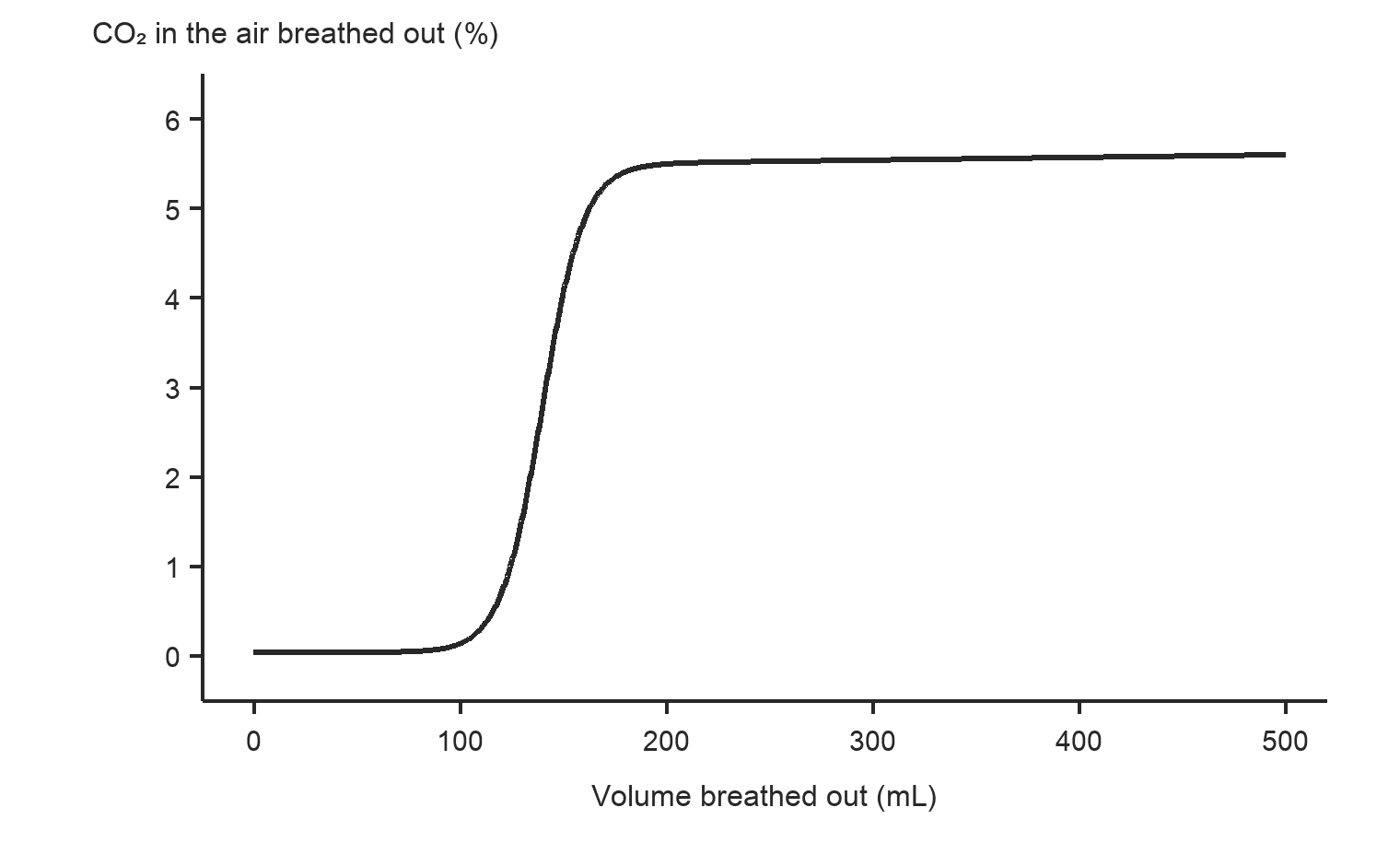
At the very end of the breath (the flat part of the trace), the analyser reads 5.6 % CO₂ and 14.6 % O₂; this end-of-breath air is taken to be alveolar air. When the whole 500 mL breath is collected in a bag and mixed, the bag air contains 4.0 % CO₂.
(a) Why does the air breathed out during the first 100 mL or so contain almost no CO₂? (1 mark)
(b) Alveolar air is saturated with water vapour, whose partial pressure is 47 mm Hg, so the partial pressure of a gas in it = (its percentage ÷ 100) × (760 − 47) mm Hg. Calculate the pCO₂ and pO₂ of her alveolar air, and compare them with the usual values. (2 marks)
(c) All the CO₂ in a breath comes from its alveolar part; the dead-space part carries almost none. So, CO₂ % of the mixed breath = (alveolar part ÷ whole breath) × CO₂ % at the end of the breath. Use this to find the alveolar part and the dead space of her breath, and check your answer against the figure. (2 marks)
- 405 marks
Question 40
In a hospital laboratory in Chandigarh, two blood samples X and Y are taken from a resting patient: one from an artery and one from a vein of the arm. The carbon dioxide carried in each form is given as mL of CO₂ per 100 mL of blood. (Hypothetical data.)
Measurement Sample X Sample Y pCO₂ (mm Hg) 40 45 pH 7.40 7.37 CO₂ dissolved in plasma 2.4 2.7 CO₂ as carbaminohaemoglobin 2.6 3.5 CO₂ as bicarbonate 43.0 45.8 Total CO₂ 48.0 52.0 Chloride ions inside red blood cells (mmol per litre of cells) 52 55 (a) Which sample came from the vein? Give two pieces of evidence from the table. (1 mark)
(b) Calculate how much CO₂ each 100 mL of blood picked up in the tissues in each of the three forms, and the percentage of the total picked up as bicarbonate. (2 marks)
(c) A student says, "Bicarbonate is found in the plasma, so it must be made in the plasma. The higher chloride inside the red cells of the venous sample has nothing to do with carrying CO₂." Evaluate both parts of this claim. (2 marks)