
Question 384 marksHard
Competency: Analysis
Case study: In a school laboratory, two coils P and S are set up facing each other, as shown. Coil P is joined to a cell, a key K and a rheostat, and coil S is joined to a centre-zero galvanometer G. There is no cell in the circuit of S. A student carries out six actions one after another and records what the galvanometer needle does.
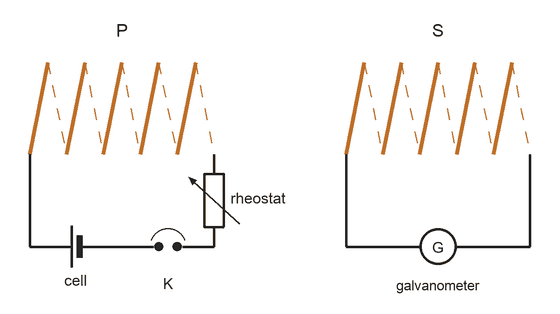
| No. | Action | Galvanometer needle |
|---|---|---|
| 1 | Key K is pressed, so the current in P rises from zero to a steady value | Deflects to the right, then returns to zero |
| 2 | Key K is kept pressed and the current in P is steady | No deflection |
| 3 | Key K is released | Deflects to the left, then returns to zero |
| 4 | The rheostat slider is moved so that the current in P increases | ? |
| 5 | The rheostat slider is moved so that the current in P decreases | ? |
| 6 | The current in P is steady and coil S is moved away from P | ? |
(a) Explain the observations in actions 1 and 2.
(b) Complete the observations for actions 4, 5 and 6, with a reason for each.
(c) Name the phenomenon shown in this experiment and name one device that works on the same principle.