
Opening your dashboard
Class 10 Physics Chapter 10 Electro-magnetism: Competency-Based Questions (CBQ)
40 questions on Chapter 10, each worked through on its own page with the AI tutor. Class 10 Physics, ICSE 2026-27.
40 questions
1–5 marks · Mixed difficulty
- 11 mark
Question 1
Competency: Analysis
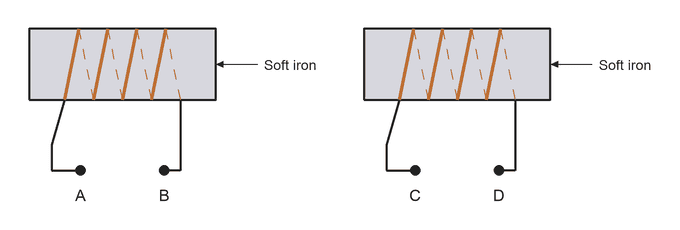
The given rods will attract each other when:
- 21 mark
Question 2
Competency: Analysis
A magnetic compass is present on a small table, very close to the wall in a room. A man enters the room and switches on the Air Conditioner fitted near the ceiling. He observes that the needle in the compass shows immediate deflection. Identify the most probable reason for the deflection.
- 31 mark
Question 3
Competency: Analysis
Assertion (A): When current is passed through a wire, a magnetic field is generated around the wire.
Reason (R): Whenever there is a change of magnetic flux linked up with the coil, the induced current is generated in the coil.
- 42 marks
Question 4
Competency: Analysis & Application
A straight wire is passed vertically through cardboard sprinkled with iron filings.
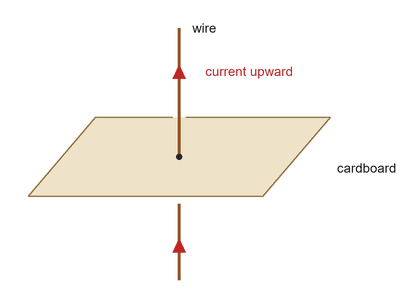
(a) When current is passed through the wire in the upward direction, it is seen that the iron filings are arranging themselves in a definite pattern. Why?
(b) What would happen to this arrangement if more current were passed through the wire?
- 52 marks
Question 5
Competency: Application
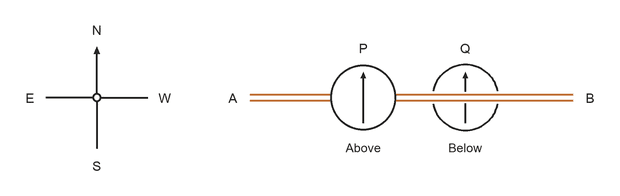
The diagram below shows a copper conductor placed along the east-west direction. Magnetic compass P is present above the conductor, and Q is below the conductor. If current is passed through the wire from A to B, then which of the two compasses will show prominent deflection and why?
- 63 marks
Question 6
Competency: Recall, Understanding & Application
Read the excerpt from a story and answer the questions that follow:
On stage, a soft iron box sits atop a hidden copper coiled platform, conductive to electricity. I summoned a man who fancied himself a modern-day Hercules onto the stage and challenged him to lift the iron box. With ease, he lifted it up. Then, with a wave of my magic wand and a hidden switch activated, I said, "I'm going to take away your strength." When I asked him to lift the box again, he struggled, unable to budge it.
(a) Explain the secret behind the magic.
(b) If you are asked to design the same magic in your science lab, give the necessary circuit diagram.
(c) Give any one device that works on the same principle.
- 73 marks
Question 7
Competency: Recall
In the given diagram, X represents a conductor carrying current into the plane of the paper and kept in a magnetic field. N & S represent the poles of a magnet and concentric circles of the magnetic field produced by the conductor.
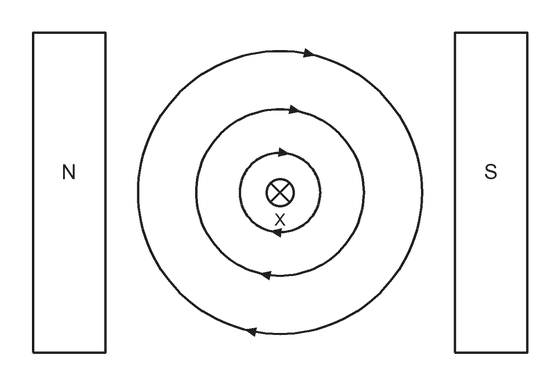
(a) State the direction of the force experienced by the conductor.
(b) Explain the cause of the above-said force.
(c) Name the law used to determine the direction of the force in the conductor.
- 83 marks
Question 8
Competency: Analysis & Application
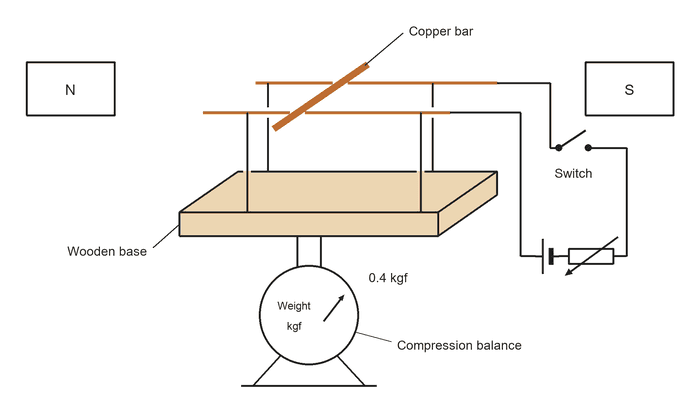
The above circuit diagram illustrates a copper bar placed on two copper wires stretched over a wooden base placed between two poles of magnets. This entire setup is placed on a compression balance, which shows a weight of 0.4 kgf.
(a) What will be the observation of the compression balance when we close the switch?
(b) How will this observation change, when we increase the current in the circuit?
(c) Name the rule used to come to the conclusion in (a).
- 94 marks
Question 9
Competency: Analysis & Evaluation
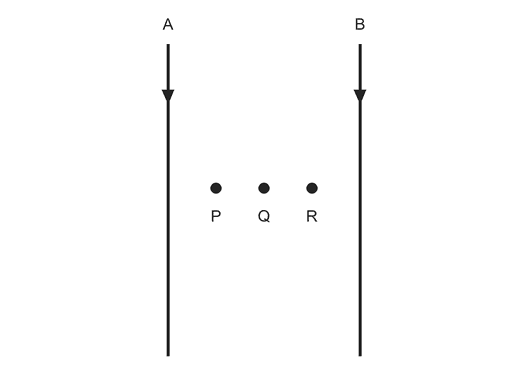
The diagram above shows two parallel wires carrying current in the downward direction. The magnitude of the current in wire A is greater than in wire B. It is also observed that the wires exert force on each other.
(a) State the direction of the force experienced by wire A.
(b) Name the law/laws used to come to the conclusion in (a).
(c) When a compass is placed in between the two wires, it does not remain along the direction of the magnetic field of wire A or wire B at one of the points P, Q, or R. State with a reason at which point you will observe this.
- 101 mark
Question 10
Competency: Understanding
Assertion (A): A strong bar magnet lying at rest inside a coil produces no deflection in a galvanometer joined to the coil.
Reason (R): An e.m.f. is induced in a coil only while the magnetic flux linked with the coil is changing.
- 111 mark
Question 11
Competency: Application
The lamps in a garden work on 12 V a.c. They are to be run from the 240 V a.c. mains through a transformer whose primary coil has 1600 turns. Taking the transformer to be ideal, how many turns should its secondary coil have ?
- 122 marks
Question 12
Competency: Application & Analysis
A student winds 20 turns of insulated copper wire into a flat circular coil, fixes the coil upright on a table and joins it to a battery. The figure shows the coil as the student sees it from the front.
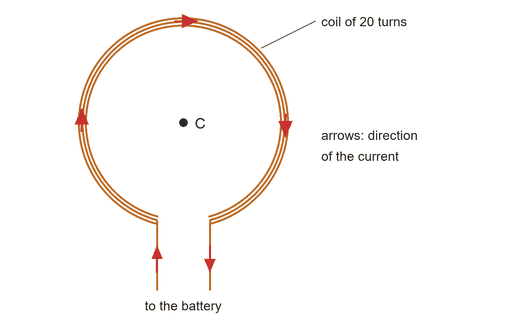
(a) A small compass is held at the centre C of the coil. Does the north pole of its needle point towards the student or away from the student ? Give a reason. (The field of the coil at C is much stronger than the earth's field.)
(b) The student now interchanges the battery connections and removes 10 of the 20 turns. The current in the coil is kept the same as before. State how the magnetic field at C changes in direction and in strength.
- 132 marks
Question 13
Competency: Analysis & Evaluation
A student tests a solenoid by counting how many steel pins one end of it can lift. In every trial the solenoid has the same length. Her results are given below.
Trial Number of turns Current Inside the solenoid Pins lifted 1 100 1 A air 3 2 200 1 A air 6 3 200 2 A air 12 4 200 2 A soft iron rod 45 She writes: "The strength of the magnetic field of a solenoid depends only on the current in it."
(a) Do the results support her statement ? Justify your answer from the table.
(b) Which one change made the solenoid stronger by the largest factor ? Explain why this change has such a large effect.
- 144 marks
Question 14
Competency: Application & Analysis
Case study: A housing society receives electricity through a transformer fixed on a pole near its gate. The details on its plate are copied below. Take the transformer to be ideal (no loss of energy).
Quantity Value Voltage across the primary coil 11 000 V a.c. Voltage across the secondary coil 220 V a.c. Number of turns in the primary coil 5000 Power supplied to the houses at full load 44 kW (a) State the kind of transformer this is, and find the number of turns in its secondary coil.
(b) Calculate the current in the secondary coil and the current in the primary coil at full load.
(c) One of the two coils is wound with a much thicker wire than the other. Use your answers to (b) to decide which coil it is, and explain why. A resident suggests feeding the primary coil with 11 000 V d.c. instead of a.c. What would the houses then receive ? Give a reason.
- 154 marks
Question 15
Competency: Analysis
Case study: At a science fair, a visitor turns the handle of a small a.c. generator at a steady rate. The handle is fixed directly to the coil, so one turn of the handle is one rotation of the coil. A sensor joined across the coil plots the induced e.m.f. against time, as shown.
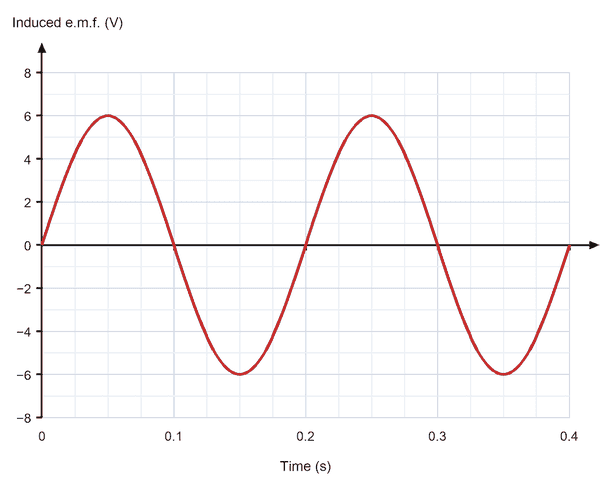
(a) From the graph, read the maximum e.m.f. and the time taken for one complete cycle. Hence find the frequency of the a.c. and the number of rotations the coil makes in one minute.
(b) At which of the two instants, s or s, is the plane of the coil parallel to the magnetic field ? Give a reason from the graph.
(c) The visitor now turns the handle twice as fast. State two ways in which the graph changes, and explain each change.
- 164 marks
Question 16
Competency: Evaluation & Creation
Case study: For a science project, Riya makes a model d.c. motor. A rectangular coil of 10 turns is fixed on an axle between the unlike poles of two bar magnets and is fed from a 3 V battery through two carbon brushes. In place of a split ring, she solders the two ends of the coil to two separate complete brass rings, one brush pressing on each ring. She starts with the plane of the coil along the magnetic field and switches on. The coil turns through about a quarter of a rotation, swings to and fro a few times and comes to rest with its plane at right angles to the field.
(a) Explain why Riya's coil does not keep on rotating.
(b) What should she use in place of the two complete rings ? Explain how this change keeps the coil turning in one direction.
(c) With this correction the motor runs, but slowly. Riya thinks of two ways to make it faster: winding 20 turns in place of 10, or using a 6 V battery in place of the 3 V one. Design a fair test by which she can find out which of the two changes increases the speed more. State what she should change, what she should measure and how, and what she must keep the same.
- 171 mark
Question 17
Competency: Analysis
A long straight wire is held vertically through a horizontal card. A small compass is placed on the card at different distances from the wire, and the angle through which its needle turns from the north-south direction is noted. The earth's field is the same in all the trials. (Hypothetical data.)
Trial Current (A) Distance from wire (cm) Deflection of needle 1 5 5 27° 2 5 10 14° 3 10 10 27° 4 10 20 14° Which conclusion is supported by the table?
- 181 mark
Question 18
Competency: Application
A flat circular coil is to be used as a small electromagnet, and the magnetic field at its centre is wanted to be as strong as possible. For this question take the field at the centre to be proportional to , where is the number of turns, is the current and is the radius of the coil. Four coils are available. (Hypothetical data.)
Coil Turns Current (A) Radius (cm) P 20 2.0 5 Q 50 1.0 20 R 40 1.5 10 S 10 3.0 3 Which coil gives the strongest field at its centre?
- 191 mark
Question 19
Competency: Analysis
A solenoid is joined to a cell and a rheostat, and current flows in it as shown by the arrows on its front turns. Two small compasses, X and Z, lie on the axis of the solenoid, X just beyond its left end and Z just beyond its right end. The figure shows the needles as they lay before the current was switched on, pointing to the top of the page (north). The field of the solenoid at X and at Z is much stronger than the earth's field.
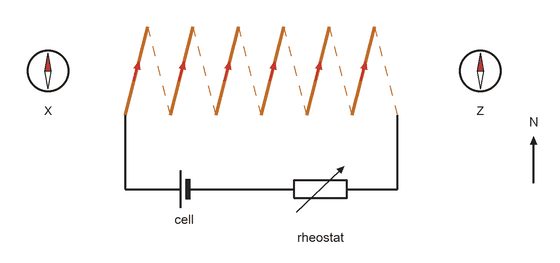
After the current is switched on, in which direction do the north poles of X and Z point?
- 201 mark
Question 20
Competency: Analysis
A flat coil joined to a sensitive galvanometer lies in the uniform magnetic field between the poles of a large magnet. The plane of the coil is at right angles to the field, and the coil is small enough to stay wholly inside the uniform region unless it is pulled out of it. Three actions are tried, one after another.
P: The coil is moved sideways inside the uniform field, with its plane still at right angles to the field.
Q: The coil is turned about an axis in its own plane until its plane is parallel to the field.
R: The coil is pulled steadily out of the field altogether.
During which of these actions does the galvanometer show a deflection?
- 211 mark
Question 21
Competency: Application
A straight wire carrying a current of 2.0 A has 0.15 m of its length at right angles to a uniform magnetic field, and a force of 0.12 N acts on it. The experiment is repeated in the same field with the current raised to 3.0 A, and with only half the length of the wire (0.075 m) kept at right angles to the field. What is the force on the wire now?
- 221 mark
Question 22
Competency: Understanding
Read the Assertion (A) and the Reason (R) and choose the correct option.
Assertion (A): A simple d.c. motor keeps turning even though, twice in every rotation, there is a moment when no current flows through its coil.
Reason (R): At that moment the coil is carried past its position by the inertia of its rotational motion.
- 231 mark
Question 23
Competency: Understanding
Read the Assertion (A) and the Reason (R) and choose the correct option.
Assertion (A): When the coil of an a.c. generator is turned twice as fast, the frequency of the alternating current it gives is doubled.
Reason (R): The e.m.f. induced in the coil depends only on the number of turns in the coil.
- 241 mark
Question 24
Competency: Analysis
A student lists the readings on four ideal transformers. Each reading was taken with an alternating voltage applied across the primary coil. (Hypothetical data.)
Transformer Primary turns Secondary turns Voltage across primary Voltage across secondary T1 1000 50 200 V 10 V T2 400 1600 110 V 440 V T3 600 60 120 V 12 V T4 2400 120 240 V 24 V One row cannot belong to an ideal transformer. Which one is it?
- 251 mark
Question 25
Competency: Application
For a simple a.c. generator the e.m.f. at time is given by , where is the maximum e.m.f. and is the number of rotations of the coil per second. Here the angle is in radians, and radians . A generator with V has its coil turned at 25 rotations per second, and the time is when the e.m.f. is zero. What is the e.m.f. at s?
- 261 mark
Question 26
Competency: Application
A bar magnet is pushed into a coil of 150 turns in 0.20 s, and the average induced e.m.f. is found to be 30 mV. The magnet is then pushed into a second coil of the same size but with 300 turns, in the same way but in 0.05 s. The flux through each turn changes by the same amount in both cases. (Hypothetical data.) What e.m.f. is induced in the second coil?
- 272 marks
Question 27
Competency: Understanding
In a car, the ignition switch can carry only a small current, but the starter motor needs a very large current. A relay joins the two circuits. It has a coil wound on a soft iron core, a movable soft iron armature and a pair of contacts in the starter circuit. When the small current flows in the coil, the armature is pulled towards the core and closes the contacts.
(a) Explain why the armature is pulled towards the core when the small current flows.
(b) Why must the core and the armature be made of soft iron and not of steel?
- 282 marks
Question 28
Competency: Application
The figure is a view from above. A battery is joined by two wires to two horizontal metal rails, and a metal rod lies across the rails. The terminals of the battery are marked X and Y, and the rod is seen to move to the right. A uniform magnetic field acts over the whole region, directed vertically upwards, out of the page towards the reader, as shown by the dots.
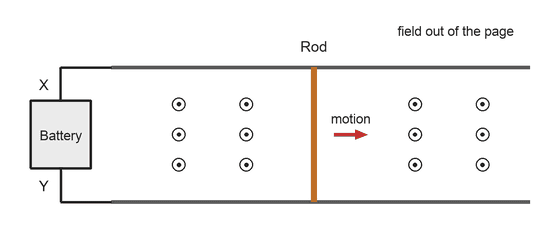
(a) Which terminal of the battery, X or Y, is the positive terminal? Name the rule you use.
(b) The field is now reversed and the battery connections are also interchanged. In which direction does the rod move?
- 292 marks
Question 29
Competency: Evaluation
Dev passes a large current through a long straight wire that goes vertically through a card, and he sprinkles iron filings on the card. After he taps the card, the filings settle into rings round the wire. He then switches the current off and sees that the rings of filings are still there. He says, "The magnetic field of the wire stays on for a long time after the current stops."
(a) Evaluate Dev's claim. Give the reason why the rings are still visible.
(b) Describe a simple test with a compass that can show whether the magnetic field of the wire is still present.
- 302 marks
Question 30
Competency: Analysis
A student sets up a flat circular coil upright and places a small compass at its centre, with the needle pointing north-south before the current is switched on. She then notes the deflection of the needle for four different settings. The field of the coil is the only field that changes. (Hypothetical data.)
Trial Turns Current (A) Radius of coil (cm) Deflection 1 5 0.40 5 32° 2 5 0.80 5 51° 3 5 0.40 10 17° 4 10 0.40 10 32° (a) Which two trials should she compare to find the effect of the radius of the coil alone? State what the comparison shows.
(b) Trials 1 and 4 give the same deflection although the number of turns and the radius are both different. Explain how this is possible.
- 312 marks
Question 31
Competency: Application
A mobile phone charger contains a transformer whose primary coil has 1100 turns and whose secondary coil has 55 turns. It is meant to be connected to the 220 V a.c. mains. A careless student joins the 55-turn coil to an 11 V a.c. supply instead, and measures the a.c. voltage across the 1100-turn coil. Assume the transformer is ideal.
(a) What voltage does the student measure across the 1100-turn coil? What kind of transformer is it now being used as?
(b) Which of the two coils is wound with thicker wire in the charger as it is meant to be used? Give a reason.
- 322 marks
Question 32
Competency: Creativity
Meera wants a simple detector that shows whenever the door of a storeroom is opened or shut, without using any cell. She has a small strong bar magnet, a coil of about 500 turns of insulated wire, a centre-zero galvanometer and long connecting wires. The door is closed most of the time.
(a) Suggest where she should fix the magnet and the coil, and how she should connect the circuit, so that the galvanometer responds when the door moves.
(b) State what the needle does when the door is opened, while it stays open, and when it is shut again. How can she tell opening from shutting? Give a reason.
- 333 marks
Question 33
Competency: Analysis
The graph shows how the magnetic flux linked with the coil of an a.c. generator changes with time during one rotation of the coil. The points P, Q, R and S are marked on the curve.
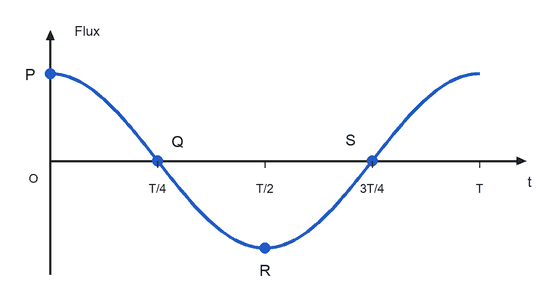
(a) At which of the points P, Q, R and S is the induced e.m.f. zero? Give the reason using the shape of the graph.
(b) At which points is the e.m.f. greatest? How does the direction of the e.m.f. at Q compare with that at S?
(c) At the point P, what is the position of the plane of the coil with respect to the magnetic field?
- 343 marks
Question 34
Competency: Evaluation
Two small d.c. motors are used to wind up a load on a model crane. Each runs from a 6 V battery and lifts its load at a steady speed. (Hypothetical data.)
Motor Current (A) Load lifted (kg) Height raised (m) Time taken (s) P 1.0 0.50 0.80 4.0 Q 0.60 0.30 0.60 5.0 Take .
(a) Find the electrical energy supplied to each motor during the lift.
(b) Find the useful work done in raising the load and the efficiency of each motor.
(c) Which motor is the better one? Name the energy change in a motor and say where the rest of the energy goes.
- 353 marks
Question 35
Competency: Application
A straight horizontal metal rod lies in the north-south direction and is joined by flexible wires to a sensitive galvanometer. A strong magnet produces a uniform magnetic field over the region, directed vertically downwards. The rod is moved horizontally towards the east, so that it cuts the field.
(a) Name the rule that gives the direction of the induced current and state the direction of the current in the rod.
(b) State the direction of the current if the rod is instead moved towards the west.
(c) What would the galvanometer show if the rod were moved vertically upwards in the same field? Give a reason.
- 363 marks
Question 36
Competency: Analysis
Two coils, A and B, are wound on a common axis with a gap between them and are joined in series to a cell, as shown. The arrows on the front turns show the direction of the current in each coil. The two coils are wound in opposite directions.
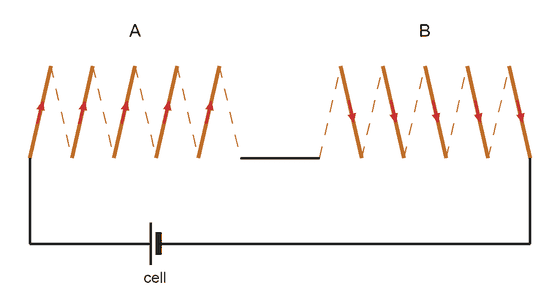
(a) Name the magnetic pole at the right end of A and at the left end of B.
(b) Will the coils attract or repel each other? Give a reason.
(c) The connections to coil B only are now interchanged. State what happens and why.
- 374 marks
Question 37
Competency: Evaluation
Case study: A hydro-electric station in a hill village generates 11 kW of electric power. This power must be sent along a cable of total resistance 1.0 to houses several kilometres away. The heat produced per second in the cable is , where is the current in the cable, and this energy is wasted. An engineer compares three ways of sending the 11 kW, each at a different voltage. (Hypothetical data.)
Voltage at which the power is sent 220 V 2200 V 11 000 V (a) Find the current in the cable in each of the three cases.
(b) Find the heat produced per second in the cable in each case, and the percentage of the 11 kW that is wasted when the power is sent at 220 V.
(c) Name the two transformers that the engineer should use and where each should be fixed. Explain why this plan works only with alternating current.
- 384 marks
Question 38
Competency: Analysis
Case study: In a school laboratory, two coils P and S are set up facing each other, as shown. Coil P is joined to a cell, a key K and a rheostat, and coil S is joined to a centre-zero galvanometer G. There is no cell in the circuit of S. A student carries out six actions one after another and records what the galvanometer needle does.
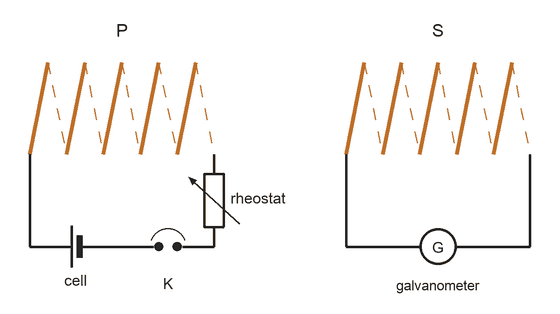
No. Action Galvanometer needle 1 Key K is pressed, so the current in P rises from zero to a steady value Deflects to the right, then returns to zero 2 Key K is kept pressed and the current in P is steady No deflection 3 Key K is released Deflects to the left, then returns to zero 4 The rheostat slider is moved so that the current in P increases ? 5 The rheostat slider is moved so that the current in P decreases ? 6 The current in P is steady and coil S is moved away from P ? (a) Explain the observations in actions 1 and 2.
(b) Complete the observations for actions 4, 5 and 6, with a reason for each.
(c) Name the phenomenon shown in this experiment and name one device that works on the same principle.
- 395 marks
Question 39
Competency: Evaluation
Case study: A school science club builds a small model wind turbine. Its blades are fixed directly to the coil of a simple a.c. generator, and the coil turns between the poles of a strong magnet, so each turn of the blades rotates the coil once. A student places the turbine in front of a fan at three settings, measures the steady speed of the blades and reads the greatest e.m.f., the peak value, on a voltmeter joined across the coil. She wants to find out how the output of the generator depends on the speed of the blades. (Hypothetical data.)
Speed of the blades (rotations per minute) 120 240 360 Peak e.m.f. (V) 2.0 4.0 6.0 (a) Find the frequency of the a.c. at each speed. Use the table to show how the peak e.m.f. depends on the speed.
(b) Predict the frequency and the peak e.m.f. when the blades turn at 300 rotations per minute.
(c) The student says, "If a strong wind turns the blades at 3000 rotations per minute, the turbine will give the same supply as our 220 V, 50 Hz mains." Evaluate the claim using the table, and state two changes in the generator that would increase its peak e.m.f. at a given speed.
- 404 marks
Question 40
Competency: Analysis
Case study: A sealed box is fixed flat on a table. A long straight wire inside it passes at right angles to the table, and a large steady current flows in the wire. The current is so large that its magnetic field at the compasses is much stronger than the earth's field there. Four identical small compasses A, B, C and D lie on the table at the same distance from the box. The figure is a view from above, and it shows the direction in which the north pole of each needle points. The shaded end of each needle is its north pole.
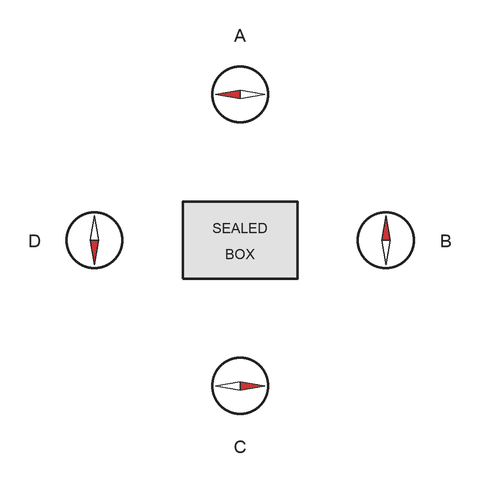
(a) State whether the current in the wire flows towards the reader or away from the reader. Name the rule you use.
(b) A fifth compass E is placed on the table at the same distance from the box, midway between A and B. In which direction does its north pole point?
(c) The current is now reversed, and compass A is moved to twice its distance from the box. State the new direction of the north pole of A and how the strength of the field at A compares with its strength before. (Take the field of the wire to be still much stronger than the earth's field at A.)