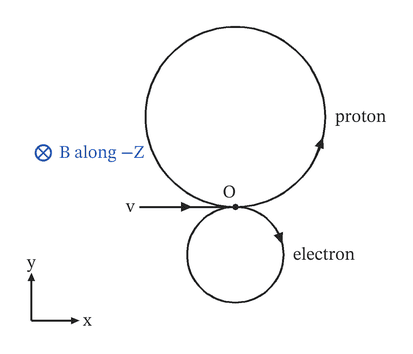
An electron and a proton are moving along the +X axis.
Question 253 marksAsked 2025Medium
An electron and a proton are moving along the +Xaxis. If an external magnetic field B=0.314T is applied along −Zaxis:
(a) What is the path followed by the electron due to the magnetic field?
(b) Calculate the frequency of revolution of the proton.
Solution:
Key idea: The magnetic force F=q(v×B) is always perpendicular to the velocity. When v is perpendicular to B, the charge moves in a circle with qvB=rmv2.
Step 1 — Find the direction of the force on the electron (part (a)).
The velocity is along +X and the field along −Z, so they are perpendicular. For a positive charge, v×B points along +Y. The electron is negative, so the force on it is along −Y.
Step 2 — Describe the path of the electron.
A force of constant size that stays perpendicular to the velocity makes the electron move with uniform speed in a circle in the X-Y plane. It starts bending towards −Y, so seen from the +Z side (field pointing away from the viewer) it goes round clockwise. The proton bends the other way, towards +Y, and goes round anticlockwise. Since the radius is r=qBmv (Step 3), the proton's circle is larger if the two particles have the same speed, about 1836 times larger (the ratio of their masses); the figure is not to scale.
Step 3 — Derive the frequency of revolution (part (b)).
The magnetic force provides the centripetal force, which gives the radius of the circle.
qvB=rmv2
r=qBmv
One revolution covers 2πr at speed v, so the time for one revolution is T=v2πr.
T=qB2πm
f=2πmqB
The frequency does not depend on the speed of the proton.
Step 4 — Put in the values for the proton.
We use q=1.6×10⁻¹⁹C, m=1.67×10⁻²⁷kg and B=0.314T, taking π=3.14.
f=2×3.14×1.67×10−271.6×10−19×0.314
f=1.67×10−278×10−21
f≈4.79×10⁶Hz
Therefore, (a) the electron moves in a circle in the X-Y plane, turning towards −Y (clockwise seen from +Z), and (b) the proton revolves with frequency about 4.79×10⁶Hz.