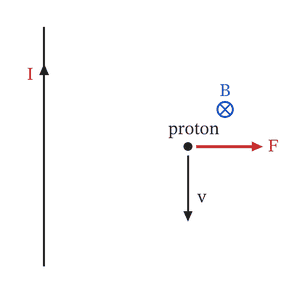
A long straight wire AB carries a current of 5 A .
Question 172 marksAsked 2023Medium
A long straight wire AB carries a current of 5A. P is a proton travelling with a velocity of 2×10⁶m/s, parallel to the wire, 0.2m from it and in a direction opposite to the current, as shown in Figure 2 below. Calculate the force which magnetic field of the current carrying conductor AB exerts on the proton.
Solution:
Key idea: The wire produces a field B=2πrμ0I at distance r.
A charge moving through it feels the force F=q(v×B), of size qvBsinθ.
Step 1 — Find the field at the proton.
The proton is 0.2m from the wire, which carries 5A. We use 2πμ0=2×10⁻⁷T m A−1.
B=0.22×10−7×5
B=5×10⁻⁶T
By the right-hand grip rule this field is into the page at P (to the right of an upward current).
Step 2 — Find the size of the force.
The proton moves in the plane of the page and the field is perpendicular to the page, so θ=90∘.
F=evB
F=1.6×10−19×2×106×5×10−6
F=1.6×10⁻¹⁸N
Step 3 — Find the direction of the force.
The proton is positive and moves down the page in a field into the page, so v×B points away from the wire.
As a check, the moving proton is like a current opposite to the wire's current, and opposite currents repel.
Therefore, the force on the proton is 1.6×10⁻¹⁸N, directed away from the wire AB.