Solution:
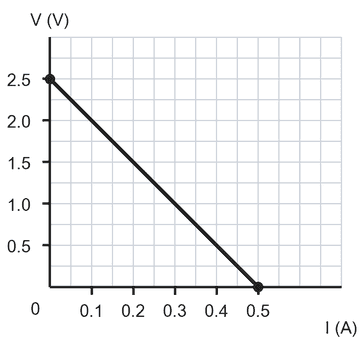
Key idea: An ammeter is joined in series, so the whole current passes through it. A voltmeter is joined in parallel across the part whose p.d. it measures. For a cell, V=E−Ir: a graph of terminal voltage V against current I is a straight line with intercept E on the V-axis and slope −r.
Step 1 — Identify the instruments (part (a)).
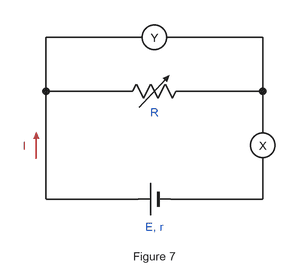
X is in series in the main circuit, so it carries the current I: X is an ammeter. Y is joined across the variable resistor R, in parallel with it, so it measures the p.d. V: Y is a voltmeter.
Step 2 — Read the emf from the graph (part (b)(1)).
When I=0, no current flows in the cell, so there are no lost volts and V=E. The line meets the V-axis at 2.5 V.
E=2.5 V
Step 3 — Find the internal resistance (part (b)(2)).
The line meets the I-axis at 0.5 A, where the terminal voltage is zero. We put this point into V=E−Ir.
0=2.5−0.5r
0.5r=2.5
r=5 Ω
(This is the size of the slope of the line: 0.5 A2.5 V=5 Ω.)
Therefore, (a) X is an ammeter and Y is a voltmeter; (b) the emf is E=2.5 V and the internal resistance is r=5 Ω.