Solution:
Key idea: The current in the potentiometer wire is the driver emf divided by the total resistance of the driver circuit. The potential gradient is the p.d. across the wire divided by its length. At the null point, the emf of the secondary cell equals the p.d. across the balanced length, and no current flows through it (so its internal resistance does not matter).
Step 1 — Find the current in AB (part (a)).
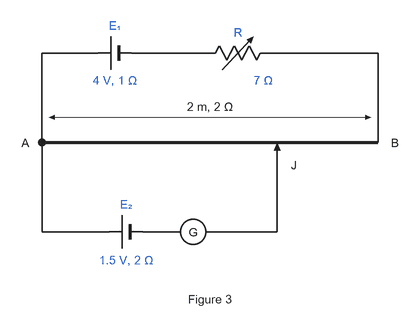
With the jockey off the wire, the driver circuit is E1 (4 V, 1 Ω) in series with R=7 Ω and the wire of 8 Ω (the value given in the text).
I=1+7+84
I=0.25 A
Step 2 — Find the potential gradient (part (b)).
The p.d. across the 8 Ω wire is spread over its 2 m length.
VAB=0.25×8
VAB=2 V
k=22
k=1 V m−1
Step 3 — Find the balancing length AC (part (c)).
At balance, no current flows through E2, so its emf 1.5 V equals the p.d. across AC.
AC=kE2
AC=11.5
AC=1.5 m
Note: The figure labels the wire "2m, 2Ω", while the text gives 8 Ω. We use the text value. With 2 Ω the current would be 0.4 A, the gradient 0.4 V m−1 and the balancing length 3.75 m, longer than the 2 m wire, so no null point could be found.
Therefore, (a) the current in AB is 0.25 A, (b) the potential gradient is 1 V m−1 and (c) AC=1.5 m (150 cm).