Solution:
Key idea: Kirchhoff's junction law: the currents entering a junction add up to the currents leaving it. Kirchhoff's loop law: round a closed loop, the sum of the emfs equals the sum of the IR drops (internal resistances included).
Step 1 — Mark the currents.
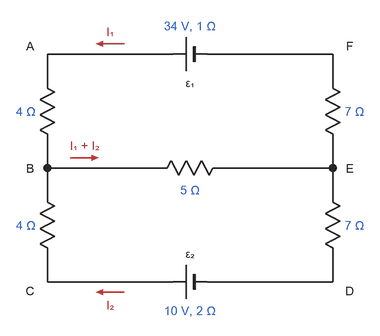
The current I1 flows from F to A through ε1, then down AB. I2 flows from D to C through ε2, then up CB. At B they join, and I1+I2 flows through the 5 Ω resistor from B to E. At E the current splits: I1 goes up through EF and I2 down through ED. Both batteries have their long plate (+) on the left, so they drive current towards A and C, as marked.
Step 2 — Apply the loop law to loop ABEFA.
In this loop the emf is 34 V. The current I1 passes 4 Ω (AB), 7 Ω (EF) and the internal resistance 1 Ω, while I1+I2 passes 5 Ω.
34=(4+7+1)I1+5(I1+I2)
17I1+5I2=34...(1)
Step 3 — Apply the loop law to loop CBEDC.
In this loop the emf is 10 V. The current I2 passes 4 Ω (CB), 7 Ω (ED) and the internal resistance 2 Ω, while I1+I2 passes 5 Ω.
10=(4+7+2)I2+5(I1+I2)
5I1+18I2=10...(2)
Step 4 — Solve the two equations.
We multiply equation (1) by 18 and equation (2) by 5, so that the I2 terms match.
306I1+90I2=612...(3)
25I1+90I2=50...(4)
Subtracting equation (4) from equation (3) removes I2.
281I1=562
I1=2 A
Now we put I1=2 into equation (2).
5×2+18I2=10
18I2=0
I2=0
Step 5 — Explain the result.
With I2=0, the potential difference across BE is 5×2=10 V. Loop CBEDC has the 10 V battery against exactly this 10 V across BE (the 4 Ω and 7 Ω in that loop carry no current), so no current flows through ε2.
Therefore, I1=2 A and I2=0.