
Question 74 marksAsked 2016Medium
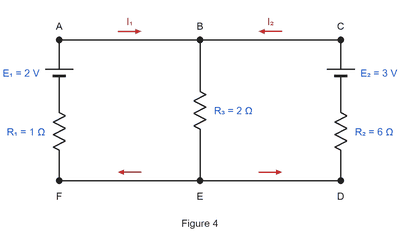
In the circuit shown in Figure 4 below, and are two cells having emfs and respectively, and negligible internal resistances. Applying Kirchoff's laws of electrical networks, find the values of currents and .
Confirming your payment
Sign up now and get 250 free tokens.
Previous Year Questions · Question 7 of 36
In the circuit shown in Figure 4 below, and are two cells having emfs and respectively, and negligible internal resistances. Applying Kirchoff's laws of electrical networks, find the values of currents and .
Solution:
Key idea: Kirchhoff's first law (junction law): the total current entering a junction equals the total current leaving it. Kirchhoff's second law (loop law): round any closed loop, the sum of the emfs equals the sum of the potential drops .
Step 1 — Mark the currents.
The figure shows flowing from A to B and from C to B. By the junction law at B, the current down the middle branch BE through is . At E it splits again: returns through F and through D. In both side branches the long plate (+) of the cell faces the top, so both cells drive current upwards, which matches the arrows.
Step 2 — Apply the loop law to loop ABEFA.
Going round ABEFA, the emf is , and the drops are across and across .
Step 3 — Apply the loop law to loop CBEDC.
Going round CBEDC, the emf is , and the drops are across and across .
Step 4 — Solve the two equations.
We multiply equation (1) by 4 so that the terms match.
Subtracting equation (2) from equation (3) removes .
Now we put into equation (2).
Step 5 — Check the answer.
We put both currents back into loop ABEFA. The middle branch carries , so the drops add up to
This equals the emf . Both currents are positive, so they flow in the directions marked.
Therefore, and .