Solution:
Key idea: The two halves of a p-n junction diode differ in their majority charge carriers. Two diodes and a centre-tapped transformer give full-wave rectification. A Zener diode keeps a steady voltage in reverse breakdown.
Part (i) — P-type and N-type
Step 1 — State the difference.
A P-type semiconductor is made by doping silicon or germanium with a trivalent impurity (such as boron); its majority carriers are holes. An N-type semiconductor is made by doping with a pentavalent impurity (such as phosphorus or arsenic); its majority carriers are free electrons.
Part (ii) — full-wave rectifier
Step 2 — Draw the circuit.
The full-wave rectifier uses a transformer whose secondary coil has a centre tap C, two diodes D1 and D2 and a load resistance RL. The ends A and B of the secondary are joined to the anodes of D1 and D2; the cathodes are joined together and connected through RL to the centre tap.
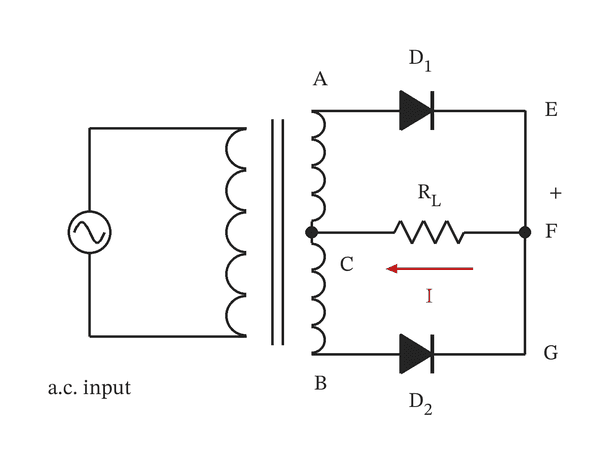
Step 3 — Explain the working.
During the half cycle when A is positive with respect to C, D1 is forward biased and conducts, while D2 is reverse biased. Current flows through RL from F to C. During the next half cycle B is positive, so D2 conducts and D1 does not. Current again flows through RL from F to C, in the same direction. So both halves of every cycle give current through the load in one direction.
Step 4 — Show the output against time.
For a sinusoidal input, the output across RL is a series of positive half-sine pulses, one for every half cycle, with no gaps between them. It is a pulsating (unsmoothed) d.c. voltage that repeats every half period, so its frequency is twice the input frequency.

Part (iii) — voltage regulator
Step 5 — Name the diode.
A Zener diode, connected in reverse bias across the load with a series resistor, is used as a voltage regulator, because in breakdown the voltage across it stays almost constant.
Therefore, (i) P-type has holes and N-type has free electrons as majority carriers; (ii) the full-wave rectifier gives positive half-sine pulses for both half cycles of the input; (iii) a Zener diode is used as a voltage regulator.
