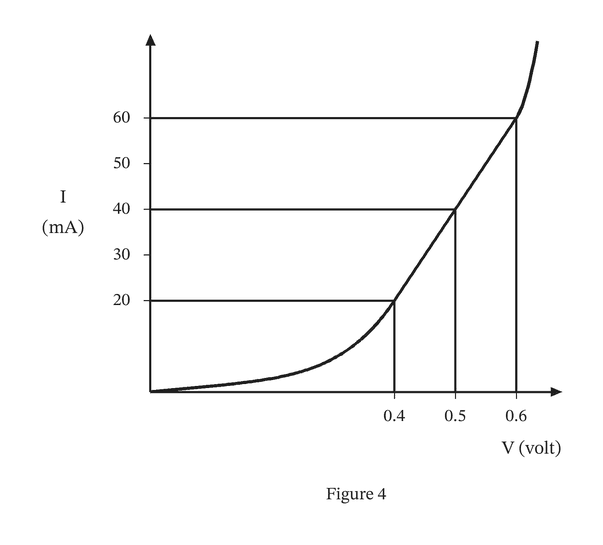
Solution:
Key idea: The resistance of a diode at a point on its characteristic is R=IV (static, or d.c., resistance). The dynamic (a.c.) resistance is the inverse slope, r=ΔIΔV. In the band picture, the gap between the valence band and the conduction band decides whether a solid is a conductor, a semiconductor or an insulator.
Part (i) — resistance of the diode
Step 1 — Read the graph at V = 0.5 V.
The guide lines on the graph show that a voltage of 0.5 V gives a current of 40 mA. In amperes this current is 0.040 A.
Step 2 — Calculate the resistance at V = 0.5 V.
We divide the voltage by the current at this point.
R1=IV
R1=0.0400.5 Ω
R1=12.5 Ω
Step 3 — Read the graph at I = 60 mA.
The graph shows that the current is 60 mA, or 0.060 A, at V=0.6 V.
Step 4 — Calculate the resistance at I = 60 mA.
Again we divide the voltage by the current.
R2=0.0600.6 Ω
R2=10 Ω
The resistance is smaller at the larger current, because the diode current rises faster than the voltage in forward bias.
Step 5 — Find the dynamic resistance as well.
Between 0.4 V and 0.6 V the graph is a straight line, so its slope is the same at both points. The dynamic resistance there is the change in voltage divided by the change in current.
r=ΔIΔV
r=0.060−0.0200.6−0.4 Ω
r=5 Ω
Note: The question does not say which resistance it means. The values above, 12.5 Ω and 10 Ω, are the static (d.c.) resistances at the two points; if the dynamic (a.c.) resistance is meant, it is 5 Ω at both points, since both lie on the straight part of the curve.
Part (ii) — energy band diagrams
Step 6 — Draw the three band diagrams.
In each diagram the lower band is the valence band (VB), filled with electrons, and the upper band is the conduction band (CB). In a conductor the two bands overlap, so there is no forbidden gap. In an insulator the forbidden gap Eg is large (more than about 3 eV). In a semiconductor the gap is small (about 1 eV; 1.1 eV for silicon).
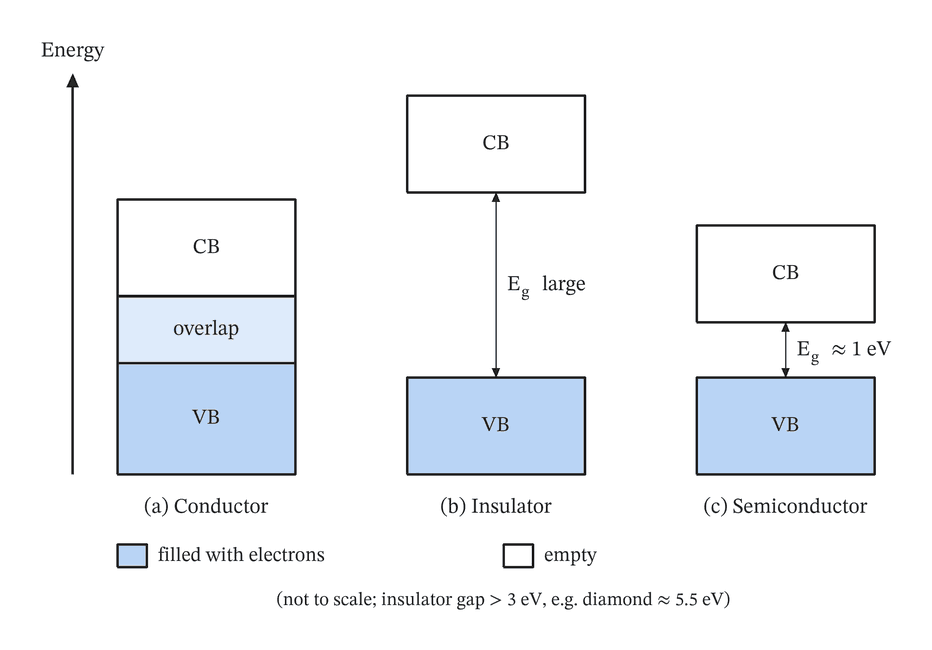
Therefore, (i) the resistance of the diode is 12.5 Ω at V = 0.5 V and 10 Ω at I = 60 mA (dynamic resistance 5 Ω on the straight part); (ii) the bands overlap in a conductor, are separated by a large gap in an insulator and by a small gap in a semiconductor.