
Opening your dashboard
Class 12 Physics Chapter 13 Electromagnetic Waves: Previous Year Questions
10 questions on Chapter 13, each solved step by step. Class 12 Physics, ICSE 2026-27.
10 questions with solutions
1–3 marks · Easy difficulty
- 11 mark
Question 1
How are electric vector (), magnetic vector () and velocity vector () oriented in an electromagnetic wave?
Solve with AIWritten solution
Solution:
Key idea: An electromagnetic wave is a transverse wave made of an oscillating electric field and an oscillating magnetic field that travel together.
Step 1 — Relate the two field vectors.
The electric vector and the magnetic vector oscillate at right angles to each other, and in phase.
Step 2 — Relate the fields to the direction of travel.
Both fields are perpendicular to the direction in which the wave travels, so the wave is transverse. The velocity points along .
Therefore, , and are mutually perpendicular, with in the direction of .
- 21 mark
Question 2
To which regions of the electromagnetic spectrum do the following wavelengths belong:
(a)
(b)
Solve with AIWritten solution
Solution:
Key idea: Visible light covers roughly (violet) to (red). Shorter wavelengths, down to about , are ultraviolet; longer wavelengths, up to about , are infrared.
Step 1 — Place 250 nm.
The wavelength is shorter than violet light () but longer than about , so it lies in the ultraviolet region.
Step 2 — Place 1500 nm.
The wavelength () is longer than red light () but far shorter than , so it lies in the infrared region. (Optical fibres for communication use infrared close to this wavelength.)
Therefore, (a) 250 nm is ultraviolet and (b) 1500 nm is infrared.
- 33 marks
Question 3
(i) State any one property which is common to all electromagnetic waves.
(ii) Arrange the following electromagnetic waves in increasing order of their frequencies (i.e., begin with the lowest frequency) :
Visible light, -rays, X-rays, microwaves, radio waves, infrared radiations and ultraviolet radiations.
Solve with AIWritten solution
Solution:
Key idea: All electromagnetic waves are the same kind of wave (oscillating electric and magnetic fields); they differ only in frequency and wavelength. Since is the same for all of them in vacuum, a higher frequency means a shorter wavelength.
Step 1 — Part (i): state a common property.
Every electromagnetic wave travels through vacuum with the same speed, . (Other common properties: they are all transverse, and none of them needs a material medium to travel.)
Step 2 — Part (ii): sort the waves by wavelength.
Going from the longest wavelength to the shortest, the waves are radio waves (metres to kilometres), microwaves (millimetres to about ), infrared, visible light, ultraviolet, X-rays and -rays (shorter than about ).
Step 3 — Part (ii): turn this into increasing frequency.
Frequency is , so the longest wavelength has the lowest frequency. The order from Step 2 is therefore already the order of increasing frequency.
Therefore, (i) all electromagnetic waves travel at 3 × 10⁸ m s⁻¹ in vacuum; (ii) in increasing order of frequency: radio waves, microwaves, infrared radiations, visible light, ultraviolet radiations, X-rays, γ-rays.
- 42 marks
Question 4
(i) What is the ratio of the speed of gamma rays to that of radio waves in vacuum?
(ii) Name an electromagnetic wave which is used in the radar system used in aircraft navigation.
Solve with AIWritten solution
Solution:
Key idea: Gamma rays and radio waves are both electromagnetic waves. In vacuum every electromagnetic wave travels at the same speed , whatever its frequency.
Step 1 — Part (i): find the ratio of speeds.
Both waves travel at in vacuum, so the ratio of their speeds is
Step 2 — Part (ii): name the wave used in radar.
Aircraft radar sends out short pulses of microwaves and times the echoes. Microwaves travel in straight lines, can be sent as narrow beams and are reflected well by the metal body of an aircraft.
Therefore, (i) the ratio of the speeds is 1 : 1; (ii) radar uses microwaves.
- 52 marks
Question 5
State any two properties of microwaves.
Solve with AIWritten solution
Solution:
Key idea: Microwaves are electromagnetic waves with wavelengths from about to about (frequencies of roughly to ), between infrared and radio waves.
Step 1 — State the first property.
Microwaves travel in straight lines and can be sent as narrow, well-directed beams, so they are used for radar and for point-to-point and satellite communication.
Step 2 — State the second property.
Microwaves are reflected strongly by metal surfaces (which is why radar works), and they are absorbed by water molecules, which heats the water; this is how a microwave oven cooks food.
Any two of these properties answer the question; others are that they travel at in vacuum and pass easily through the atmosphere and the ionosphere.
Therefore, two properties of microwaves are: they travel in straight lines as narrow beams, and they are reflected by metals (and absorbed by water, which heats it).
- 62 marks
Question 6
(i) State any one use of infrared radiations.
(ii) State any one source of ultraviolet radiations.
Solve with AIWritten solution
Solution:
Key idea: Infrared radiation is given out by warm bodies and has a heating effect. Ultraviolet radiation comes from very hot bodies and from electric discharges in gases such as mercury vapour.
Step 1 — Part (i): give a use of infrared.
Infrared is used in the remote controls of TV sets and air conditioners, which send their signals as pulses of infrared. (Other uses: night-vision cameras, and heat lamps in physiotherapy.)
Step 2 — Part (ii): give a source of ultraviolet.
The Sun is the main natural source of ultraviolet radiation. (Man-made sources: mercury-vapour lamps and the arcs used in electric welding.)
Therefore, (i) infrared is used in TV remote controls; (ii) the Sun is a source of ultraviolet radiation.
- 72 marks
Question 7
(i) State how vectors , and are oriented in an electromagnetic wave
(ii) Name the electromagnetic wave / radiation which is used to study crystal structure.
Solve with AIWritten solution
Solution:
Key idea: In an electromagnetic wave the electric and magnetic fields oscillate at right angles to each other and to the direction of travel. X-rays have wavelengths comparable to the spacing of atoms in a crystal (about ).
Step 1 — Part (i): describe the orientation.
The electric vector , the magnetic vector and the velocity vector (printed as a capital C; it is the velocity ) are mutually perpendicular. The wave travels along .
Step 2 — Part (ii): name the radiation for crystal structure.
To study crystal structure we need a wave whose wavelength is close to the distance between neighbouring atoms, so that the regular rows of atoms diffract it. X-rays have wavelengths of this size, so X-ray diffraction is used.
Therefore, (i) , and are mutually perpendicular, with the wave travelling along ; (ii) X-rays are used to study crystal structure.
- 82 marks
Question 8
(a) Name the electromagnetic radiation whose frequency is .
(b) What is the speed of radio waves in vacuum?
Solve with AIWritten solution
Solution:
Key idea: The region of the spectrum follows from the wavelength . Radio waves have wavelengths longer than about , and microwaves about to . All electromagnetic waves travel at in vacuum.
Step 1 — Part (a): find the wavelength for the printed frequency.
The paper prints the frequency as . The wavelength is
This enormous wavelength lies far beyond the long-wave end of the radio region, so a wave is an (extremely low frequency) radio wave.
Step 2 — Part (a): check the likely intended frequency.
A power of ten seems to have been lost in printing; the question most likely means . That wavelength is
A wavelength of is a microwave.
Step 3 — Part (b): state the speed of radio waves.
Radio waves are electromagnetic waves, so in vacuum they travel at the speed of light.
Therefore, (a) a wave of 10 Hz, as printed, is a radio wave (if 10¹⁰ Hz is meant, it is a microwave); (b) radio waves travel at 3 × 10⁸ m s⁻¹ in vacuum.
- 92 marks
Question 9
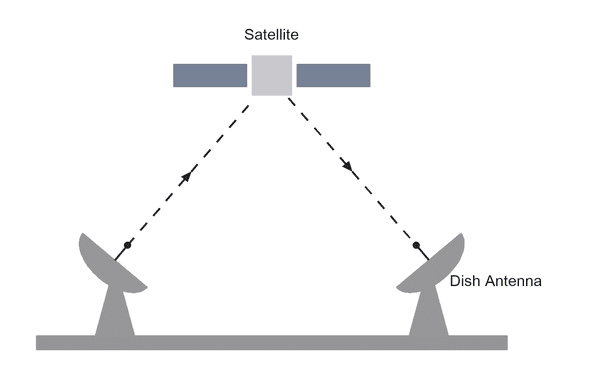
(i) Name the electromagnetic wave travelling from the satellite to the dish antenna shown in the image above.
(ii) If the wavelength of an electromagnetic wave is , what is its frequency?
Solve with AIWritten solution
Solution:
Key idea: Satellite links use microwaves, because microwaves travel in straight lines as narrow beams and pass through the atmosphere and the ionosphere. For any electromagnetic wave , with .
Step 1 — Part (i): name the wave.
The picture shows a signal going from the satellite to the dish antenna on the ground. Satellite communication uses microwaves: they can be beamed to a dish, and they pass through the ionosphere instead of being reflected back by it as lower-frequency radio waves are.
Step 2 — Part (ii): write the relation for frequency.
We rearrange for the frequency , where the wavelength is , or .
Step 3 — Part (ii): substitute the values.
We put in the speed of light and the wavelength.
Therefore, (i) the wave from the satellite to the dish antenna is a microwave; (ii) the frequency is 5 × 10¹⁶ Hz.
- 102 marks
Question 10
(i) Name the electromagnetic wave that scans the contents of the luggage of a traveller during a security check.
(ii) Which physical quantity is the same for UV rays, red light and radio waves when they are travelling in vacuum?
Solve with AIWritten solution
Solution:
Key idea: X-rays pass through soft materials such as cloth, plastic and leather but are stopped more by metals and dense objects, so they show what is inside a bag. All electromagnetic waves travel at the same speed in vacuum.
Step 1 — Part (i): name the wave used in luggage scanners.
Airport baggage scanners send X-rays through the luggage. Dense or metal objects absorb more X-rays than clothes do, so they show up clearly in the image.
Step 2 — Part (ii): find the common quantity.
UV rays, red light and radio waves have very different frequencies and wavelengths, but they are all electromagnetic waves. In vacuum every electromagnetic wave travels at the same speed.
Therefore, (i) X-rays scan the luggage; (ii) the speed (3 × 10⁸ m s⁻¹) is the same for UV rays, red light and radio waves in vacuum.