(i) When an alternating emf e = 310 (100π t V is applied to a series LCR circuit, current flowing through it is i = 5…
Question 145 marksAsked 2020Medium
(i) When an alternating emf e=310sin(100πt V is applied to a series LCR circuit, current flowing through it is i=5sin(100πt+π/3) A.
(1) What is the phase difference between the current and the emf?
(2) Calculate the average power consumed by the circuit.
(ii) Obtain an expression for the resonant frequency (f0) of a series LCR circuit.
Solution:
Key idea: If e=E0sinωt and i=I0sin(ωt+ϕ), the current leads the emf by ϕ, and the average power is P=2E0I0cosϕ.
The resonant frequency f0=2πLC1 is the frequency at which the two reactances are equal.
Step 1 — Part (i)(1): read the phase difference.
The paper leaves out the closing bracket after 100πt; the emf is e=310sin(100πt)V.
The current i=5sin(100πt+π/3) has the extra angle π/3 inside the sine, so it is ahead of the emf.
ϕ=3πrad
ϕ=60∘
The current leads the emf by 60∘.
Step 2 — Part (i)(2): find the average power.
The peak values are E0=310V and I0=5A. The r.m.s. values are the peaks divided by 2, so their product is half the product of the peaks.
P=2E0I0cosϕ
P=2310×5×cos60∘
P=775×0.5
P=387.5W
Step 3 — Part (ii): draw the phasor diagram.
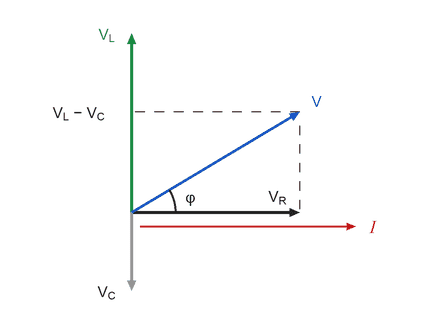
Let the same current i=I0sinωt flow through the resistor R, the inductor L and the capacitor C joined in series, where ω is the angular frequency of the supply. We draw all the voltages as phasors (rotating arrows) measured from the current phasor I.
The voltage across the resistor, VR=IR, is in phase with the current.
The voltage across the inductor, VL=IXL, leads the current by 90∘, where XL=ωL is the inductive reactance.
The voltage across the capacitor, VC=IXC, lags behind the current by 90∘, where XC=ωC1 is the capacitive reactance.
Step 4 — Part (ii): find the impedance.
The phasors VL and VC point in opposite directions, so their net value is VL−VC, at right angles to VR. The supply voltage is the resultant.
V=VR2+(VL−VC)2
V=IR2+(XL−XC)2
Dividing by I gives the impedance Z.
Z=R2+(XL−XC)2
Step 5 — Part (ii): apply the resonance condition.
The impedance is least, and the current greatest, when XL=XC. This happens at one angular frequency ω0.
ω0L=ω0C1
ω02=LC1
ω0=LC1
Dividing by 2π gives the resonant frequency.
f0=2πLC1
Therefore, (i) the current leads the emf by π/3 (60°) and the average power is 387.5 W; (ii) the resonant frequency is f0=2πLC1.