An alternating emf of 220 V is applied to a circuit containig a resistor R having resistance of 160 and a capacitor…
Question 85 marksAsked 2018Medium
An alternating emf of 220 V is applied to a circuit containig a resistor R having resistance of 160Ω and a capacitor 'C' is series. The current is found to lead the supply voltage by an angle θ=tan−1(3/4).
(i) Calculate:
(1) The capacitive reactance
(2) Impedance of the circuit
(3) Current flowing in the circuit
(ii) If the frequency of the applied emf is 50 Hz, what is the value of the capacitance of the capacitor 'C'?
Solution:
Key idea: In a series RC circuit the current leads the supply voltage by an angle θ with tanθ=RXC, where XC=2πfC1 is the capacitive reactance.
The impedance is Z=R2+XC2.
Step 1 — Part (i)(1): find the capacitive reactance.
The phase angle is θ=tan−1(43), so tanθ=43.
We rearrange tanθ=RXC for XC, with a resistance of 160Ω.
XC=Rtanθ
XC=160×43
XC=120Ω
Step 2 — Part (i)(2): find the impedance.
The resistance R and the reactance XC combine at right angles, so we use Pythagoras.
Z=R2+XC2
Z=1602+1202
Z=40000
Z=200Ω
Step 3 — Part (i)(3): find the current.
The applied emf 220V is an r.m.s. value, so the r.m.s. current is the emf divided by the impedance.
I=ZV
I=200220
I=1.1A
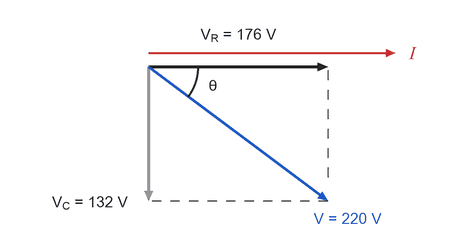
The phasor diagram below shows the result. The resistor voltage VR is 1.1×160, or 176V, along the current. The capacitor voltage VC is 1.1×120, or 132V, lagging the current by 90∘. Their resultant is the supply voltage, 220V, which the current leads by θ.
Step 4 — Part (ii): find the capacitance.
The reactance is XC=2πfC1, so we rearrange it for C and use f=50Hz.
C=2πfXC1
C=2π×50×1201
C≈2.65×10⁻⁵F
C≈26.5μF
Therefore, (i) the capacitive reactance is 120 Ω, the impedance is 200 Ω and the current is 1.1 A; (ii) the capacitance is about 26.5 μF.