Solution:
Key idea: Yes. This reverse effect is electromagnetic induction (Faraday's laws): whenever the magnetic flux linked with a closed circuit changes, an emf is induced in it and a current flows. A steady field alone does not produce a current; the flux must change.
Step 1 — Answer the question.
A magnetic field can produce an electric current, provided the magnetic flux linked with the circuit keeps changing. The induced emf equals the rate of change of flux linkage, e=−dtdϕ.
Step 2 — Describe an example.
Connect a coil to a galvanometer and push the N pole of a bar magnet towards the coil, as in the figure.
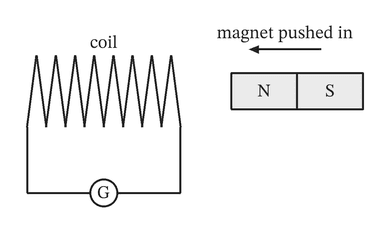
As the magnet comes closer, the flux through the coil increases, and the galvanometer deflects, showing a current. When the magnet is held still, the flux stops changing and the deflection falls to zero. When the magnet is pulled away, the galvanometer deflects the other way. Moving the magnet faster gives a larger deflection, because the flux changes faster.
Step 3 — Explain the direction.
By Lenz's law the induced current opposes the change that causes it: while the N pole approaches, the near face of the coil becomes a N pole and repels the magnet.
Therefore, yes, a magnetic field can produce an electric current when the flux linked with a circuit changes, as when a magnet is moved towards or away from a coil joined to a galvanometer (electromagnetic induction).
