
Confirming your payment

Skip to content

Sign up now and get .

Opening your dashboard

Class 12 Maths Chapter 3 Inverse Trigonometric Functions: Previous Year Questions

28 questions on Chapter 3, each solved step by step. Class 12 Maths, ICSE 2026-27.

28 questions with solutions

1–5 marks · Mixed difficulty

The first 13 solutions are on this page. This chapter is a long one, so the rest open on their own page to keep this one quick to load.

  1. 1

    Question 1

    Solve: cos⁡−1(sin⁡cos⁡−1x)=π6\cos^{-1}(\sin \cos^{-1}x) = \dfrac{\pi}{6}

    MediumAsked 2015
    3 marks
    Solve with AI
    Written solution

    Solution:

    Key idea: For −1≤x≤1-1 \le x \le 1, the angle cos⁡−1x\cos^{-1}x lies in [0,π][0, \pi], where sine is never negative. So sin⁡(cos⁡−1x)=1−x2\sin(\cos^{-1}x) = \sqrt{1 - x^2}.

    Step 1 — Simplify the inner expression.

    Let θ=cos⁡−1x\theta = \cos^{-1}x, so that cos⁡θ=x\cos\theta = x and 0≤θ≤π0 \le \theta \le \pi. On this interval sin⁡θ≥0\sin\theta \ge 0, so we take the positive square root.

    sin⁡θ=1−cos⁡2θ\sin\theta = \sqrt{1 - \cos^2\theta}

    sin⁡θ=1−x2\sin\theta = \sqrt{1 - x^2}

    Step 2 — Rewrite the equation.

    With this, the given equation becomes an equation in 1−x2\sqrt{1 - x^2}.

    cos⁡−1(1−x2)=π6\cos^{-1}\left(\sqrt{1 - x^2}\right) = \dfrac{\pi}{6}

    Step 3 — Remove the inverse cosine.

    We take the cosine of both sides; this is allowed because π6\dfrac{\pi}{6} lies in [0,π][0, \pi].

    1−x2=cos⁡π6\sqrt{1 - x^2} = \cos\dfrac{\pi}{6}

    1−x2=32\sqrt{1 - x^2} = \dfrac{\sqrt{3}}{2}

    Step 4 — Solve for xx.

    We square both sides and rearrange.

    1−x2=341 - x^2 = \dfrac{3}{4}

    x2=14x^2 = \dfrac{1}{4}

    x=±12x = \pm\dfrac{1}{2}

    Step 5 — Check both values.

    For x=12x = \dfrac{1}{2} the angle cos⁡−1x\cos^{-1}x is π3\dfrac{\pi}{3}, whose sine is 32\dfrac{\sqrt{3}}{2}. For x=−12x = -\dfrac{1}{2} the angle is 2π3\dfrac{2\pi}{3}, whose sine is also 32\dfrac{\sqrt{3}}{2}. In both cases cos⁡−132\cos^{-1}\dfrac{\sqrt{3}}{2} gives π6\dfrac{\pi}{6}, so both values work.

    Therefore, x=12x = \dfrac{1}{2} or x=−12x = -\dfrac{1}{2}.

  2. 2

    Question 2

    Solve the equation for xx: sin⁡−15x+sin⁡−112x=π2\sin^{-1}\dfrac{5}{x} + \sin^{-1}\dfrac{12}{x} = \dfrac{\pi}{2}, x≠0x \ne 0

    MediumAsked 2015
    5 marks
    Solve with AI
    Written solution

    Solution:

    Key idea: For −1≤y≤1-1 \le y \le 1, sin⁡−1y+cos⁡−1y=π2\sin^{-1}y + \cos^{-1}y = \dfrac{\pi}{2}.

    Also sin⁡(cos⁡−1y)=1−y2\sin(\cos^{-1}y) = \sqrt{1 - y^2}, because cos⁡−1y\cos^{-1}y lies in [0,π][0, \pi], where sine is not negative.

    Step 1 — Note when the terms are defined.

    Both 5x\dfrac{5}{x} and 12x\dfrac{12}{x} must lie between −1-1 and 11, so ∣x∣≥12|x| \ge 12.

    Step 2 — Turn the sum into a single inverse cosine.

    We move sin⁡−15x\sin^{-1}\dfrac{5}{x} to the right and use the identity from the key idea.

    sin⁡−112x=π2−sin⁡−15x\sin^{-1}\dfrac{12}{x} = \dfrac{\pi}{2} - \sin^{-1}\dfrac{5}{x}

    sin⁡−112x=cos⁡−15x\sin^{-1}\dfrac{12}{x} = \cos^{-1}\dfrac{5}{x}

    Step 3 — Take the sine of both sides.

    The left side gives 12x\dfrac{12}{x}, and the right side gives the positive root from the key idea.

    12x=1−25x2\dfrac{12}{x} = \sqrt{1 - \dfrac{25}{x^2}}

    The right side is not negative, so 12x≥0\dfrac{12}{x} \ge 0, which means x>0x > 0.

    Step 4 — Square and solve.

    Squaring both sides removes the root.

    144x2=1−25x2\dfrac{144}{x^2} = 1 - \dfrac{25}{x^2}

    169x2=1\dfrac{169}{x^2} = 1

    x2=169x^2 = 169

    x=±13x = \pm 13

    Step 5 — Keep the value that fits.

    Step 3 needs x>0x > 0, so we reject −13-13; for that value both angles are negative and their sum is −π2-\dfrac{\pi}{2}.

    For x=13x = 13, the numbers 513\dfrac{5}{13} and 1213\dfrac{12}{13} satisfy (513)2+(1213)2=1\left(\dfrac{5}{13}\right)^2 + \left(\dfrac{12}{13}\right)^2 = 1.

    So the angle whose sine is 1213\dfrac{12}{13} has cosine 513\dfrac{5}{13}, and the two angles add up to π2\dfrac{\pi}{2}.

    Therefore, x=13x = 13.

  3. 3

    Question 3

    Solve for xx, if:

    tan⁡(cos⁡−1x)=25\tan(\cos^{-1}x) = \dfrac{2}{\sqrt{5}}
    MediumAsked 2016
    3 marks
    Solve with AI
    Written solution

    Solution:

    Key idea: The angle cos⁡−1x\cos^{-1}x lies in [0,π][0, \pi]. Its tangent is positive only in (0,π2)\left(0, \dfrac{\pi}{2}\right), where its cosine is also positive. We link tangent and cosine with sec⁡2θ=1+tan⁡2θ\sec^2\theta = 1 + \tan^2\theta.

    Step 1 — Name the angle.

    Let θ=cos⁡−1x\theta = \cos^{-1}x, so cos⁡θ=x\cos\theta = x.

    Since tan⁡θ=25>0\tan\theta = \dfrac{2}{\sqrt{5}} > 0, the angle lies in (0,π2)\left(0, \dfrac{\pi}{2}\right) and cos⁡θ>0\cos\theta > 0.

    Step 2 — Find sec⁡2θ\sec^2\theta.

    We use the identity from the key idea.

    sec⁡2θ=1+tan⁡2θ\sec^2\theta = 1 + \tan^2\theta

    sec⁡2θ=1+45\sec^2\theta = 1 + \dfrac{4}{5}

    sec⁡2θ=95\sec^2\theta = \dfrac{9}{5}

    Step 3 — Find cos⁡θ\cos\theta.

    Taking the reciprocal and then the positive square root (from Step 1):

    cos⁡2θ=59\cos^2\theta = \dfrac{5}{9}

    cos⁡θ=53\cos\theta = \dfrac{\sqrt{5}}{3}

    Step 4 — Check the answer.

    With this cosine, the sine of θ\theta is found from sin⁡2θ+cos⁡2θ=1\sin^2\theta + \cos^2\theta = 1, and then we divide.

    sin⁡θ=1−59\sin\theta = \sqrt{1 - \dfrac{5}{9}}

    sin⁡θ=23\sin\theta = \dfrac{2}{3}

    tan⁡θ=2/35/3\tan\theta = \dfrac{2/3}{\sqrt{5}/3}

    tan⁡θ=25\tan\theta = \dfrac{2}{\sqrt{5}}

    This matches the given value.

    Therefore, x=53x = \dfrac{\sqrt{5}}{3}.

  4. 4

    Question 4

    If sin⁡−1x+tan⁡−1x=π2\sin^{-1}x + \tan^{-1}x = \dfrac{\pi}{2}, prove that:

    2x2+1=52x^2 + 1 = \sqrt{5}
    MediumAsked 2016
    5 marks
    Solve with AI
    Written solution

    Solution:

    Key idea: For −1≤x≤1-1 \le x \le 1, sin⁡−1x+cos⁡−1x=π2\sin^{-1}x + \cos^{-1}x = \dfrac{\pi}{2}. So the given condition says that tan⁡−1x\tan^{-1}x and cos⁡−1x\cos^{-1}x are the same angle.

    Step 1 — Rewrite the condition.

    We move sin⁡−1x\sin^{-1}x to the right and use the identity.

    tan⁡−1x=π2−sin⁡−1x\tan^{-1}x = \dfrac{\pi}{2} - \sin^{-1}x

    tan⁡−1x=cos⁡−1x\tan^{-1}x = \cos^{-1}x

    Step 2 — Find where the common angle lies.

    Let θ\theta be this common angle, so tan⁡θ=x\tan\theta = x and cos⁡θ=x\cos\theta = x. The value of cos⁡−1x\cos^{-1}x lies in [0,π][0, \pi] and the value of tan⁡−1x\tan^{-1}x lies in (−π2,π2)\left(-\dfrac{\pi}{2}, \dfrac{\pi}{2}\right), so θ\theta lies in [0,π2)\left[0, \dfrac{\pi}{2}\right). It cannot be 00, because then xx would be 00, while cos⁡−10\cos^{-1}0 is π2\dfrac{\pi}{2}. So θ\theta is in the first quadrant and x>0x > 0.

    Step 3 — Write tan⁡θ\tan\theta in terms of xx.

    In the first quadrant sin⁡θ=1−x2\sin\theta = \sqrt{1 - x^2}, so dividing by cos⁡θ\cos\theta gives the second line.

    tan⁡θ=sin⁡θcos⁡θ\tan\theta = \dfrac{\sin\theta}{\cos\theta}

    x=1−x2xx = \dfrac{\sqrt{1 - x^2}}{x}

    Step 4 — Clear the root.

    We multiply by xx and then square both sides.

    x2=1−x2x^2 = \sqrt{1 - x^2}

    x4=1−x2x^4 = 1 - x^2

    x4+x2−1=0x^4 + x^2 - 1 = 0

    Step 5 — Solve as a quadratic in x2x^2.

    The quadratic formula gives two values for x2x^2; only the positive one is possible because x2>0x^2 > 0.

    x2=−1±1+42x^2 = \dfrac{-1 \pm \sqrt{1 + 4}}{2}

    x2=5−12x^2 = \dfrac{\sqrt{5} - 1}{2}

    Step 6 — Reach the required form.

    We double both sides and add 11.

    2x2=5−12x^2 = \sqrt{5} - 1

    2x2+1=52x^2 + 1 = \sqrt{5}

    Therefore, 2x2+1=52x^2 + 1 = \sqrt{5}, as required.

  5. 5

    Question 5

    Prove that 12cos⁡−1(1−x1+x)=tan⁡−1x\dfrac{1}{2}\cos^{-1}\left(\dfrac{1 - x}{1 + x}\right) = \tan^{-1}\sqrt{x}

    MediumAsked 2017
    3 marks
    Solve with AI
    Written solution

    Solution:

    Key idea: The substitution x=tan⁡θ\sqrt{x} = \tan\theta turns 1−x1+x\dfrac{1 - x}{1 + x} into 1−tan⁡2θ1+tan⁡2θ\dfrac{1 - \tan^2\theta}{1 + \tan^2\theta}, which is the double-angle form of cos⁡2θ\cos 2\theta.

    Also cos⁡−1(cos⁡ϕ)=ϕ\cos^{-1}(\cos\phi) = \phi whenever 0≤ϕ≤π0 \le \phi \le \pi.

    Step 1 — Make the substitution.

    The term x\sqrt{x} needs x≥0x \ge 0. Let x=tan⁡θ\sqrt{x} = \tan\theta with 0≤θ<π20 \le \theta < \dfrac{\pi}{2}.

    Then x=tan⁡2θx = \tan^2\theta, and θ=tan⁡−1x\theta = \tan^{-1}\sqrt{x}.

    Step 2 — Simplify the fraction.

    We replace xx by tan⁡2θ\tan^2\theta and use the double-angle formula.

    1−x1+x=1−tan⁡2θ1+tan⁡2θ\dfrac{1 - x}{1 + x} = \dfrac{1 - \tan^2\theta}{1 + \tan^2\theta}

    1−x1+x=cos⁡2θ\dfrac{1 - x}{1 + x} = \cos 2\theta

    Step 3 — Remove the inverse cosine.

    Since 0≤2θ<π0 \le 2\theta < \pi, the inverse cosine of cos⁡2θ\cos 2\theta is 2θ2\theta itself.

    12cos⁡−1(1−x1+x)=12cos⁡−1(cos⁡2θ)=12⋅2θ=θ=tan⁡−1x\begin{aligned} \dfrac{1}{2}\cos^{-1}\left(\dfrac{1 - x}{1 + x}\right) &= \dfrac{1}{2}\cos^{-1}(\cos 2\theta) \\ &= \dfrac{1}{2} \cdot 2\theta \\ &= \theta \\ &= \tan^{-1}\sqrt{x} \end{aligned}

    Therefore, 12cos⁡−1(1−x1+x)=tan⁡−1x\dfrac{1}{2}\cos^{-1}\left(\dfrac{1 - x}{1 + x}\right) = \tan^{-1}\sqrt{x} for every x≥0x \ge 0.

  6. 6

    Question 6

    Solve the equation for x:

    sin⁡−1x+sin⁡−1(1−x)=cos⁡−1x, x≠0\sin^{-1}x + \sin^{-1}(1 - x) = \cos^{-1}x,\ x \ne 0
    MediumAsked 2017
    5 marks
    Solve with AI
    Written solution

    Solution:

    Key idea: We isolate one inverse sine and take the sine of both sides, using sin⁡(A−B)=sin⁡Acos⁡B−cos⁡Asin⁡B\sin(A - B) = \sin A\cos B - \cos A\sin B.

    We also use the fact that sin⁡(cos⁡−1x)\sin(\cos^{-1}x) and cos⁡(sin⁡−1x)\cos(\sin^{-1}x) both equal 1−x2\sqrt{1 - x^2}.

    Step 1 — Find the allowed values of xx.

    The term sin⁡−1x\sin^{-1}x needs −1≤x≤1-1 \le x \le 1, and sin⁡−1(1−x)\sin^{-1}(1 - x) needs −1≤1−x≤1-1 \le 1 - x \le 1, which means 0≤x≤20 \le x \le 2. Together, 0≤x≤10 \le x \le 1.

    Step 2 — Isolate one inverse sine.

    We move sin⁡−1x\sin^{-1}x to the right-hand side.

    sin⁡−1(1−x)=cos⁡−1x−sin⁡−1x\sin^{-1}(1 - x) = \cos^{-1}x - \sin^{-1}x

    Step 3 — Take the sine of both sides.

    The left side becomes 1−x1 - x; the right side is expanded with the formula for sin⁡(A−B)\sin(A - B).

    1−x=sin⁡(cos⁡−1x)cos⁡(sin⁡−1x)−cos⁡(cos⁡−1x)sin⁡(sin⁡−1x)1 - x = \sin(\cos^{-1}x)\cos(\sin^{-1}x) - \cos(\cos^{-1}x)\sin(\sin^{-1}x)

    1−x=1−x2⋅1−x2−x⋅x1 - x = \sqrt{1 - x^2} \cdot \sqrt{1 - x^2} - x \cdot x

    1−x=1−2x21 - x = 1 - 2x^2

    Step 4 — Solve the equation.

    We bring all terms to one side and factorise.

    2x2−x=02x^2 - x = 0

    x(2x−1)=0x(2x - 1) = 0

    So x=0x = 0 or x=12x = \dfrac{1}{2}.

    The question excludes the value 00.

    Step 5 — Check x=12x = \dfrac{1}{2} in the original equation.

    Taking the sine may bring in extra roots, so we substitute back. The left side is the first line below and the right side is the second.

    sin⁡−112+sin⁡−112=π3\sin^{-1}\dfrac{1}{2} + \sin^{-1}\dfrac{1}{2} = \dfrac{\pi}{3}

    cos⁡−112=π3\cos^{-1}\dfrac{1}{2} = \dfrac{\pi}{3}

    Both sides agree.

    Therefore, x=12x = \dfrac{1}{2}.

  7. 7

    Question 7

    Solve : 3tan⁡−1x+cot⁡−1x=π3\tan^{-1} x + \cot^{-1} x = \pi

    EasyAsked 2018
    2 marks
    Solve with AI
    Written solution

    Solution:

    Key idea: For every real xx, tan⁡−1x+cot⁡−1x=π2\tan^{-1}x + \cot^{-1}x = \dfrac{\pi}{2}, so cot⁡−1x=π2−tan⁡−1x\cot^{-1}x = \dfrac{\pi}{2} - \tan^{-1}x.

    Step 1 — Replace cot⁡−1x\cot^{-1}x.

    We substitute the identity so that only tan⁡−1x\tan^{-1}x remains.

    3tan⁡−1x+π2−tan⁡−1x=π3\tan^{-1}x + \dfrac{\pi}{2} - \tan^{-1}x = \pi

    Step 2 — Solve for tan⁡−1x\tan^{-1}x.

    We collect the tan⁡−1x\tan^{-1}x terms and subtract π2\dfrac{\pi}{2}.

    2tan⁡−1x=π22\tan^{-1}x = \dfrac{\pi}{2}

    tan⁡−1x=π4\tan^{-1}x = \dfrac{\pi}{4}

    Step 3 — Find xx.

    We take the tangent of both sides.

    x=tan⁡π4x = \tan\dfrac{\pi}{4}

    x=1x = 1

    Therefore, x=1x = 1.

  8. 8

    Question 8

    If tan⁡−1a+tan⁡−1b+tan⁡−1c=π\tan^{-1} a + \tan^{-1} b + \tan^{-1} c = \pi, prove that a+b+c=abca + b + c = abc.

    MediumAsked 2018
    4 marks
    Solve with AI
    Written solution

    Solution:

    Key idea: We use tan⁡(A+B)=tan⁡A+tan⁡B1−tan⁡Atan⁡B\tan(A + B) = \dfrac{\tan A + \tan B}{1 - \tan A\tan B} and tan⁡(π−C)=−tan⁡C\tan(\pi - C) = -\tan C.

    Step 1 — Name the angles.

    Let A=tan⁡−1aA = \tan^{-1}a, B=tan⁡−1bB = \tan^{-1}b and C=tan⁡−1cC = \tan^{-1}c, so tan⁡A=a\tan A = a, tan⁡B=b\tan B = b and tan⁡C=c\tan C = c. Each angle lies in (−π2,π2)\left(-\dfrac{\pi}{2}, \dfrac{\pi}{2}\right), and the condition says A+B=π−CA + B = \pi - C.

    Step 2 — Check that tan⁡(A+B)\tan(A + B) exists.

    Since CC lies in (−π2,π2)\left(-\dfrac{\pi}{2}, \dfrac{\pi}{2}\right), the angle π−C\pi - C lies in (π2,3π2)\left(\dfrac{\pi}{2}, \dfrac{3\pi}{2}\right). Also A+BA + B is less than π\pi. So A+BA + B lies strictly between π2\dfrac{\pi}{2} and π\pi, where the tangent is defined; in particular ab≠1ab \neq 1.

    Step 3 — Take the tangent of both sides.

    We apply the two formulas from the key idea.

    tan⁡(A+B)=tan⁡(π−C)\tan(A + B) = \tan(\pi - C)

    a+b1−ab=−c\dfrac{a + b}{1 - ab} = -c

    Step 4 — Rearrange.

    We multiply both sides by 1−ab1 - ab and then add cc to both sides.

    a+b=−c(1−ab)a + b = -c(1 - ab)

    a+b=−c+abca + b = -c + abc

    a+b+c=abca + b + c = abc

    Therefore, a+b+c=abca + b + c = abc, as required.

  9. 9

    Question 9

    Solve: Sin (2tan⁡−1x)=1\left(2\tan^{-1} x\right) = 1

    EasyAsked 2019
    2 marks
    Solve with AI
    Written solution

    Solution:

    Key idea: For any angle θ\theta, sin⁡2θ=2tan⁡θ1+tan⁡2θ\sin 2\theta = \dfrac{2\tan\theta}{1 + \tan^2\theta}.

    Step 1 — Write the left side in terms of xx.

    Let θ=tan⁡−1x\theta = \tan^{-1}x, so tan⁡θ=x\tan\theta = x. The formula from the key idea gives the second line.

    sin⁡2θ=2tan⁡θ1+tan⁡2θ\sin 2\theta = \dfrac{2\tan\theta}{1 + \tan^2\theta}

    sin⁡2θ=2x1+x2\sin 2\theta = \dfrac{2x}{1 + x^2}

    Step 2 — Solve the equation.

    We set this equal to 11, clear the fraction and factorise.

    2x1+x2=1\dfrac{2x}{1 + x^2} = 1

    x2−2x+1=0x^2 - 2x + 1 = 0

    (x−1)2=0(x - 1)^2 = 0

    x=1x = 1

    Step 3 — Check the answer.

    For x=1x = 1 the angle 2tan⁡−112\tan^{-1}1 is π2\dfrac{\pi}{2}, and sin⁡π2\sin\dfrac{\pi}{2} is 11, as required.

    Therefore, x=1x = 1.

  10. 10

    Question 10

    Solve for x:

    tan⁡−1(x−1x−2)+tan⁡−1(x+1x+2)=π4\tan^{-1}\left(\dfrac{x-1}{x-2}\right) + \tan^{-1}\left(\dfrac{x+1}{x+2}\right) = \dfrac{\pi}{4}
    MediumAsked 2019
    4 marks
    Solve with AI
    Written solution

    Solution:

    Key idea: When ab<1ab < 1, tan⁡−1a+tan⁡−1b=tan⁡−1a+b1−ab\tan^{-1}a + \tan^{-1}b = \tan^{-1}\dfrac{a + b}{1 - ab}.

    Step 1 — Name the two fractions.

    Let a=x−1x−2a = \dfrac{x - 1}{x - 2} and b=x+1x+2b = \dfrac{x + 1}{x + 2}. We find a+ba + b and 1−ab1 - ab separately.

    Step 2 — Find a+ba + b.

    We add the fractions over the common denominator (x−2)(x+2)(x - 2)(x + 2).

    a+b=(x−1)(x+2)+(x+1)(x−2)(x−2)(x+2)a + b = \dfrac{(x - 1)(x + 2) + (x + 1)(x - 2)}{(x - 2)(x + 2)}

    a+b=(x2+x−2)+(x2−x−2)x2−4a + b = \dfrac{(x^2 + x - 2) + (x^2 - x - 2)}{x^2 - 4}

    a+b=2x2−4x2−4a + b = \dfrac{2x^2 - 4}{x^2 - 4}

    Step 3 — Find 1−ab1 - ab.

    The product of the numerators is x2−1x^2 - 1 and the product of the denominators is x2−4x^2 - 4.

    1−ab=1−x2−1x2−41 - ab = 1 - \dfrac{x^2 - 1}{x^2 - 4}

    1−ab=(x2−4)−(x2−1)x2−41 - ab = \dfrac{(x^2 - 4) - (x^2 - 1)}{x^2 - 4}

    1−ab=−3x2−41 - ab = \dfrac{-3}{x^2 - 4}

    Step 4 — Apply the formula and solve.

    Since tan⁡π4\tan\dfrac{\pi}{4} is 11, the quotient a+b1−ab\dfrac{a + b}{1 - ab} must equal 11. The factors x2−4x^2 - 4 cancel.

    2x2−4−3=1\dfrac{2x^2 - 4}{-3} = 1

    2x2−4=−32x^2 - 4 = -3

    x2=12x^2 = \dfrac{1}{2}

    x=±12x = \pm\dfrac{1}{\sqrt{2}}

    Step 5 — Check the condition ab<1ab < 1.

    The product abab depends only on x2x^2, so we put x2=12x^2 = \dfrac{1}{2}.

    ab=12−112−4ab = \dfrac{\frac{1}{2} - 1}{\frac{1}{2} - 4}

    ab=17ab = \dfrac{1}{7}

    This is less than 11, so the formula applies to both values and both are solutions.

    Therefore, x=12x = \dfrac{1}{\sqrt{2}} or x=−12x = -\dfrac{1}{\sqrt{2}}.

  11. 11

    Question 11

    If sec⁡−1x=cosec⁡−1y\sec^{-1} x = \operatorname{cosec}^{-1} y, show that 1x2+1y2=1\dfrac{1}{x^2} + \dfrac{1}{y^2} = 1

    MediumAsked 2019
    4 marks
    Solve with AI
    Written solution

    Solution:

    Key idea: If θ\theta is sec⁡−1x\sec^{-1}x, its secant is xx, so cos⁡θ=1x\cos\theta = \dfrac{1}{x}. If θ\theta is cosec⁡−1y\operatorname{cosec}^{-1}y, its cosecant is yy, so sin⁡θ=1y\sin\theta = \dfrac{1}{y}.

    Then we use cos⁡2θ+sin⁡2θ=1\cos^2\theta + \sin^2\theta = 1.

    Step 1 — Name the common angle.

    Let θ\theta be the common value of sec⁡−1x\sec^{-1}x and cosec⁡−1y\operatorname{cosec}^{-1}y. Then sec⁡θ=x\sec\theta = x and cosec⁡θ=y\operatorname{cosec}\theta = y, which give the two lines below.

    cos⁡θ=1x\cos\theta = \dfrac{1}{x}

    sin⁡θ=1y\sin\theta = \dfrac{1}{y}

    Step 2 — Use the Pythagorean identity.

    We substitute these values into cos⁡2θ+sin⁡2θ=1\cos^2\theta + \sin^2\theta = 1.

    (1x)2+(1y)2=1\left(\dfrac{1}{x}\right)^2 + \left(\dfrac{1}{y}\right)^2 = 1

    1x2+1y2=1\dfrac{1}{x^2} + \dfrac{1}{y^2} = 1

    Therefore, 1x2+1y2=1\dfrac{1}{x^2} + \dfrac{1}{y^2} = 1, as required.

  12. 12

    Question 12

    Prove that tan⁡2(sec⁡−12)+cot⁡2(cosec⁡−13)=11\tan^2\left(\sec^{-1} 2\right) + \cot^2\left(\operatorname{cosec}^{-1} 3\right) = 11

    EasyAsked 2020
    2 marks
    Solve with AI
    Written solution

    Solution:

    Key idea: The identities tan⁡2θ=sec⁡2θ−1\tan^2\theta = \sec^2\theta - 1 and cot⁡2θ=cosec⁡2θ−1\cot^2\theta = \operatorname{cosec}^2\theta - 1 let us work without finding the angles.

    Step 1 — Find the first term.

    Let α=sec⁡−12\alpha = \sec^{-1}2, so sec⁡α=2\sec\alpha = 2.

    tan⁡2α=sec⁡2α−1\tan^2\alpha = \sec^2\alpha - 1

    tan⁡2α=4−1\tan^2\alpha = 4 - 1

    tan⁡2α=3\tan^2\alpha = 3

    Step 2 — Find the second term.

    Let β=cosec⁡−13\beta = \operatorname{cosec}^{-1}3, so cosec⁡β=3\operatorname{cosec}\beta = 3.

    cot⁡2β=cosec⁡2β−1\cot^2\beta = \operatorname{cosec}^2\beta - 1

    cot⁡2β=9−1\cot^2\beta = 9 - 1

    cot⁡2β=8\cot^2\beta = 8

    Step 3 — Add the two terms.

    We add the results of Steps 1 and 2.

    tan⁡2α+cot⁡2β=3+8\tan^2\alpha + \cot^2\beta = 3 + 8

    tan⁡2α+cot⁡2β=11\tan^2\alpha + \cot^2\beta = 11

    Therefore, tan⁡2(sec⁡−12)+cot⁡2(cosec⁡−13)=11\tan^2\left(\sec^{-1}2\right) + \cot^2\left(\operatorname{cosec}^{-1}3\right) = 11.

  13. 13

    Question 13

    If cos⁡−1x2+cos⁡−1y3=θ\cos^{-1}\dfrac{x}{2} + \cos^{-1}\dfrac{y}{3} = \theta, then prove that

    9x2−12xycos⁡θ+4y2−36sin⁡2θ9x^2 - 12xy\cos\theta + 4y^2 - 36\sin^2\theta
    HardAsked 2020
    4 marks
    Solve with AI
    Written solution

    Solution:

    Key idea: We write θ\theta as the sum of two angles α\alpha and β\beta, expand cos⁡(α+β)=cos⁡αcos⁡β−sin⁡αsin⁡β\cos(\alpha + \beta) = \cos\alpha\cos\beta - \sin\alpha\sin\beta, isolate the square-root term and square.

    Step 1 — Name the angles and find their sines.

    Let α=cos⁡−1x2\alpha = \cos^{-1}\dfrac{x}{2} and β=cos⁡−1y3\beta = \cos^{-1}\dfrac{y}{3}, so α+β=θ\alpha + \beta = \theta. Both angles lie in [0,π][0, \pi], where sine is not negative, so we take positive roots.

    sin⁡α=1−x24\sin\alpha = \sqrt{1 - \dfrac{x^2}{4}}

    sin⁡α=4−x22\sin\alpha = \dfrac{\sqrt{4 - x^2}}{2}

    sin⁡β=1−y29\sin\beta = \sqrt{1 - \dfrac{y^2}{9}}

    sin⁡β=9−y23\sin\beta = \dfrac{\sqrt{9 - y^2}}{3}

    Step 2 — Expand cos⁡θ\cos\theta.

    We use cos⁡α=x2\cos\alpha = \dfrac{x}{2}, cos⁡β=y3\cos\beta = \dfrac{y}{3} and the sines from Step 1.

    cos⁡θ=cos⁡αcos⁡β−sin⁡αsin⁡β\cos\theta = \cos\alpha\cos\beta - \sin\alpha\sin\beta

    cos⁡θ=xy6−4−x2 9−y26\cos\theta = \dfrac{xy}{6} - \dfrac{\sqrt{4 - x^2}\,\sqrt{9 - y^2}}{6}

    Step 3 — Isolate the square roots.

    We multiply by 66 and rearrange.

    6cos⁡θ=xy−4−x2 9−y26\cos\theta = xy - \sqrt{4 - x^2}\,\sqrt{9 - y^2}

    xy−6cos⁡θ=4−x2 9−y2xy - 6\cos\theta = \sqrt{4 - x^2}\,\sqrt{9 - y^2}

    Step 4 — Square both sides.

    Squaring removes the roots; then we expand the right-hand side.

    x2y2−12xycos⁡θ+36cos⁡2θ=(4−x2)(9−y2)x^2y^2 - 12xy\cos\theta + 36\cos^2\theta = (4 - x^2)(9 - y^2)

    x2y2−12xycos⁡θ+36cos⁡2θ=36−4y2−9x2+x2y2x^2y^2 - 12xy\cos\theta + 36\cos^2\theta = 36 - 4y^2 - 9x^2 + x^2y^2

    Step 5 — Simplify.

    The term x2y2x^2y^2 cancels. We move 9x29x^2 and 4y24y^2 to the left, and use 1−cos⁡2θ=sin⁡2θ1 - \cos^2\theta = \sin^2\theta.

    9x2−12xycos⁡θ+4y2=36−36cos⁡2θ9x^2 - 12xy\cos\theta + 4y^2 = 36 - 36\cos^2\theta

    9x2−12xycos⁡θ+4y2=36sin⁡2θ9x^2 - 12xy\cos\theta + 4y^2 = 36\sin^2\theta

    9x2−12xycos⁡θ+4y2−36sin⁡2θ=09x^2 - 12xy\cos\theta + 4y^2 - 36\sin^2\theta = 0

    Note: The paper prints the result without an equals sign. We read the printed expression as equal to 00, which is the same identity as the one proved in Step 5.

    Therefore, 9x2−12xycos⁡θ+4y2−36sin⁡2θ=09x^2 - 12xy\cos\theta + 4y^2 - 36\sin^2\theta = 0.

  14. 14

    Question 14

    Evaluate: cos⁡(2cos⁡−1x+sin⁡−1x)\cos\left(2\cos^{-1} x + \sin^{-1} x\right) at x=15x = \dfrac{1}{5}

    MediumAsked 2020
    4 marks
  15. 15

    Question 15

    Solve for xx: 5tan⁡−1x+3cot⁡−1x=2π5\tan^{-1} x + 3\cot^{-1} x = 2\pi

    EasyAsked 2023
    2 marks
  16. 16

    Question 16

    If tan⁡−1(x−1x+1)+tan⁡−1(2x−12x+1)=tan⁡−1(2336)\tan^{-1}\left(\dfrac{x - 1}{x + 1}\right) + \tan^{-1}\left(\dfrac{2x - 1}{2x + 1}\right) = \tan^{-1}\left(\dfrac{23}{36}\right) then prove that 24x2−23x−12=024x^2 - 23x - 12 = 0

    MediumAsked 2023
    4 marks
  17. 17

    Question 17

    The value of cosec⁡[sin⁡−1(−12)]−sec⁡[cos⁡−1(−12)]\operatorname{cosec}\left[\sin^{-1}\left(\dfrac{-1}{2}\right)\right] - \sec\left[\cos^{-1}\left(\dfrac{-1}{2}\right)\right] is equal to ______.

    MCQEasyAsked 2024
    1 mark
  18. 18

    Question 18

    Solve for x: sin⁡−1(x2)+cos⁡−1x=π6\sin^{-1}\left(\dfrac{x}{2}\right) + \cos^{-1} x = \dfrac{\pi}{6}

    MediumAsked 2024
    4 marks
  19. 19

    Question 19

    If sin⁡−1x+sin⁡−1y+sin⁡−1z=π\sin^{-1} x + \sin^{-1} y + \sin^{-1} z = \pi, show that x2−y2−z2+2yz1−x2=0x^2 - y^2 - z^2 + 2yz\sqrt{1 - x^2} = 0

    HardAsked 2024
    4 marks
  20. 20

    Question 20

    Find the value of tan⁡−1x−cot⁡−1x\tan^{-1} x - \cot^{-1} x, if (tan⁡−1x)2−(cot⁡−1x)=5π8(\tan^{-1}x)^2 - (\cot^{-1}x) = \dfrac{5\pi}{8}

    MediumAsked 2025
    2 marks
  21. 21

    Question 21

    Observe the two graphs, Graph 1 and Graph 2 given below and answer the questions that follow.

    Class 12 Maths Inverse Trigonometric Functions Class 12 Maths Inverse Trigonometric Functions

    (i) Which one of the graphs represents y=sin⁡−1xy = \sin^{-1}x?

    EasyAsked 2025
    1 mark
  22. 22

    Question 22

    Observe the two graphs, Graph 1 and Graph 2 given below and answer the questions that follow.
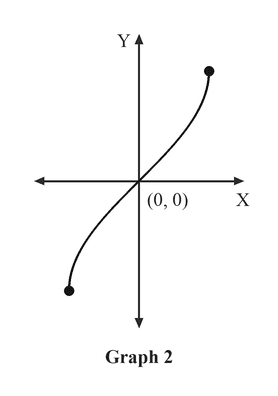
    Class 12 Maths Inverse Trigonometric Functions Class 12 Maths Inverse Trigonometric Functions

    (ii) Write the domain and range of y=sin⁡−1xy = \sin^{-1}x.

    EasyAsked 2025
    1 mark
  23. 23

    Question 23

    Observe the two graphs, Graph 1 and Graph 2 given below and answer the questions that follow.

    Class 12 Maths Inverse Trigonometric Functions Class 12 Maths Inverse Trigonometric Functions

    (iii) Prove that sin⁡−115+sin⁡−125=π2\sin^{-1}\dfrac{1}{\sqrt{5}} + \sin^{-1}\dfrac{2}{\sqrt{5}} = \dfrac{\pi}{2}

    EasyAsked 2025
    2 marks
  24. 24

    Question 24

    Observe the two graphs, Graph 1 and Graph 2 given below and answer the questions that follow.

    Class 12 Maths Inverse Trigonometric Functions Class 12 Maths Inverse Trigonometric Functions

    (iv) Find the value of tan⁡−1[2sin⁡(2cos⁡−132)]\tan^{-1}\left[2\sin\left(2\cos^{-1}\dfrac{\sqrt{3}}{2}\right)\right]

    EasyAsked 2025
    2 marks
  25. 25

    Question 25

    Statement 1: If 0<x<π20 < x < \dfrac{\pi}{2} then the value of tan⁡−1(cot⁡x)=π2−x\tan^{-1}(\cot x) = \dfrac{\pi}{2} - x

    Statement 2: tan⁡−1(tan⁡x)=x, ∀ x∈R\tan^{-1}(\tan x) = x,\ \forall\, x \in R

    MCQMediumAsked 2026
    1 mark
  26. 26

    Question 26

    Find the principal value of sec⁡−1(−2)\sec^{-1}(-\sqrt{2}).

    EasyAsked 2026
    1 mark
  27. 27

    Question 27

    If tan⁡−1(1+x2−1−x21+x2+1−x2)=α\tan^{-1}\left(\dfrac{\sqrt{1 + x^2} - \sqrt{1 - x^2}}{\sqrt{1 + x^2} + \sqrt{1 - x^2}}\right) = \alpha, prove that sin⁡2α=x2\sin 2\alpha = x^2

    MediumAsked 2026
    4 marks
  28. 28

    Question 28

    Solve for xx: 2tan⁡−1(13)+sec⁡−1(527)=tan⁡−1x\quad 2\tan^{-1}\left(\dfrac{1}{3}\right) + \sec^{-1}\left(\dfrac{5\sqrt{2}}{7}\right) = \tan^{-1} x

    MediumAsked 2026
    4 marks