
Opening your dashboard
Class 12 Maths Chapter 2 Functions: Previous Year Questions
14 questions on Chapter 2, each solved step by step. Class 12 Maths, ICSE 2026-27.
14 questions with solutions
1–4 marks · Mixed difficulty
The first 11 solutions are on this page. This chapter is a long one, so the rest open on their own page to keep this one quick to load.
- 14 marks
Question 1
If the function is invertible then find its inverse. Hence prove that
Solve with AIWritten solution
Solution:
Key idea: A function has an inverse exactly when it is one-one and onto (a bijection) from its domain to its codomain. To find the inverse, we write and solve for in terms of .
Step 1 — Fix the domain and the codomain.
The square root is real only when , that is, when . A square root is never negative, so the outputs lie in . Since the question says is invertible, we take
Step 2 — Show that is one-one.
Suppose two inputs and in the domain give the same output.
Both sides are non-negative, so we may square them without creating new solutions.
So equal outputs come only from equal inputs, and is one-one.
Step 3 — Show that is onto and find the inverse.
Take any and solve for . Squaring gives the first line below.
Since , this is at least , so it lies in the domain. Because , substituting it back gives . Every in is reached, so is onto. Renaming the variable as , the inverse is
Step 4 — Prove that .
We put inside and simplify, remembering that here , so the square root of is itself.
Watch out: In general . It equals here only because the domain of is .
Therefore, for , and for every in the domain of .
- 22 marks
Question 2
If and , , and R is the set of real number then find fog(x) and gof (f).
Solve with AIWritten solution
Solution:
Key idea: The composite means : apply first, then apply to the result. Similarly .
Step 1 — Find .
We feed into , which cubes its input.
Step 2 — Find .
We feed into , which squares its input, doubles it and adds .
Note: The paper writes "gof (f)"; it means . Also, is negative when is negative, so the codomain of should really be , not . Neither point changes the two composites.
Therefore, and .
- 34 marks
Question 3
If f: A A and A= R , show that the function is one-one onto. Hence, find
Solve with AIWritten solution
Solution:
Key idea: A function is one-one if two inputs with the same output must be equal, and onto if every element of the codomain is an output. A one-one onto function has an inverse, found by solving for .
Step 1 — Check that really maps into .
The value is left out because it makes the denominator zero. We must also make sure no output equals . Suppose it did.
This is impossible, so and every output lies in .
Step 2 — Show that is one-one.
Suppose for .
We cross-multiply, since both denominators are non-zero.
Expanding both sides gives the next line.
The terms and appear on both sides, so they cancel.
So is one-one.
Step 3 — Show that is onto.
Take any and look for an with . We multiply out and collect the terms.
This is allowed because . The value found is , and Step 1 shows that an output of is never , so this lies in . By construction , so every is reached and is onto.
Step 4 — Write the inverse.
Step 3 gives . Renaming the variable as :
This is the same rule as itself, so is its own inverse.
Therefore, is one-one and onto, and , that is, .
- 44 marks
Question 4
If the function be defined and be defined as
Show that
Solve with AIWritten solution
Solution:
Key idea: The composite means , and means . To simplify a fraction inside a fraction, multiply its numerator and denominator by the inner denominator.
Step 1 — Check that both composites are defined.
The composite needs . Suppose instead that equals , and cross-multiply.
This is impossible. In the same way, needs . Supposing that equals and cross-multiplying gives the lines below.
This is also impossible, so both composites exist for every allowed .
Step 2 — Find .
We replace in by , then multiply the top and bottom by .
Step 3 — Find .
Now we replace in by and multiply the top and bottom by .
Step 4 — Compare the two results.
Both composites simplify to the same expression, . (So and are inverses of each other.)
Therefore, and both equal , so .
- 51 mark
Question 5
Let be a function with domain . Then domain of is:
Solve with AIAnswer
(A)
(B)
- Correct
(C)
(D)
Answer: (C)
Key idea: The inverse function reverses each pair . So the domain of is the range of , the set of all outputs of .
Step 1 — Find every output of .
We cube each element of the domain : , , and .
Step 2 — Read off the domain of .
The range of is , and this set is the domain of .
Why the others are wrong:
- (A) This is the domain of written in reverse order; it is the range of , not its domain.
- (B) Cubes of the non-negative numbers are never negative, so are not outputs of .
- (D) The minus signs are wrong: , and are positive.
Therefore, the domain of is , so the answer is (C).
- 62 marks
Question 6
If is a real invertible function, then find
Solve with AIWritten solution
Solution:
Key idea: To find , write and undo each operation in reverse order. Fifth roots and cube roots of real numbers are always defined (they are odd roots), so each step can be undone.
Step 1 — Write .
We call the output .
Step 2 — Undo the fifth root.
We raise both sides to the power .
Step 3 — Isolate the cube and undo it.
We move to one side, take the cube root, and add .
So . Renaming the variable gives .
Step 4 — Check by composing.
We put this expression into ; the s cancel and the cube root undoes the cube.
Therefore, .
- 72 marks
Question 7
Let and . If is a function defined by then show that is a one-one and an onto function.
Solve with AIWritten solution
Solution:
Key idea: The function is one-one if two inputs with the same output must be equal. It is onto if every is an output for some .
Step 1 — Show that is one-one.
Suppose with , and cross-multiply (both denominators are non-zero).
Expanding both sides gives the next line.
The terms and cancel from both sides.
We add to both sides.
So is one-one.
Step 2 — Solve for a given .
We multiply out and collect the terms.
This is allowed because for .
Step 3 — Check that this lies in .
Suppose this were equal to . Multiplying by gives the lines below.
This is impossible, so and . Substituting back, , so every is an output.
Step 4 — Note that outputs never leave .
If , then , which is impossible, so really maps into .
Therefore, is both one-one and onto.
- 81 mark
Question 8
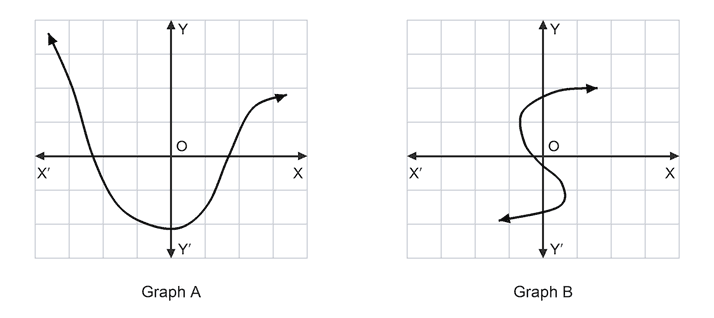
Which one of the following graphs is a function of x?
 Solve with AI
Written solution
Solution:
Key idea: Vertical line test: a graph is the graph of a function of when every vertical line meets it at most once. Then each has exactly one .
Step 1 — Test Graph A.
As we move along Graph A from its left arrow to its right arrow, the curve always moves to the right; it never turns back. So any vertical line meets Graph A at most once, and each gives one .
Step 2 — Test Graph B.
Graph B is S-shaped and turns back to the left twice. The vertical line along the -axis meets it at three points (above O, near O and below O), so one value of has three values of . Graph B fails the test.
Therefore, Graph A is a function of .
- 92 marks
Question 9
Let be defined as is invertible. Find .
Solve with AIWritten solution
Solution:
Key idea: To find , write and solve for . The domain of is the codomain of , here .
Step 1 — Write and clear the fraction.
We call the output and multiply both sides by .
Step 2 — Solve for .
We expand, keep the term on one side, and divide by (allowed because ).
So .
Step 3 — Check by composing.
We put the inverse into and simplify the denominator first.
Therefore, , for .
- 102 marks
Question 10
If is defined by , show that is one-one and onto.
Solve with AIWritten solution
Solution:
Key idea: The function is one-one if equal outputs come only from equal inputs, and onto if every real number is an output.
Step 1 — Show that is one-one.
Suppose . We multiply both sides by and add .
So is one-one.
Step 2 — Show that is onto.
Take any real and solve for .
This is a real number for every real .
Step 3 — Confirm that this is mapped to .
We substitute it back into .
So every real number is an output, and is onto.
Therefore, is one-one and onto.
- 111 mark
Question 11
Assertion: If Set A has elements, Set B has elements and , then the number of one-one function(s) from is zero.
Reason: A function is defined only if all elements in Set A have an image in Set B.
Solve with AIAnswer
(A) Both Assertion and Reason are true and Reason is the correct explanation for Assertion.
- Correct
(B) Both Assertion and Reason are true but Reason is not the correct explanation for Assertion.
(C) Assertion is true and Reason is false.
(D) Assertion is false and Reason is true.
Answer: (B) Both Assertion and Reason are true but Reason is not the correct explanation for Assertion.
Key idea: In a one-one function, different elements of must have different images in . A function needs every element of to have exactly one image.
Step 1 — Judge the Assertion.
A one-one function from would need different images, one for each element of . Set has only elements and , so there are not enough images: at least two elements of must share one. Hence no one-one function exists, and the number is zero. The Assertion is true.
Step 2 — Judge the Reason.
The Reason states the definition of a function: every element of must have an image in . This is true.
Step 3 — Decide whether the Reason explains the Assertion.
The Assertion rests on counting: a one-one function needs different images, but only are available. The Reason says nothing about images being different, and it holds whatever and are. So it does not explain why the count is zero.
Note: Some readers see the Reason as part of the argument, since every element of must be mapped somewhere. Even so, the deciding fact is that the images must be different, which the Reason does not state.
Why the others are wrong:
- (A) The Reason is true, but it does not explain the Assertion; the explanation is that different images cannot fit into elements.
- (C) The Reason is true: it is the definition of a function.
- (D) The Assertion is true: with , two elements of must share an image, so no function is one-one.
Therefore, both statements are true but the Reason does not explain the Assertion, so the answer is (B).
- 121 mark
Question 12
If set A contains four elements and set B contains five elements, then the number of one-one and onto mapping from is:
- 132 marks
Question 13
Let be an invertible function, then find .
- 142 marks
Question 14
Find the range of the function