Solution:
Key idea: In DNA profiling each person's DNA gives a pattern of bands, and two samples from the same person give the same pattern. A suspect is linked to a crime-scene sample only if his or her bands match those of the sample.
Step 1 — (i) Compare the dark bands of each suspect with sample C.
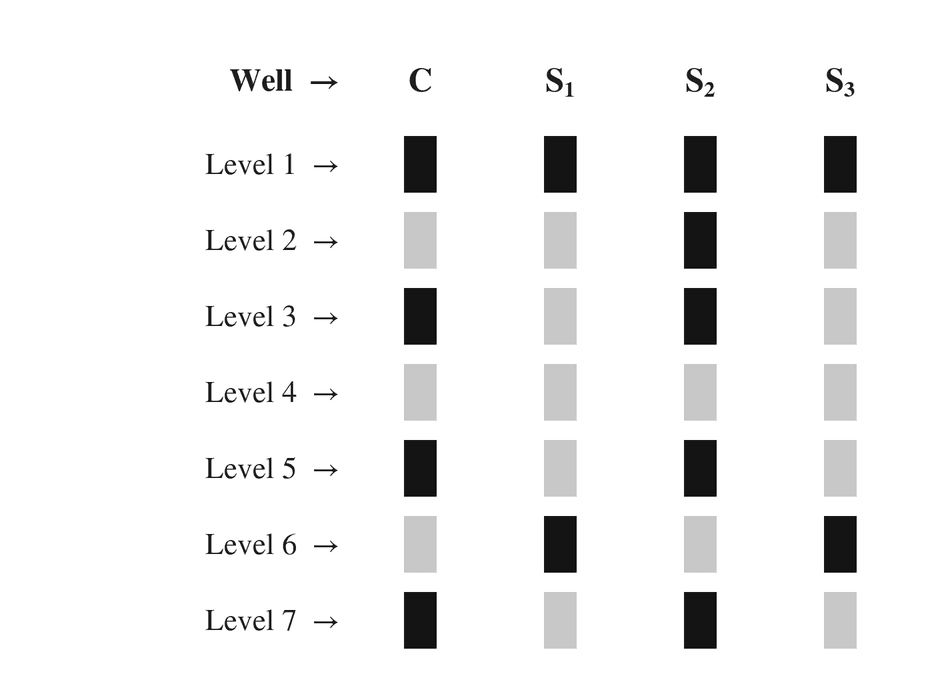
Sample C has dark bands at levels 1, 3, 5 and 7. Suspect S1 has dark bands only at levels 1 and 6, and suspect S3 has the same pattern as S1, so each of them differs from C at four levels. Suspect S2 has dark bands at levels 1, 2, 3, 5 and 7, so it shares all four dark bands of C and differs at only one level.
Step 2 — (i) Decide which suspect matches.
Suspect S2 is the only one whose pattern contains every band of the crime-scene sample, so S2 is the suspect whose DNA matches it.
Note: As printed, lane S2 also shows a dark band at level 2 where C has only a faint one. We take S2 as the intended match; in real casework an unexplained extra band would call for the test to be repeated before a match is declared.
Step 3 — (ii) State the principle of DNA profiling.
DNA profiling is based on DNA polymorphism: certain regions of DNA, the variable number tandem repeats (VNTRs) or short tandem repeats (STRs), are repeated a different number of times in different people. When the DNA is cut and the fragments are separated by gel electrophoresis, these repeats give fragments of different lengths, so every person (except identical twins) has a unique band pattern, inherited half from each parent.
Therefore, (i) suspect S₂'s DNA matches the crime-scene sample; (ii) DNA profiling is based on DNA polymorphism, the differing numbers of tandem repeats (VNTRs/STRs) that give each individual a unique band pattern.