
Question 134 marksAsked 2017Medium
Name the components of lac operon and discuss their role.
Confirming your payment
Sign up now and get 250 free tokens.
Previous Year Questions · Question 13 of 31
Name the components of lac operon and discuss their role.
Solution:
Key idea: An operon is a group of genes under one control switch. The lac operon of E. coli (Jacob and Monod) is an inducible operon: its genes for using lactose are switched on only when lactose is present.
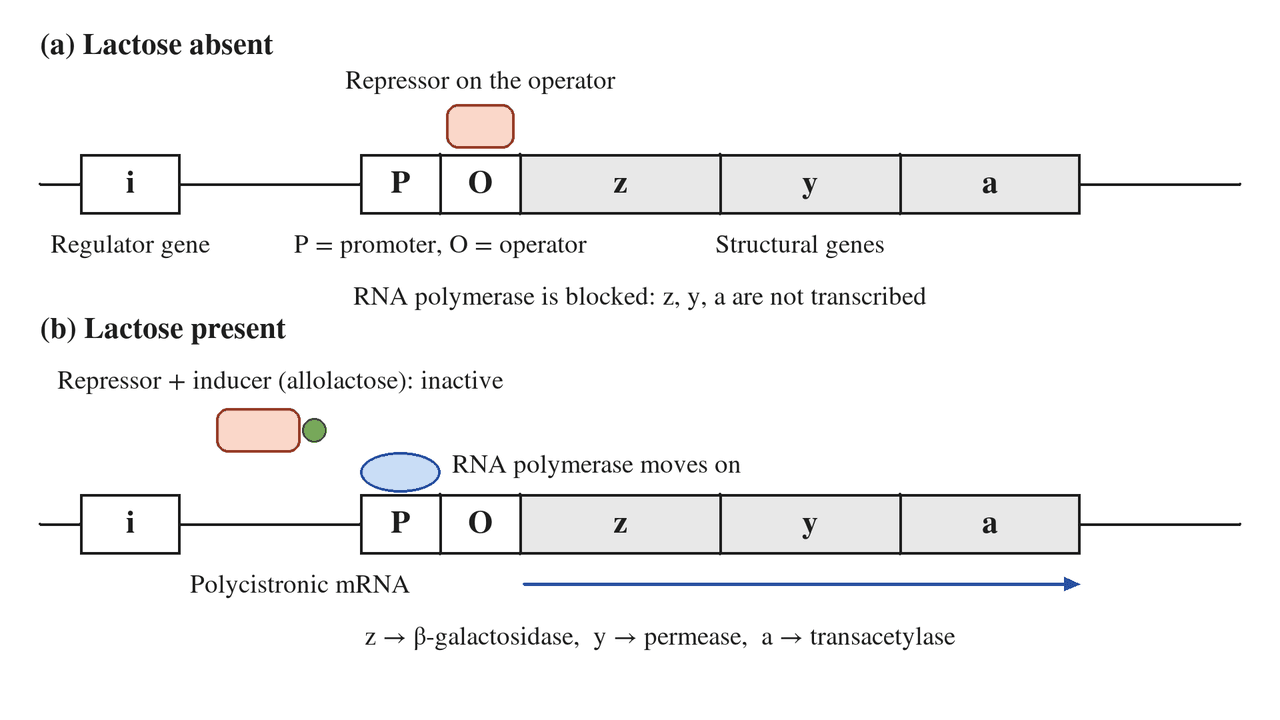
Step 1 — Regulator gene (i) and its role.
The regulator gene lies just before the operon and has its own promoter. It is expressed all the time and makes a repressor protein. With no lactose, the repressor binds to the operator and switches the operon off.
Step 2 — Promoter (P) and its role.
The promoter is the site where RNA polymerase binds to begin transcription of the structural genes.
Step 3 — Operator (O) and its role.
The operator lies between the promoter and the structural genes and acts as the on/off switch. When the repressor sits on it, RNA polymerase cannot move into the structural genes, so they are not transcribed.
Step 4 — Structural genes (z, y, a) and their roles.
The three structural genes are transcribed together as one polycistronic mRNA:
Step 5 — Inducer and its role.
Lactose acts as the inducer. Inside the cell it is converted to allolactose, which binds the repressor and changes its shape, so the repressor leaves the operator. RNA polymerase can then transcribe z, y and a, and the enzymes for using lactose are made.
Therefore, the lac operon consists of the regulator gene (makes the repressor), the promoter (binds RNA polymerase), the operator (the switch the repressor binds) and the structural genes z, y and a (β-galactosidase, permease, transacetylase), with lactose acting as the inducer.