
Question 203 marksAsked 2026Medium
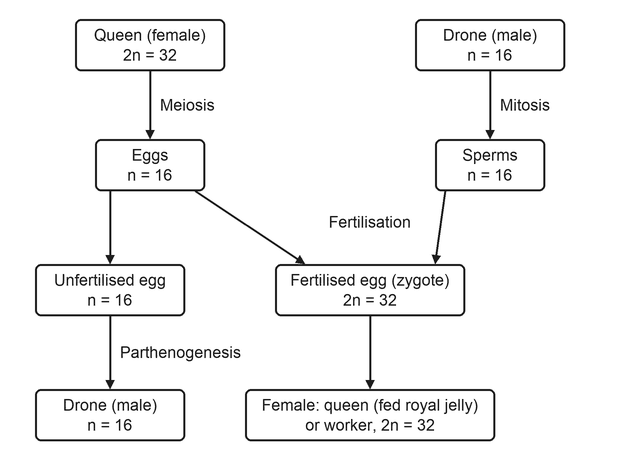
(i) Draw a flowchart to show the process of sex determination in honeybees.
(ii) If there are 16 chromosomes in the somatic cells of a male honeybee, how many chromosomes would be present in spermatozoa?
Confirming your payment
Sign up now and get 250 free tokens.
Previous Year Questions · Question 20 of 20
(i) Draw a flowchart to show the process of sex determination in honeybees.
(ii) If there are 16 chromosomes in the somatic cells of a male honeybee, how many chromosomes would be present in spermatozoa?
Solution:
Key idea: Honeybees show haplodiploid sex determination: females (queen and workers) develop from fertilised eggs and are diploid (), while males (drones) develop from unfertilised eggs and are haploid ().
Step 1 — Name the mechanism.
Honeybees show haplodiploid sex determination: the sex of a bee depends on the number of chromosome sets it receives, not on special sex chromosomes. A bee that develops from a fertilised egg is diploid and female; a bee that develops from an unfertilised egg is haploid and male.
Step 2 — Follow the queen's eggs.
The queen is a diploid female (). Her eggs are formed by meiosis, so each egg is haploid (). During her mating flight she stores the sperms of several drones, and she can release them, or not, as each egg is laid.
Step 3 — Fertilised eggs become females.
When a sperm, which carries 16 chromosomes, fertilises an egg, the zygote formed is diploid with 32 chromosomes, and it develops into a female. Whether this female becomes a fertile queen or a worker is decided by food, not by chromosomes: a larva fed on royal jelly throughout its growth becomes a queen, while larvae fed royal jelly only for the first few days become workers.
Step 4 — Unfertilised eggs become males.
An egg that is not fertilised develops by parthenogenesis into a haploid male, the drone (). A drone therefore has a mother but no father.
Step 5 — Follow sperm formation in the drone.
Because the drone is already haploid, his sperms are formed by a mitosis-like division without reduction, so every sperm carries the full set of 16 chromosomes and all the sperms of one drone are genetically identical.
The whole process is summarised in the flow chart below.
Step 6 — (ii) Count the chromosomes in a sperm.
The male honeybee is haploid, so his 16 somatic chromosomes are a single set. His sperms are formed by mitosis, not by a reducing meiosis, so the number does not change.
Therefore, (i) in honeybees fertilised eggs () become females and unfertilised eggs () become drones by parthenogenesis, as shown in the flow chart; (ii) the spermatozoa of a male with 16 somatic chromosomes also have 16 chromosomes.