Solution:
Key idea: Bleeder's disease (haemophilia) is an X-linked recessive disorder. Males (XhY) are affected with one recessive allele; females with one allele (XHXh) are healthy carriers, and a son always receives his X chromosome from his mother.
Step 1 — (i) Work out each person's place in the family.
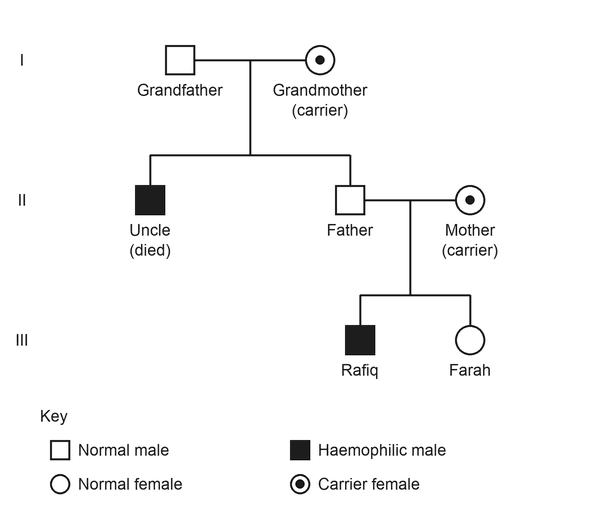
Rafiq is a haemophilic boy, and his mother is a carrier (XHXh), from whom he received Xh. His father was tested and is not reported as a carrier or patient, so he is normal (XHY). The paternal grandmother is a carrier, so the uncle who died of the same condition fits as the father's brother: a son of a carrier mother has a one-in-two chance of receiving her Xh. We take the paternal grandfather to be normal. Farah is Rafiq's sister and is not affected.
Step 2 — (i) Draw the pedigree chart.
The chart uses squares for males and circles for females; a shaded symbol is an affected person and a circle with a central dot is a carrier.
Step 3 — (ii) Identify the pattern of inheritance.
Only males are affected, the disorder passes to Rafiq from his healthy carrier mother, and the uncle received it from his carrier mother (the grandmother). This is X-linked (sex-linked) recessive inheritance, also called criss-cross inheritance.
Step 4 — (iii) Make the Punnett square for Rafiq's parents.
The father's sperms are XH or Y; the mother's eggs are XH or Xh.
| Mother's gametes ↓ / Father's gametes → | XH | Y |
|---|
| XH | XHXH (normal daughter) | XHY (normal son) |
| Xh | XHXh (carrier daughter) | XhY (haemophilic son) |
Step 5 — (iii)(a) Find the chance that Farah is affected by the disease.
Farah always receives her father's normal XH, which masks any Xh from her mother. So she cannot be haemophilic.
P(Farah affected)=0
Step 6 — (iii)(b) Find the chance that Farah is a carrier.
From her mother Farah receives XH or Xh with equal chance, so she is XHXH or XHXh.
P(Farah is a carrier)=21
Note: These chances come from the parents' genotypes. In the family's tests only the mother and the grandmother were reported as carriers, which suggests that Farah turned out to be XHXH.
Therefore, (i) the pedigree shows a carrier grandmother with a haemophilic son (the uncle) and a normal son (the father), who married a carrier woman and had a haemophilic son (Rafiq) and a daughter (Farah); (ii) the pattern is X-linked recessive (criss-cross) inheritance; (iii) (a) Farah's chance of being affected by the disease is 0, and (b) her chance of being a carrier is 1/2 (50%).
