Solution:
Key idea: Sickle-cell anaemia is an autosomal recessive disorder. An affected person is HbSHbS; an unaffected person is either normal (HbAHbA) or a carrier (HbAHbS). An unaffected parent who has an affected child must be a carrier.
Step 1 — Read the chart.
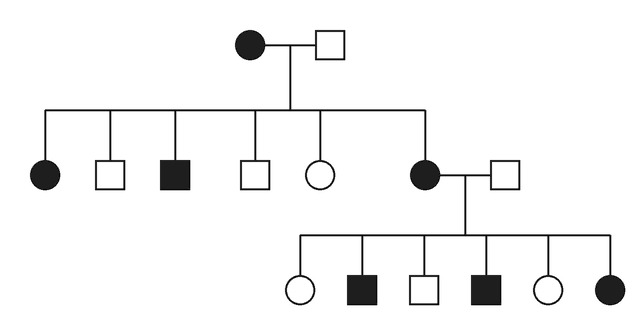
In the first generation an affected mother (shaded circle) is married to an unaffected father (open square); three of their six children are affected. One affected daughter of the second generation is married to an unaffected man, and three of their six children are also affected. The question does not say which couple is meant, so we answer for both; the answers turn out to be the same.
Step 2 — (i) Work out the genotype of the father.
Each affected child (HbSHbS) must receive one HbS allele from each parent. The father is unaffected, so he has one normal allele HbA, and he must also carry HbS to pass it to his affected children. This is true for the father in the first generation and for the married-in father in the second generation.
Step 3 — (ii) Work out the phenotype of the mother.
Both mothers (the first-generation mother and the second-generation mother) are shown as shaded symbols, so both are affected and have sickle-cell anaemia (genotype HbSHbS).
Therefore, (i) the father is a heterozygous carrier, HbAHbS (sickle-cell trait); (ii) the mother is affected: she has sickle-cell anaemia.