
Question 24 marksAsked 2016Medium
Explain the process of sex determination in honey bees.
Confirming your payment
Sign up now and get 250 free tokens.
Previous Year Questions · Question 2 of 20
Explain the process of sex determination in honey bees.
Solution:
Key idea: In honeybees the sex of an individual is decided by whether the egg is fertilised: fertilised (diploid) eggs give females and unfertilised (haploid) eggs give males. This is called haplodiploidy.
Step 1 — Name the mechanism.
Honeybees show haplodiploid sex determination: the sex of a bee depends on the number of chromosome sets it receives, not on special sex chromosomes. A bee that develops from a fertilised egg is diploid and female; a bee that develops from an unfertilised egg is haploid and male.
Step 2 — Follow the queen's eggs.
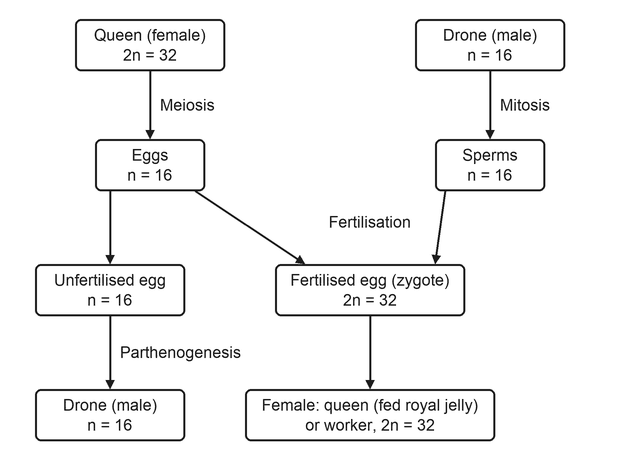
The queen is a diploid female (). Her eggs are formed by meiosis, so each egg is haploid (). During her mating flight she stores the sperms of several drones, and she can release them, or not, as each egg is laid.
Step 3 — Fertilised eggs become females.
When a sperm, which carries 16 chromosomes, fertilises an egg, the zygote formed is diploid with 32 chromosomes, and it develops into a female. Whether this female becomes a fertile queen or a worker is decided by food, not by chromosomes: a larva fed on royal jelly throughout its growth becomes a queen, while larvae fed royal jelly only for the first few days become workers.
Step 4 — Unfertilised eggs become males.
An egg that is not fertilised develops by parthenogenesis into a haploid male, the drone (). A drone therefore has a mother but no father.
Step 5 — Follow sperm formation in the drone.
Because the drone is already haploid, his sperms are formed by a mitosis-like division without reduction, so every sperm carries the full set of 16 chromosomes and all the sperms of one drone are genetically identical.
The whole process is summarised in the flow chart below.
Watch out: Queens and workers have the same chromosomes (); the difference between them comes from the diet of the larva.
Therefore, in honeybees fertilised eggs () develop into females (a queen or workers, depending on feeding with royal jelly) and unfertilised eggs () develop by parthenogenesis into haploid male drones, which form sperms by mitosis; this is haplodiploid sex determination.