
Question 232 marksAsked 2024Easy
The diagram given below shows the various steps in spermatogenesis.
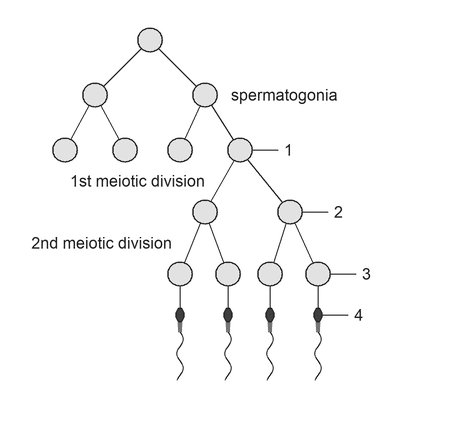
a. Name the parts labelled '1', '2' and '3'.
b. Name the process by which part '3' changes to part '4'.
Confirming your payment
Sign up now and get 250 free tokens.
Previous Year Questions · Question 23 of 30
The diagram given below shows the various steps in spermatogenesis.
a. Name the parts labelled '1', '2' and '3'.
b. Name the process by which part '3' changes to part '4'.
Solution:
Key idea: In spermatogenesis, spermatogonia multiply by mitosis and some grow into primary spermatocytes. A primary spermatocyte gives two secondary spermatocytes by the first meiotic division, and these give four spermatids by the second meiotic division. Spermatids then change into sperms.
Step 1 — (a) Identify part 1.
Part 1 is the cell that undergoes the 1st meiotic division, so it is the primary spermatocyte ().
Step 2 — (a) Identify part 2.
Part 2 is formed by the first meiotic division and then undergoes the 2nd meiotic division, so it is a secondary spermatocyte ().
Step 3 — (a) Identify part 3.
Part 3 is one of the four round cells formed by the 2nd meiotic division, so it is a spermatid ().
Step 4 — (b) Name the change from 3 to 4.
Part 4 is a tailed sperm (spermatozoon). The change of a spermatid into a sperm, without any division, is called spermiogenesis.
Therefore, (a) 1 is the primary spermatocyte, 2 the secondary spermatocyte and 3 the spermatid; (b) the change of 3 into 4 is spermiogenesis.