
Question 294 marksAsked 2017Medium
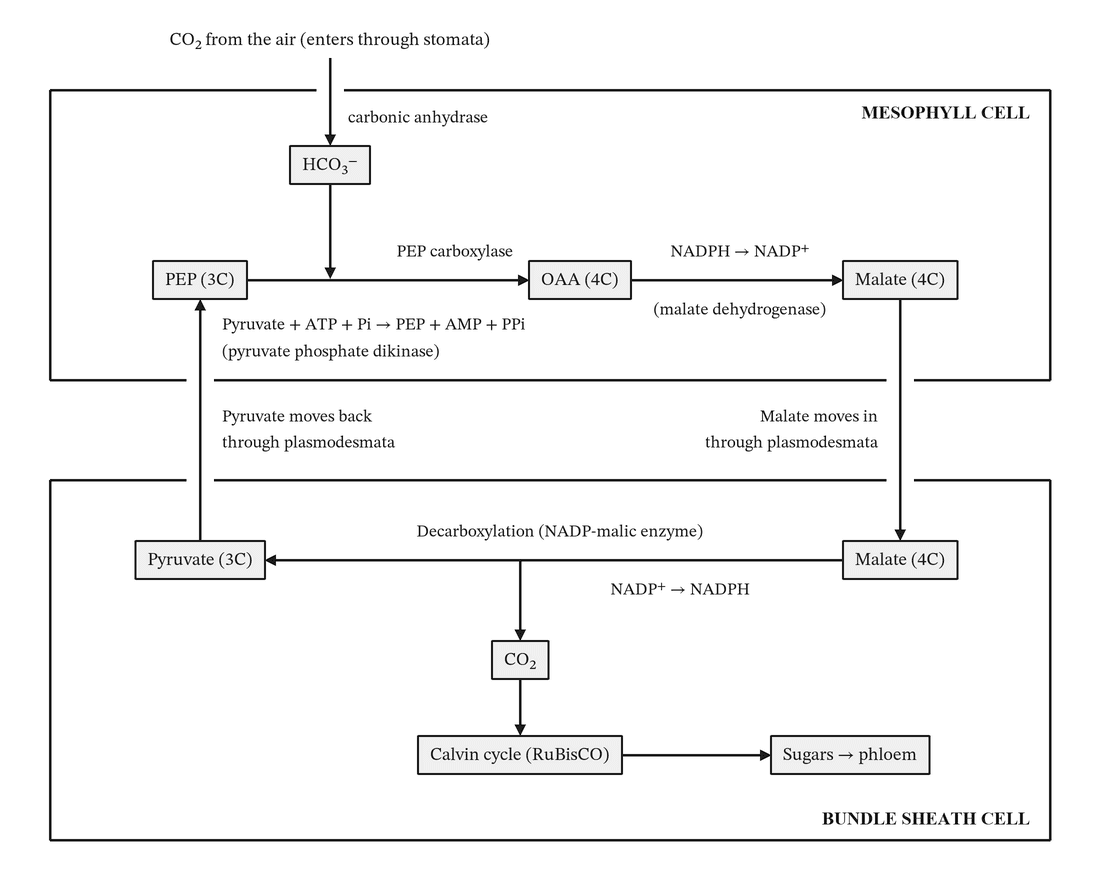
Give a graphic representation of the Hatch Slack or C4 cycle.
Confirming your payment
Sign up now and get 250 free tokens.
Previous Year Questions · Question 29 of 32
Give a graphic representation of the Hatch Slack or C4 cycle.
Solution:
This past paper question is beyond the current ISC syllabus; it is included for extra practice.
Key idea: In C₄ plants such as maize, sugarcane and sorghum, carbon dioxide is first fixed into a four-carbon acid (oxaloacetic acid) in the mesophyll cells and then released in the bundle sheath cells, where the Calvin cycle runs. This pathway was worked out by Hatch and Slack (1966), and it works with Kranz anatomy, in which a ring of bundle sheath cells surrounds each vein.
Step 1 — Look at the graphic representation.
The flow chart shows the reactions in the two kinds of cell and how they are linked.
Step 2 — Fixation in the mesophyll cell.
Carbon dioxide entering the mesophyll cell is converted to bicarbonate (HCO₃⁻) by the enzyme carbonic anhydrase. The enzyme PEP carboxylase joins bicarbonate to phosphoenolpyruvate (PEP, 3C) to form oxaloacetic acid (OAA, 4C), the first stable product. PEP carboxylase has a high affinity for its substrate and does not react with oxygen.
Step 3 — Malate is formed and moves inward.
Oxaloacetic acid is reduced by NADPH to malate (4C) in maize-type plants (some C₄ plants form aspartate instead). Malate passes through plasmodesmata into the bundle sheath cell.
Step 4 — Release of carbon dioxide in the bundle sheath.
In the bundle sheath cell, malate is decarboxylated by NADP-malic enzyme to pyruvate (3C), carbon dioxide and NADPH. This keeps the carbon dioxide concentration around RuBisCO high.
Step 5 — The Calvin cycle fixes the carbon dioxide.
The released carbon dioxide enters the Calvin cycle in the bundle sheath chloroplasts and is fixed by RuBisCO into sugars, which pass to the phloem. Because carbon dioxide is concentrated here, photorespiration is kept very low.
Step 6 — PEP is regenerated.
Pyruvate returns to the mesophyll cell, where pyruvate phosphate dikinase converts it back to PEP. This step uses one ATP but breaks it down to AMP, which costs the energy of two ATP.
Step 7 — Add up the energy cost.
For each carbon dioxide fixed, the Calvin cycle needs 3 ATP and 2 NADPH, and regenerating PEP needs 2 more ATP.
Six carbon dioxide molecules are fixed for one glucose.
So a C₄ plant uses 30 ATP and 12 NADPH per glucose, compared with 18 ATP in a C₃ plant. The extra cost pays off in hot, bright conditions, where photorespiration would otherwise waste much of a C₃ plant's fixed carbon.
Therefore, in the Hatch–Slack cycle PEP carboxylase fixes carbon dioxide into oxaloacetic acid in the mesophyll, malate carries it to the bundle sheath where it is released for the Calvin cycle, and pyruvate returns to regenerate PEP using ATP.