
Question 194 marksAsked 2016Medium
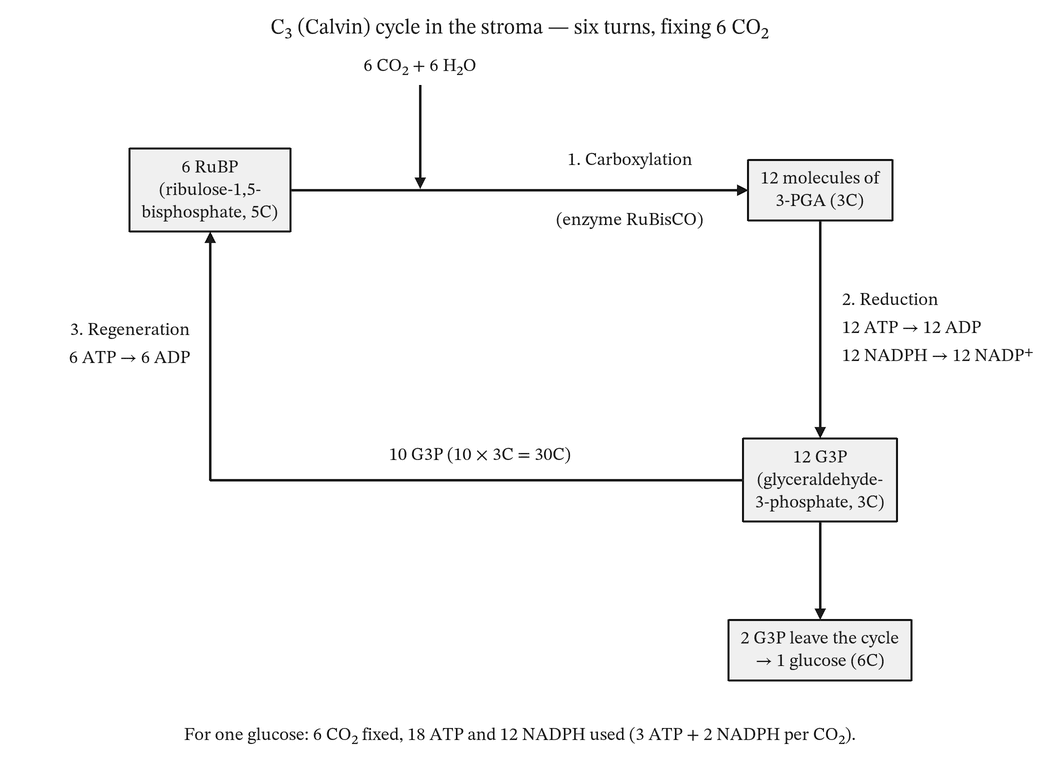
Give a graphic representation of the cycle.
Confirming your payment
Sign up now and get 250 free tokens.
Previous Year Questions · Question 19 of 32
Give a graphic representation of the cycle.
Solution:
This past paper question is beyond the current ISC syllabus; it is included for extra practice.
Key idea: The C₃ cycle (Calvin cycle) is the set of reactions in the stroma of the chloroplast that fixes carbon dioxide into sugar, using the ATP and NADPH made in the light reactions. It is called C₃ because the first stable product, 3-phosphoglycerate (3-PGA), has three carbon atoms.
Step 1 — Look at the graphic representation.
The flow chart shows the cycle for six molecules of carbon dioxide, which is what one molecule of glucose needs.
Step 2 — Carboxylation.
The enzyme RuBisCO joins carbon dioxide (with water) to ribulose-1,5-bisphosphate (RuBP, 5C). The unstable 6C product splits at once into two molecules of 3-PGA. For six turns of the cycle the carbon balance is as follows.
Step 3 — Reduction.
Each 3-PGA is first phosphorylated by ATP and then reduced by NADPH to glyceraldehyde-3-phosphate (G3P, 3C). So the 12 molecules of 3-PGA use 12 ATP and 12 NADPH and give 12 G3P.
Step 4 — Regeneration of RuBP.
Ten of the twelve G3P molecules (30 carbon atoms) are rearranged through a series of sugar phosphates to form six molecules of ribulose-5-phosphate, which are phosphorylated by six ATP to give back six RuBP (30 carbon atoms). This keeps the cycle going. The remaining two G3P molecules (6 carbon atoms) leave the cycle and are used to make one glucose molecule, and from it sucrose and starch.
Step 5 — Add up the energy used.
The cycle uses ATP in reduction and in regeneration.
So one glucose needs 18 ATP and 12 NADPH. Dividing by the six carbon dioxide molecules gives 3 ATP and 2 NADPH for every carbon dioxide fixed.
Therefore, the C₃ cycle runs through carboxylation of RuBP by RuBisCO to 3-PGA, reduction of 3-PGA to G3P using ATP and NADPH, and regeneration of RuBP, using 18 ATP and 12 NADPH to fix 6 CO₂ into one glucose.