
Question 84 marksAsked 2015Medium
With the help of diagrams, name and describe the different types of placentation seen in angiosperms.
Confirming your payment
Sign up now and get 250 free tokens.
Previous Year Questions · Question 8 of 32
With the help of diagrams, name and describe the different types of placentation seen in angiosperms.
Solution:
This past paper question is beyond the current ISC syllabus; it is included for extra practice.
Key idea: Placentation is the arrangement of the ovules inside the ovary. The ovules are attached to a ridge of tissue on the ovary wall or on an axis, called the placenta, and the type of placentation depends on where the placentae lie.
Step 1 — Look at the diagrams.
The figure shows the six types in transverse section of the ovary (basal placentation is shown in longitudinal section, because the single ovule stands at the base).
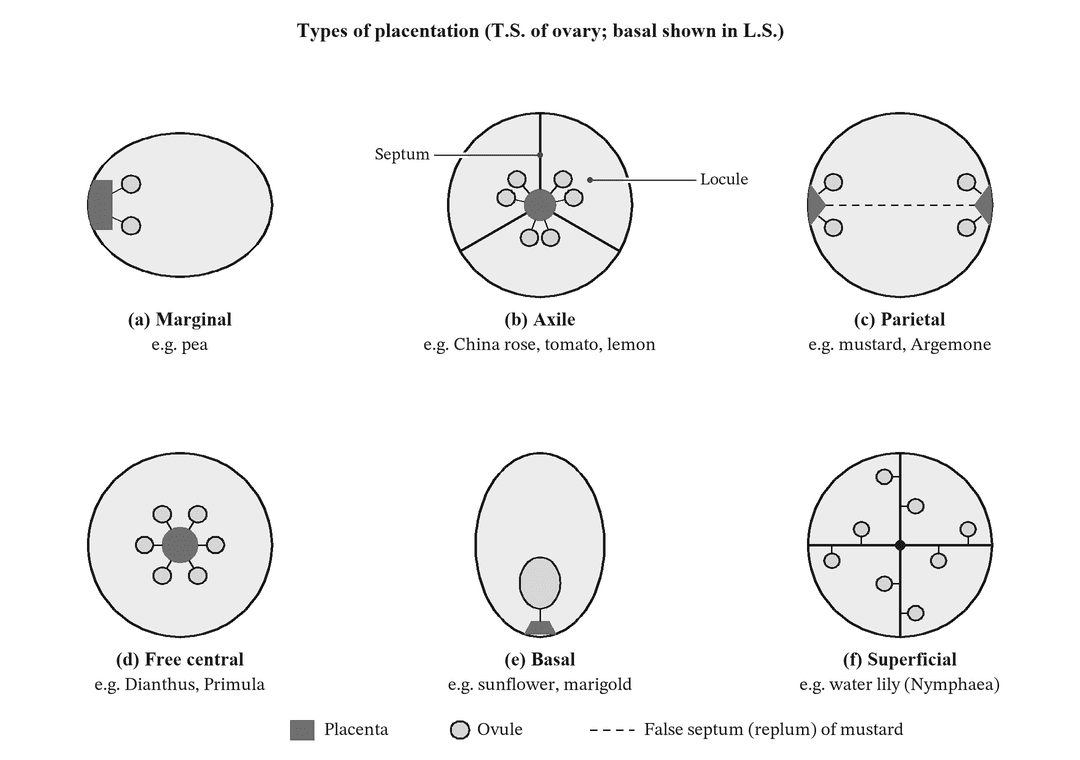
Step 2 — (a) Marginal placentation.
The ovary has one carpel (monocarpellary) and one chamber (unilocular). The placenta forms a ridge along the ventral suture, where the margins of the carpel meet, and the ovules are borne in two rows along this ridge. Example: pea.
Step 3 — (b) Axile placentation.
The ovary is made of two or more fused carpels (syncarpous) and is divided into chambers (locules) by partition walls (septa). The septa meet at the centre to form an axis, and the ovules are attached to this central axis in each locule. Examples: China rose, tomato, lemon.
Step 4 — (c) Parietal placentation.
The ovary is syncarpous but has a single chamber. The ovules develop on the inner wall of the ovary, along the lines where the margins of adjacent carpels join. In mustard, a false septum (replum) later grows across and divides the ovary into two chambers. Examples: mustard, Argemone.
Step 5 — (d) Free central placentation.
The ovary is syncarpous and unilocular. The ovules are borne on a central axis that is not joined to the ovary wall by septa, because there are no septa. Examples: Dianthus, Primula (primrose).
Step 6 — (e) Basal placentation.
The ovary is unilocular and the placenta develops at its base, bearing a single ovule. Examples: sunflower, marigold.
Step 7 — (f) Superficial placentation.
The ovary has many chambers, and the ovules are attached over the inner surfaces of the partition walls (septa) instead of only along their edges or on the axis. Example: water lily (Nymphaea).
Note: Many books describe only the first five types; superficial placentation is an extra type seen in the water lily.
Therefore, the types of placentation in angiosperms are marginal, axile, parietal, free central, basal and superficial, named after where the placentae and ovules lie in the ovary.