
Question 413 marksAsked 2026Medium
Bulb A rated 160 W, 40 V and Bulb B rated 40 W, 40 V are connected as shown in the diagram.
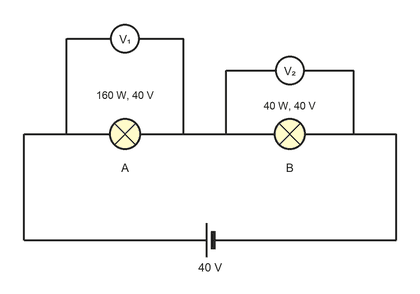
(a) Calculate the ratio : .
(b) If the bulb A fuses, the current in the circuit remains the same. State True or False.
Confirming your payment
Sign up now and get 250 free tokens.
Previous Year Questions · Question 41 of 48
Bulb A rated 160 W, 40 V and Bulb B rated 40 W, 40 V are connected as shown in the diagram.
(a) Calculate the ratio : .
(b) If the bulb A fuses, the current in the circuit remains the same. State True or False.
Solution:
Concept: A rating such as '100 W, 220 V' means the appliance uses 100 W when connected to 220 V. From it, the resistance is R = V² ÷ P and the safe (normal working) current is I = P ÷ V. In series the same current flows through each resistor, the p.d.s add up (V = V₁ + V₂ + …), and the equivalent resistance is R = R₁ + R₂ + …, more than the largest one.
Step 1 — Find the resistances (part a).
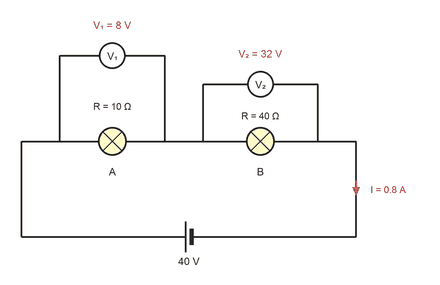
From each rating, R = V² ÷ P.
Step 2 — Use the same current (part a).
The bulbs are in series, so the same current flows through both, and the p.d. across each is proportional to its resistance.
Step 3 — Check.
The current is 40 V ÷ 50 Ω = 0.8 A, so V₁ = 8 V and V₂ = 32 V, which add up to 40 V.
Step 4 — Decide True or False (part b).
In a series circuit there is only one path for the current. If bulb A fuses, the circuit is broken, no current flows and bulb B also goes off. So the statement is False.
Watch out: In series the LARGER resistance (the lower-power bulb) takes the larger share of the p.d.
Therefore, (a) V₁ : V₂ = 1 : 4; (b) False: the current becomes zero when bulb A fuses.