
Question 301 markMCQAsked 2025Easy
In a closed circuit containing a bulb and a cell, the electromotive force (ε) and the terminal voltage (V) is related as.
(Given I is current and r is internal resistance.)
Confirming your payment
Sign up now and get 250 free tokens.
Previous Year Questions · Question 30 of 48
In a closed circuit containing a bulb and a cell, the electromotive force (ε) and the terminal voltage (V) is related as.
(Given I is current and r is internal resistance.)
(A) V = ε + Ir
(B) V = ε – Ir
(C) V = ε ÷ Ir
(D) V = ε × Ir
Answer: (B) V = ε – Ir
Concept: The e.m.f. ε of a cell is the p.d. across its terminals when it sends no current (open circuit). When it sends a current I through an external resistance R, a part Ir of the e.m.f. is used up inside the cell (internal resistance r), so the terminal voltage is V = ε − Ir, and ε = I(R + r).
Step 1 — See where the e.m.f. goes.
The current I through the internal resistance r uses up a p.d. Ir inside the cell.
Step 2 — Find what is left.
What is left across the terminals is the terminal voltage, which is less than ε when a current flows.
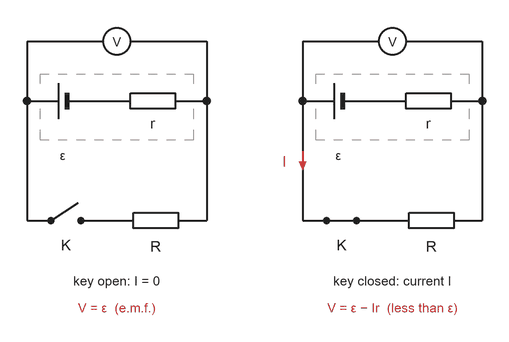
Watch out: The drop Ir is SUBTRACTED from the e.m.f., not added.
Why the other options are wrong:
Therefore, V = ε − Ir, option (B).