Solution:
Concept: Specific resistance ρ is the resistance of a wire of the material of unit length and unit area of cross-section; its S.I. unit is the ohm metre (Ω m). It depends only on the material and its temperature, not on the length or thickness of the sample. With a rise in temperature the resistance of a metal increases, that of an alloy (manganin, constantan, nichrome) increases only very slightly, and that of a semiconductor or carbon decreases.
Step 1 — Define specific resistance (part a).
The specific resistance of a material is the resistance of a wire of that material of unit length and unit area of cross-section; ρ = Ra ÷ l, and its S.I. unit is the ohm metre (Ω m).
Step 2 — Double the length (part b).
Doubling the length doubles the resistance R of the conductor, but the specific resistance does not change: it depends only on the material and its temperature.
Step 3 — Name the substance (part c).
Constantan (or manganin), an alloy whose specific resistance hardly changes with temperature; such alloys are used to make standard resistances.
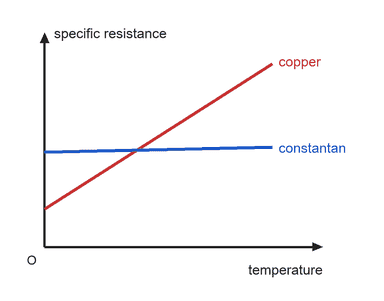
Watch out: Length changes the resistance, not the specific resistance.
Therefore, (a) specific resistance is the resistance of a wire of unit length and unit area of cross-section of the material; (b) it remains the same; (c) constantan (or manganin).
