
Question 211 markMCQAsked 2023Easy
Choose the correct relation for e.m.f. (ε) and terminal voltage V:
Confirming your payment
Sign up now and get 250 free tokens.
Previous Year Questions · Question 21 of 48
Choose the correct relation for e.m.f. (ε) and terminal voltage V:
(A) ε = V (always)
(B) V > ε [always]
(C) V < ε [when the cell is in use]
(D) None of these
Answer: (C) V < ε [when the cell is in use]
Concept: The e.m.f. ε of a cell is the p.d. across its terminals when it sends no current (open circuit). When it sends a current I through an external resistance R, a part Ir of the e.m.f. is used up inside the cell (internal resistance r), so the terminal voltage is V = ε − Ir, and ε = I(R + r).
Step 1 — Write the terminal voltage.
When a cell sends a current I, part Ir of its e.m.f. is used up inside it.
Step 2 — Apply it to a cell in use.
When the cell is in use, I is not zero, so Ir is more than zero and V is less than ε.
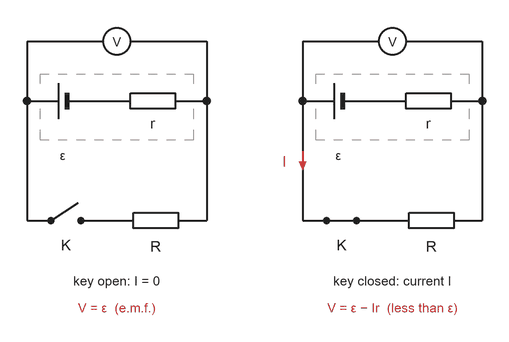
Watch out: V equals ε only when NO current is drawn.
Why the other options are wrong:
Therefore, V < ε when the cell is in use, option (C).