
Question 194 marksAsked 2022Medium
If a wire of resistance 2Ω gets stretched to thrice its original length :
(a) Calculate the new resistance of the wire.
(b) What happens to the specific resistance of the wire?
Confirming your payment
Sign up now and get 250 free tokens.
Previous Year Questions · Question 19 of 48
If a wire of resistance 2Ω gets stretched to thrice its original length :
(a) Calculate the new resistance of the wire.
(b) What happens to the specific resistance of the wire?
Solution:
Concept: When a wire is stretched (or folded), its volume l × a stays the same. So if the length becomes n times, the area becomes 1/n times. Since R = ρl ÷ a, the resistance then becomes n × n, that is n² times. Specific resistance ρ is the resistance of a wire of the material of unit length and unit area of cross-section; its S.I. unit is the ohm metre (Ω m). It depends only on the material and its temperature, not on the length or thickness of the sample.
Step 1 — Find the new area (part a).
Stretching does not change the volume l × a. If the length becomes 3l, the area becomes a ÷ 3.
Step 2 — Find the new resistance (part a).
We put the new length 3l and the new area a ÷ 3 into R = ρl ÷ a.
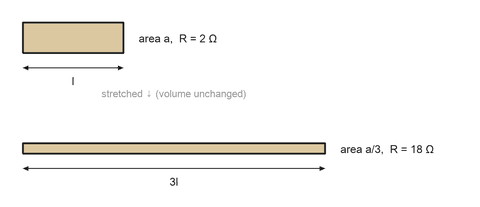
Step 3 — Decide about the specific resistance (part b).
The specific resistance remains the same: it depends only on the material of the wire and its temperature, and stretching changes only the length and the area.
Watch out: The resistance becomes 9 times, not 3 times, because the area also becomes one-third.
Therefore, (a) the new resistance is 18 Ω; (b) the specific resistance remains the same.