
Question 174 marksAsked 2022Medium
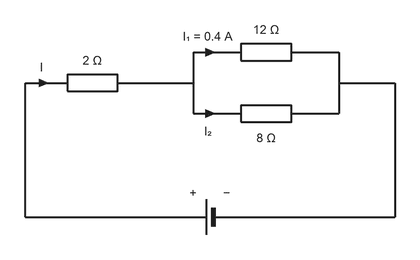
In the below circuit diagram, calculate:
(a) the external resistance of the circuit.
(b) the current .
(c) the current I.
Confirming your payment
Sign up now and get 250 free tokens.
Previous Year Questions · Question 17 of 48
In the below circuit diagram, calculate:
(a) the external resistance of the circuit.
(b) the current .
(c) the current I.
Solution:
Concept: In parallel the p.d. is the same across each resistor, the currents add up (I = I₁ + I₂ + …), and the equivalent resistance is given by 1/R = 1/R₁ + 1/R₂ + …, less than the smallest one. For two resistors, R = R₁R₂ ÷ (R₁ + R₂).
Given: I₁ = 0.4 A in the 12 Ω resistor.
Step 1 — Combine 12 Ω and 8 Ω (part a).
The 12 Ω and 8 Ω are in parallel.
Step 2 — Add 2 Ω (part a).
The pair is in series with 2 Ω.
Step 3 — Find the p.d. across the pair (part b).
The 12 Ω branch carries I₁ = 0.4 A, so its p.d. is I₁ × 12 Ω.
Step 4 — Find I₂ (part b).
The same 4.8 V is across the 8 Ω resistor, since they are in parallel.
Step 5 — Find I (part c).
The current through 2 Ω divides into the two branches, so it is their sum.

Step 6 — Check.
The p.d. across the whole external circuit, 1.0 A × 6.8 Ω = 6.8 V, equals 2 V across 2 Ω plus 4.8 V across the pair.
Watch out: Parallel resistors share the same p.d., not the same current.
Therefore, (a) the external resistance is 6.8 Ω; (b) I₂ = 0.6 A; (c) I = 1.0 A.