Solution:
Concept: A superconductor is a substance whose resistance becomes zero when it is cooled below a certain very low temperature (its critical temperature), close to absolute zero; for mercury this is about 4.2 K. Electrical power is the rate of spending electrical energy, P = W ÷ t; since W = VIt, this gives P = VI, which can also be written P = I²R or P = V² ÷ R. Its S.I. unit is the watt; one watt is one joule per second (1 V × 1 A).
Step 1 — Explain superconductors (part i).
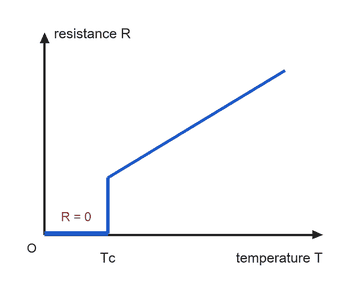
Superconductors are substances whose resistance becomes zero when they are cooled below a certain very low temperature, close to absolute zero. A current set up in a superconductor flows without any loss of energy as heat; mercury below about 4.2 K is an example.
Step 2 — Find the current (part ii).
The appliance works at its rated voltage, so it uses its rated power, and P = VI gives the current.
I=VP=220110=0.5 A
Step 3 — Name the substance (part iii).
Carbon (or a semiconductor such as germanium or silicon): on heating, more charge carriers are set free, so its resistance decreases.
Watch out: A superconductor's resistance becomes ZERO, not just small.
Therefore, (i) superconductors are substances whose resistance becomes zero below a very low critical temperature; (ii) the current drawn is 0.5 A; (iii) carbon (or a semiconductor).
