Solution:
Concept: Ohm's law: the current in a conductor is directly proportional to the p.d. across its ends, provided its physical conditions (temperature) stay the same. So V = IR, where R is the resistance, measured in ohm (1 Ω = 1 V A⁻¹).
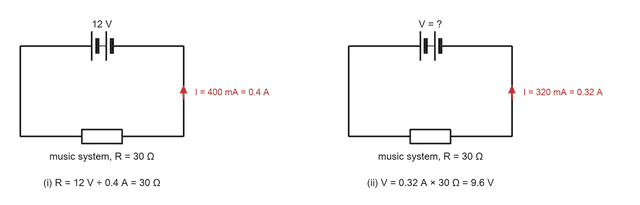
Given: V = 12 V, I = 400 mA; later I = 320 mA.
Step 1 — Change the currents into ampere.
Since 1 mA is 0.001 A, 400 mA is 0.4 A and 320 mA is 0.32 A.
Step 2 — Find the resistance (part i).
Treating the music system as a resistance, Ohm's law gives R = V ÷ I.
R=IV=0.412=30 Ω
Step 3 — Find the battery voltage (part ii).
The resistance stays 30 Ω, so the voltage that drives 0.32 A through it is V = IR.
V=IR=0.32×30=9.6 V
Watch out: Change mA to A before using V = IR: 400 mA is 0.4 A, not 400 A.
Therefore, (i) the resistance of the music system is 30 Ω and (ii) it stops playing when the battery voltage falls to 9.6 V.
