Solution:
Concept: A lever is a rigid bar that turns about a fixed point, the fulcrum F. Its class depends on what lies in the middle: the fulcrum (class I), the load (class II) or the effort (class III). When it balances, effort × effort arm = load × load arm, so M.A. = effort arm ÷ load arm. On a load–effort graph the slope (change in load ÷ change in effort) is the M.A.
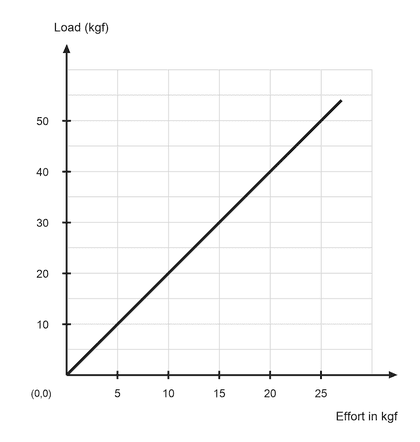
Given: Graph of load (Y-axis) against effort (X-axis), both in kgf; load and effort on the same side of the fulcrum.
Step 1 — Part (a): the attribute.
The M.A. is load ÷ effort. On a load (Y) against effort (X) graph this ratio is the slope (gradient) of the line, so the slope must be calculated.
Step 2 — Part (a): read two points.
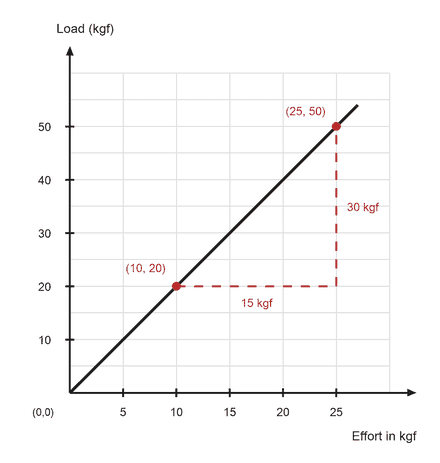
The line passes through (10 kgf, 20 kgf) and (25 kgf, 50 kgf). The slope is the change in load divided by the change in effort:
M.A.=25−1050−20=1530=2
Step 3 — Part (b): narrow down the class.
The load and the effort are on the same side of the fulcrum, so the lever is either class II (load in the middle) or class III (effort in the middle).
Step 4 — Part (b): use the M.A.
The M.A. is 2, more than 1, so the effort arm is longer than the load arm: the effort acts farther from the fulcrum than the load. The load therefore lies between the fulcrum and the effort, which is a class II lever. (A class III lever always has M.A. less than 1.)
Watch out: Read both values from the line and subtract in the same order (50 − 20 with 25 − 10).
Therefore, (a) the slope of the graph (M.A. = 2); (b) it is a class II lever, because its M.A. is more than 1, so the load must lie between the fulcrum and the effort.