Solution:
Concept: Electromagnetic induction: An e.m.f. is induced in a coil whenever the magnetic flux linked with it changes. If the circuit is closed, this e.m.f. drives an induced current, which lasts only as long as the flux keeps changing. The induced current depends on the RELATIVE motion of the magnet and the coil: the faster the flux changes, the larger the current, and its direction depends on whether they come closer or move apart.
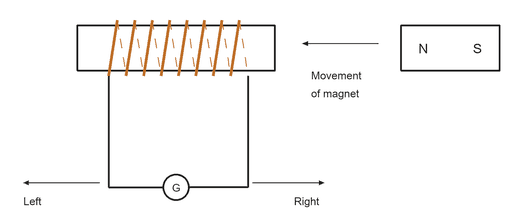
(a) Coil moves with the magnet
Step 1 — Find the relative speed.
The coil and the magnet both move in the same direction at 5 m s⁻¹, so the distance between them does not change.
relative speed=5−5=0
Step 2 — State the effect.
The flux through the coil does not change, so no e.m.f. is induced: the galvanometer shows no deflection.
(b) Coil moves against the magnet
Step 3 — Find the relative speed.
Now the coil and the magnet approach each other.
relative speed=5+5=10 m s−1
This is twice the speed of the original case.

Step 4 — State the effect.
They still come closer (the N pole still approaches the coil), so the deflection is in the same direction, to the right. The flux changes twice as fast, so the deflection is larger (about double).
Watch out: Only the RELATIVE motion matters; moving both at the same speed and in the same direction induces nothing.
Therefore, (a) there is no deflection, and (b) the deflection is to the right again but larger (about twice).