Solution:
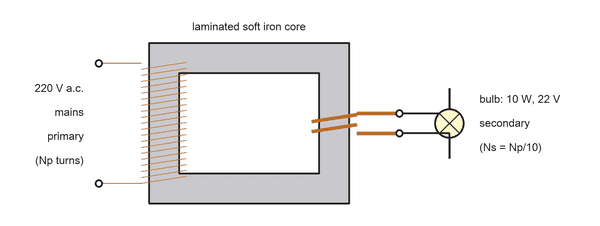
Concept: A transformer works on mutual induction and only with a.c.: the changing current in the primary coil sets up a changing flux in the soft iron core, and this changing flux, linked with the secondary coil, induces an e.m.f. in it. The e.m.f. per turn is the same in both coils, so Es ÷ Ep is equal to Ns ÷ Np (the turns ratio). In an ideal transformer the power in equals the power out, so the current changes the opposite way: Is ÷ Ip is equal to Np ÷ Ns. The rated values '10 W, 22 V' mean the bulb takes 10 W when 22 V is applied to it. Power is P = VI, and resistance is R = V ÷ I.
(a) Device
Step 1 — Name the device.
The mains voltage (220 V) must be lowered to 22 V, so the device is a step-down transformer. Its turns ratio equals the voltage ratio.
NpNs=22022=101
(b) Principle
Step 2 — State the principle.
It works on electromagnetic induction (mutual induction). The alternating current in the primary sets up a changing flux in the soft iron core; this changing flux, linked with the secondary, induces an alternating e.m.f. in it.
(c) Calculations
Step 3 — Find the current drawn by the bulb.
At its rated voltage the bulb takes its rated power, so the current is the power divided by the voltage.
I=VP=2210=115 A≈0.45 A
If the transformer is ideal, the primary takes the same 10 W from the 220 V mains, a current of about 0.045 A.
Step 4 — Find the resistance of the bulb.
The resistance is the voltage divided by the current, which is the same as V² ÷ P.
R=PV2=10222=10484=48.4 Ω
Watch out: Use the bulb's own voltage (22 V), not the mains voltage (220 V), for the bulb's current and resistance.
Therefore, (a) a step-down transformer (turns ratio 1 : 10); (b) electromagnetic (mutual) induction; (c) (1) the current drawn is 5/11 A ≈ 0.45 A, and (2) the resistance of the bulb is 48.4 Ω.
