Solution:
Concept: A conductor carrying a current I across a magnetic field of flux density B feels a force. When the conductor of length l is at right angles to the field, the force is F = BIl; it is zero when the conductor is along the field. Fleming's left-hand rule: Stretch the forefinger, the central (middle) finger and the thumb of the left hand at right angles to each other. If the forefinger points along the magnetic field and the central finger along the current, the thumb gives the direction of the force (motion) on the conductor. Outside a magnet, field lines run from a north pole to a south pole.
(a) Poles at A and B
Step 1 — Find the current.
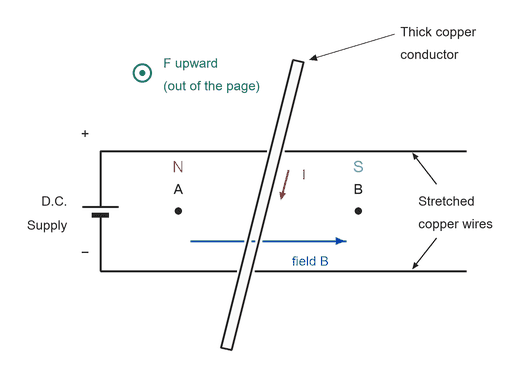
The long plate (+) of the D.C. supply is at the top, so the current flows along the upper stretched wire and then through the copper conductor from the upper wire to the lower wire.
Step 2 — Fix the force.
The wires lie flat, so 'upward' means vertically up, out of the plane of the wires (out of the page), so that the conductor tends to lift off the wires.
Step 3 — Find the field with the left hand.
Point the thumb upward (force) and the central finger along the conductor from the upper wire to the lower wire (current). The forefinger then points from A towards B, so the field must run from A to B.
Step 4 — Name the poles.
Field lines run from a north pole to a south pole, so A must be a north pole and B a south pole.
(b) Law used
Step 5 — Name the rule.
The poles are found with Fleming's left-hand rule (the motor rule).
Watch out: The force cannot be 'up the page' here, because that is almost along the conductor; it must be out of the plane of the wires.
Therefore, (a) A must be a north pole and B a south pole, and (b) Fleming's left-hand rule is used.

