Solution:
Concept: At the centre of a circular loop every small piece of the wire sets up a field in the same direction, along the axis of the loop, so the field there is strong and its lines are nearly straight. The field at the centre is stronger for a larger current, for more turns and for a smaller radius. Clock rule: Look at one face (end) of a current loop or solenoid. If the current at that face flows anticlockwise, the face behaves as a north pole; if it flows clockwise, the face behaves as a south pole.
(i) Polarity of the face towards us
Step 1 — Follow the current round the loop.
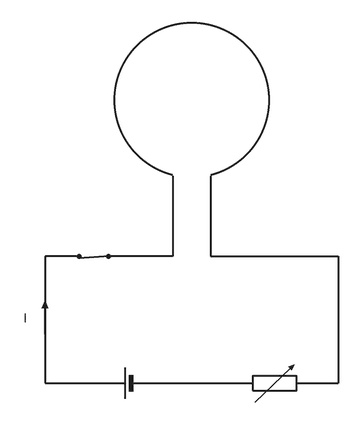
The current I flows up the left-hand wire, through the switch and into the left side of the loop. It goes up the left side, over the top and down the right side, and leaves by the right-hand wire.
Step 2 — Use the clock rule.
Seen from our side this current goes round clockwise, so the face of the loop towards us is a south pole.

(ii) Increasing the strength of the field
Step 3 — Increase the current.
The field of the loop is proportional to the current. In this circuit the current is set by the rheostat, so decreasing the resistance of the rheostat increases the current and the field. (Using more turns in the loop, or a cell of higher voltage, also works.)
Watch out: Clockwise as seen from YOUR side gives S on your side; the far face of the loop is N.
Therefore, (i) the face of the loop towards us is a south pole, and (ii) the field is made stronger by decreasing the resistance of the rheostat, so that a larger current flows.