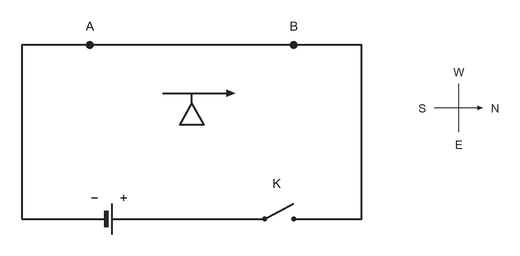
Solution:
Concept: A current in a wire sets up a magnetic field round the wire (Oersted, 1820). Round a long straight wire the field lines are concentric circles in planes at right angles to the wire, centred on the wire. The field is stronger for a larger current and weaker farther from the wire, and reversing the current reverses the direction of the field. Right-hand thumb rule: Hold the current-carrying wire in the right hand with the thumb stretched along the direction of the current; the curled fingers then point in the direction of the magnetic field lines round the wire.
(i) Direction of deflection
Step 1 — Find the direction of the current.
The long plate (+) of the cell is on the right. When the key is closed, the current flows through K, up the right-hand side to B and along the wire from B to A, that is, from north to south.
Step 2 — Find the field below the wire.
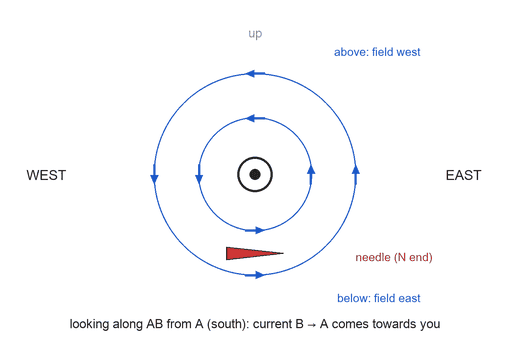
Hold the wire in the right hand with the thumb pointing south (along the current). The fingers curl round the wire; just below it they point east. So the north pole of the needle turns towards the east.
(ii) Why the deflection is produced
Step 3 — Explain the cause.
The current in the wire sets up a magnetic field round it (the magnetic effect of current). Below the wire this field is at right angles to the wire, so it pushes the poles of the needle and turns it away from the north–south line.
(iii) Needle just above AB
Step 4 — Reverse the field.
Above the wire the field points the opposite way (west), so the deflection is reversed: the north pole now turns towards the west.
(iv) A device using this principle
Step 5 — Name a device.
Any device that uses the magnetic effect of a current, for example an electric bell, an electromagnet or a galvanometer.
Watch out: Check which plate is + before using the thumb rule; here the current runs from B to A, not from A to B.
Therefore, (i) the north pole of the needle deflects towards the east; (ii) because the current produces a magnetic field round the wire; (iii) the deflection reverses (the N pole turns west); (iv) an electric bell (or an electromagnet, a galvanometer).