Solution:
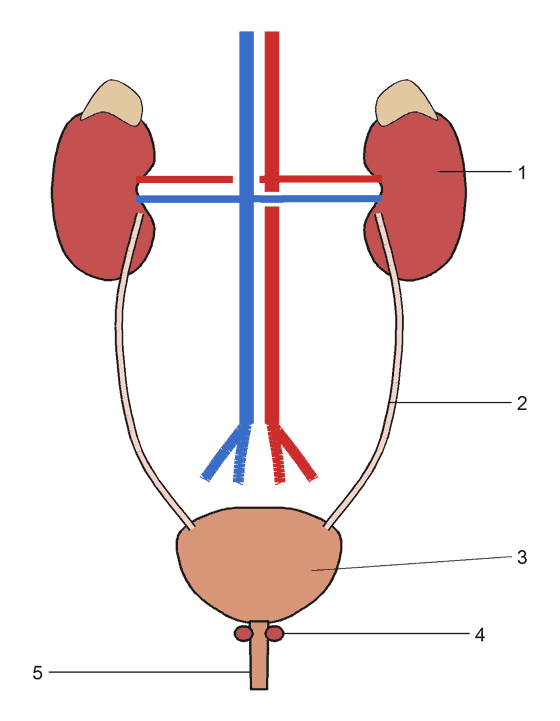
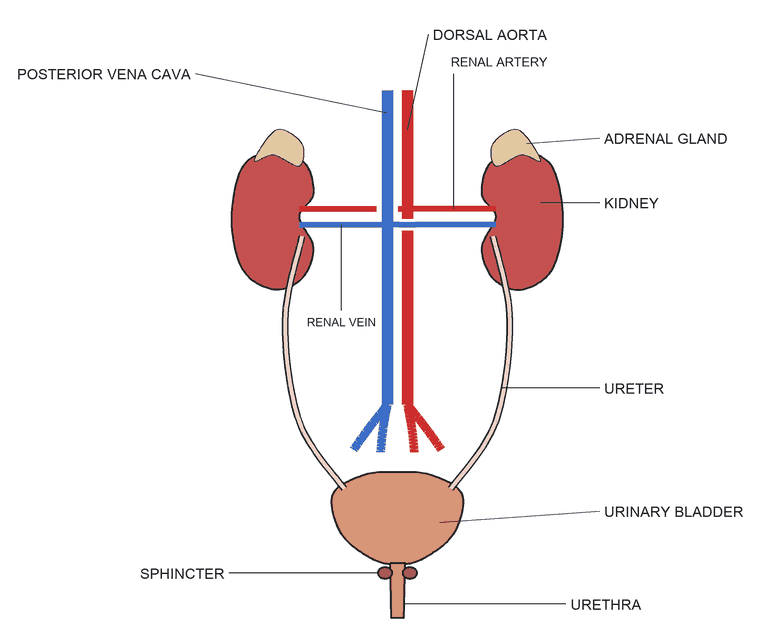
Concept: The figure shows two bean-shaped organs (1) joined by tubes (2) to a bag (3), which opens to the outside through a single tube (5) guarded by a ring of muscle (4). This is the system that forms, stores and passes out urine.
Step 1 — (i) Identify the system.
Organs that form urine, tubes that carry it, a bag that stores it and a tube that passes it out make up the urinary (excretory) system of man.
Step 2 — (ii) Label parts 2 and 4 and give the function of part 5.
Part 2 is the ureter and part 4 is the sphincter, a ring of muscle at the neck of the bladder. Part 5 is the urethra; its function is to carry urine from the urinary bladder to the outside of the body.
Step 3 — (iii) Name the units of part 1.
Part 1 is the kidney. Its structural and functional units are the nephrons (uriniferous tubules).
Step 4 — (iv) Name the fluid in part 3 and its main nitrogenous waste.
Part 3 is the urinary bladder. The fluid that collects in it is urine, and its main nitrogenous waste is urea.
Step 5 — (v) Draw the L.S. of part 1.
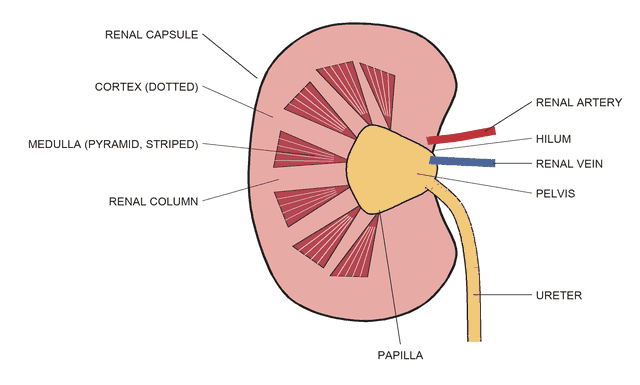
The longitudinal section of the kidney shows an outer, dotted cortex and an inner, striped medulla made of cone-shaped pyramids. The tip (papilla) of each pyramid opens into the pelvis, which leads into the ureter at the hilum, where the renal artery enters and the renal vein leaves.
Watch out: Part 4 is the sphincter, not a gland: it is the muscle that keeps the bladder closed until urination.
Therefore, (i) urinary system; (ii) 2 ureter, 4 sphincter, and 5 (urethra) carries urine out of the body; (iii) nephrons; (iv) urine, main waste urea; (v) the labelled L.S. of the kidney as drawn.