Solution:
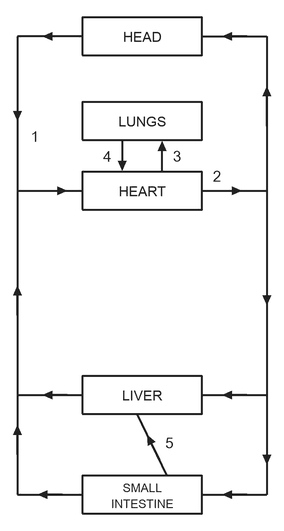
Concept: In the chart, vessels on the left bring blood back to the heart (veins) and the vessel leaving the heart on the right takes blood to the body (artery). Vessels 3 and 4 join the heart and the lungs; vessel 5 joins the small intestine to the liver.
Step 1 — Name vessels 1 to 4.
Follow the arrows on each vessel.
- 1 — Vena cava (here the superior vena cava, bringing deoxygenated blood from the head to the heart)
- 2 — Aorta (carrying oxygenated blood from the heart to the body)
- 3 — Pulmonary artery (its arrow points up, from the heart to the lungs)
- 4 — Pulmonary vein (its arrow points down, from the lungs to the heart)

Step 2 — Vessel supplying the heart muscle.
The coronary artery supplies oxygenated blood to the heart muscle.
Step 3 — Importance of vessel 5.
Vessel 5 is the hepatic portal vein. It brings blood rich in digested food from the small intestine to the liver, where it breaks up into capillaries. So the liver can:
- store excess glucose as glycogen;
- break down excess amino acids (deamination), forming urea;
- detoxify harmful substances absorbed with the food.
Step 4 — Circulation between heart and lungs.
This is pulmonary circulation: deoxygenated blood goes from the right ventricle through the pulmonary artery to the lungs, and oxygenated blood returns through the pulmonary veins to the left atrium.
Step 5 — Draw the blood cells in a smear.
The drawing should show RBCs, the different WBCs and platelets in plasma.

RBCs are small biconcave discs with no nucleus. WBCs are larger and nucleated: the neutrophil with a lobed nucleus, the eosinophil with a two-lobed nucleus, the lymphocyte with a large round nucleus and the monocyte with a kidney-shaped nucleus. Platelets are tiny cell fragments with no nucleus.
Watch out: Vessel 3 carries blood TO the lungs (pulmonary artery) and vessel 4 FROM the lungs (pulmonary vein); read the arrows.
Therefore, (i) 1 = vena cava, 2 = aorta, 3 = pulmonary artery, 4 = pulmonary vein; (ii) coronary artery; (iii) the hepatic portal vein takes digested food to the liver for storage and processing; (iv) pulmonary circulation; (v) as drawn.