Solution:
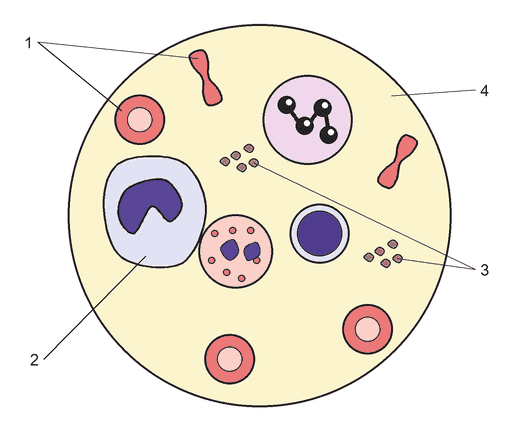
Concept: A blood smear shows the three kinds of blood cells floating in the liquid plasma.
Step 1 — Name components 1 to 4.
Each number points to a different part of the smear.
- 1 — Red blood cells (RBCs, erythrocytes), seen from the face and from the side
- 2 — White blood cell (WBC, leucocyte), here a monocyte with a kidney-shaped nucleus
- 3 — Blood platelets (thrombocytes)
- 4 — Plasma

Step 2 — Two structural differences between 1 and 2.
Compare a mature RBC with a WBC.
| 1 (RBC) | 2 (WBC) |
|---|
| No nucleus when mature | Has a nucleus |
| Biconcave, disc-shaped | Irregular (amoeboid) shape |
| Contains the red pigment haemoglobin | No haemoglobin (colourless) |
Any two of these are enough.
Step 3 — Protein in part 4 that forms threads.
The soluble plasma protein is fibrinogen. During clotting, thrombin changes it into insoluble fibrin threads.
Step 4 — Lifespan of component 1.
An RBC lives for about 120 days; old RBCs are then destroyed, mainly in the spleen and the liver.
Step 5 — Why RBCs are efficient without some organelles.
Mature RBCs have no nucleus, no mitochondria and no endoplasmic reticulum, and each loss helps them carry oxygen.
- No nucleus: the cell is biconcave, with a larger surface for gas exchange and more room for haemoglobin, so it carries more oxygen.
- No mitochondria: the cell does not use the oxygen it carries, so all of it reaches the tissues.
- No endoplasmic reticulum: the cell stays small and flexible and passes through narrow capillaries.
Watch out: Number 2 is a WBC; RBCs (1) are the small biconcave discs with no nucleus.
Therefore, (i) 1 = RBCs, 2 = WBC, 3 = platelets, 4 = plasma; (ii) RBCs have no nucleus and are biconcave, WBCs have a nucleus and an irregular shape; (iii) fibrinogen; (iv) about 120 days; (v) the missing nucleus and mitochondria let RBCs carry more oxygen and deliver all of it.