Solution:
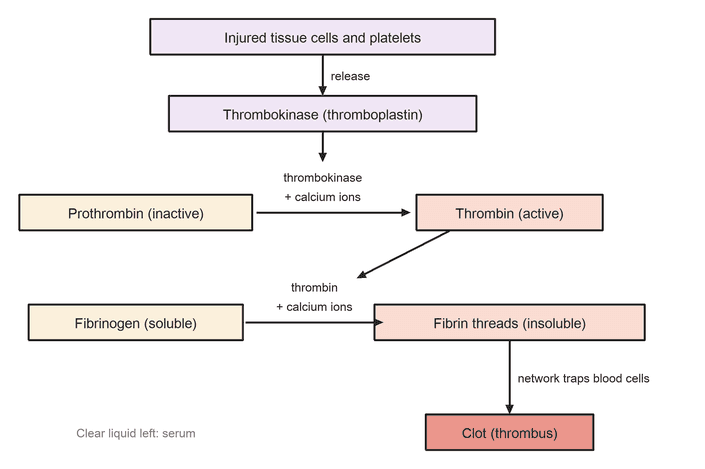
Concept: Blood clots by a chain of reactions. Injured tissue cells and platelets release thrombokinase (thromboplastin); with calcium ions it changes inactive prothrombin into active thrombin; thrombin, again with calcium ions, changes soluble fibrinogen into insoluble fibrin threads, which trap blood cells to form the clot.
Step 1 — Start with the source.
Platelets (and injured tissue cells) at a wound release thromboplastin (thrombokinase).
Step 2 — Follow the chain.
Thromboplastin, with calcium ions, changes prothrombin into thrombin. Thrombin then acts on soluble fibrinogen and changes it into insoluble fibrin threads, which form the clot.
Watch out: Fibrinogen comes before fibrin; thrombin is needed to change one into the other.
Therefore, the sequence is Platelets → Thromboplastin → Thrombin → Fibrinogen → Fibrin.
