
Question 71 markAsked 2016Medium
Give scientific reasons for the following statements:
Mature erythrocytes in humans lack nucleus and mitochondria.
Confirming your payment
Sign up now and get 250 free tokens.
Previous Year Questions · Question 7 of 71
Give scientific reasons for the following statements:
Mature erythrocytes in humans lack nucleus and mitochondria.
Solution:
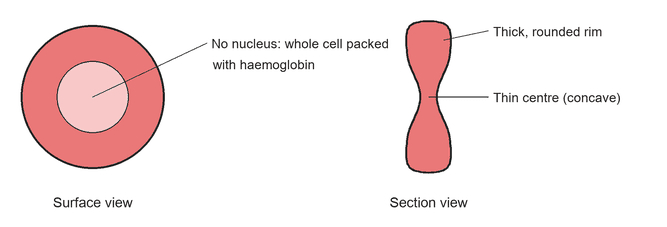
Concept: A mature human red blood cell (RBC) is a biconcave disc with no nucleus, no mitochondria and no endoplasmic reticulum. Its cytoplasm is packed with haemoglobin, the iron-containing pigment that carries oxygen. Losing these organelles makes the RBC a better oxygen carrier.
Step 1 — No nucleus.
Losing the nucleus makes the RBC biconcave (thin in the centre, thick at the rim). This gives a larger surface area for its volume, so oxygen diffuses in and out faster. The space saved holds more haemoglobin, so each cell carries more oxygen.
Step 2 — No mitochondria.
Aerobic respiration takes place in mitochondria. Without them the RBC respires without oxygen and does not use the oxygen it carries, so all of it is delivered to the tissues.
Step 3 — No endoplasmic reticulum.
Having few organelles keeps the cell small and flexible, so it can bend and pass through very narrow capillaries in single file.
Watch out: The reason is about carrying MORE oxygen and delivering ALL of it, not about the cell being 'simple'.
Therefore, without a nucleus the biconcave RBC has more room for haemoglobin and a larger surface for gas exchange, and without mitochondria it uses none of the oxygen it carries.